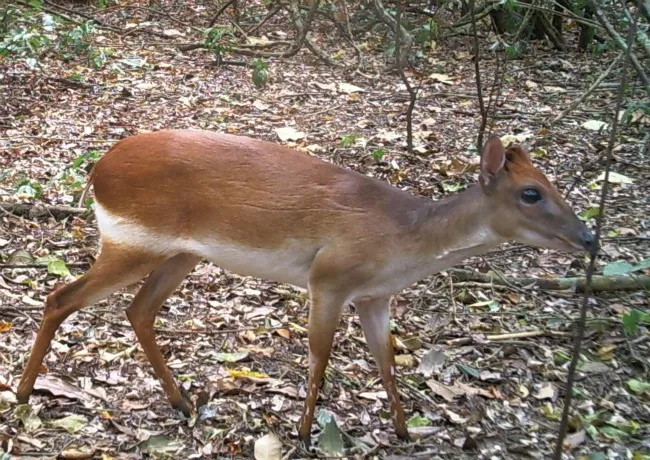
Camera traps in a forest near Kenya's coast have captured images of a rare, dainty antelope, a discovery that has surprised scientists since it was not known that the elusive animals lived in the region.
Thousands of images from 52 camera traps stationed around the Boni-Dodori forests in northern Kenya uncovered what may be the world's largest population of Aders' duiker, a critically endangered antelope species that, until the recent discovery, was thought to live in only two spots on Earth.
"This population is a lifeline for the critically endangered antelope, which until now was thought to exist only in tiny populations in coastal Kenya and Zanzibar," said Rajan Amin, a senior conservation biologist with the Zoological Society of London, in a statement.
The forest-dwelling antelopes are the size of a house pet. They measure about 27 inches (69 centimeters) from head to hindquarters and about 12 inches (31 cm) at the shoulder.
Much about the Aders' duiker (Cephalophus adersi) remains mysterious, but scientists identified the species in the camera trap photos from a tell-tale white band along the thigh and mahogany coloring on the upper back.
Monkeys with groupies? Camera traps also snapped these yellow baboons.
(Image credit: ZSL.)
Previous study of the species revealed the antelopes sometimes follow troops of monkeys through the forest, and feed on material the primates drop from the trees.
Population numbers are sparse, but one study from 1999 estimated as few as 640 Aders' duiker were left on the planet, and their numbers were expected to decline.
Sign up for the Live Science daily newsletter now
Get the world’s most fascinating discoveries delivered straight to your inbox.
The camera-trap pictures also revealed important populations of a number of species such as African wild dogs (Lycaon pictus), elephants (Loxodonta africana) and lions (Panthera leo), living in and around the biodiverse forest, which is under threat from rapid coastal and agricultural development.
The camera traps that caught sight of the rare animals were set up by several international and Kenyan conservation groups, the Zoological Society of London among them, and the groups are calling for the swift conservation of the forest where the species lives.
The antelope discovery comes just months after scientists discovered what may be a new species of elephant shrew living in the same forest.
"Given time and conservation action we could unearth even more new species in this isolated forest, but we are running out of time to stop the forest and its hidden secrets from being destroyed by rapid coastal development," Amin said.
For the science geek in everyone, Live Science offers a fascinating window into the natural and technological world, delivering comprehensive and compelling news and analysis on everything from dinosaur discoveries, archaeological finds and amazing animals to health, innovation and wearable technology. We aim to empower and inspire our readers with the tools needed to understand the world and appreciate its everyday awe.