













'Infinity Symbol' Found at Center of Milky Way

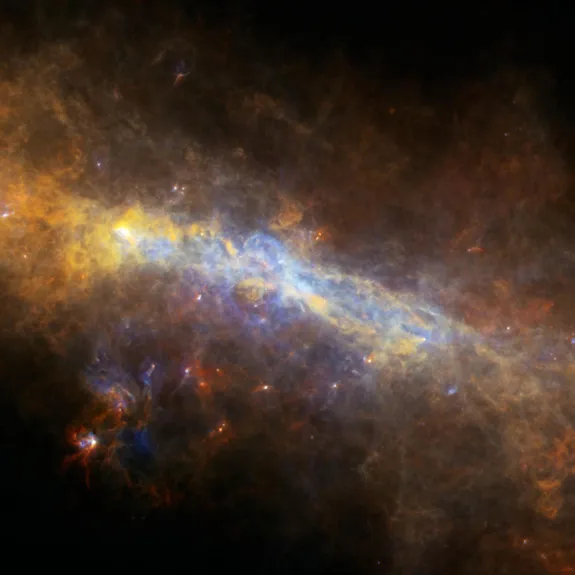
A twisted ring of gas, one that stretches more than 600 light-years across the heart of the Milky Way galaxy, has been discovered by astronomers using a powerful infrared space telescope.
The gaseous ring, which gives birth to new stars, has a kink in the middle, such that it looks like a cosmic infinity symbol.
Parts of the ring have been seen before, but the European Space Agency's Herschel Space Telescope has just made unprecedented observations of the whole structure. The Herschel spacecraft is specially suited to peer into the Milky Way's center because it detects infrared and sub-millimeter light, which can penetrate through the dust hovering between here and there. [Photos: The Universe in Infrared]
According to NASA's Jet Propulsion Laboratory (JPL) in Pasadena, Calif., astronomers were shocked by what they saw when they aimed the telescope at the galaxy's inner ring.
"[The] ring, which is in the plane of our galaxy, looked more like an infinity symbol with two lobes pointing to the side," JPL officials said in a statement. "In fact, they later determined the ring was torqued in the middle, so it only appears to have two lobes. To picture the structure, imagine holding a stiff, elliptical band and twisting the ends in opposite directions, so that one side comes up a bit." [Top 3 Questions People Ask Astrophysicists]
Scientists don't yet understand why the newly observed infinity symbol is twisted and kinked, and little is known about how gas rings, and even rings within larger rings, form in spiral galaxies in the first place. And there's yet another mystery: The torqued portion of the new ring appears to be slightly offset from the center of the galaxy, wherein lies a massive black hole.
"This is what is so exciting about launching a new space telescope like Herschel," said Sergio Molinari of the Institute of Space Physics in Rome, lead author of a new paper on the ring in the journal Astrophysical Journal Letters. "We have a new and exciting mystery on our hands, right at the center of our own galaxy." This article was provided by Life's Little Mysteries, a sister site to LiveScience.com. Follow us on Twitter @llmysteries, then join us on Facebook. Follow Natalie Wolchover on Twitter @nattyover.
Get the world’s most fascinating discoveries delivered straight to your inbox.

Natalie Wolchover was a staff writer for Live Science from 2010 to 2012 and is currently a senior physics writer and editor for Quanta Magazine. She holds a bachelor's degree in physics from Tufts University and has studied physics at the University of California, Berkeley. Along with the staff of Quanta, Wolchover won the 2022 Pulitzer Prize for explanatory writing for her work on the building of the James Webb Space Telescope. Her work has also appeared in the The Best American Science and Nature Writing and The Best Writing on Mathematics, Nature, The New Yorker and Popular Science. She was the 2016 winner of the Evert Clark/Seth Payne Award, an annual prize for young science journalists, as well as the winner of the 2017 Science Communication Award for the American Institute of Physics.