This ScienceLives article was provided to LiveScience in partnership with the National Science Foundation.
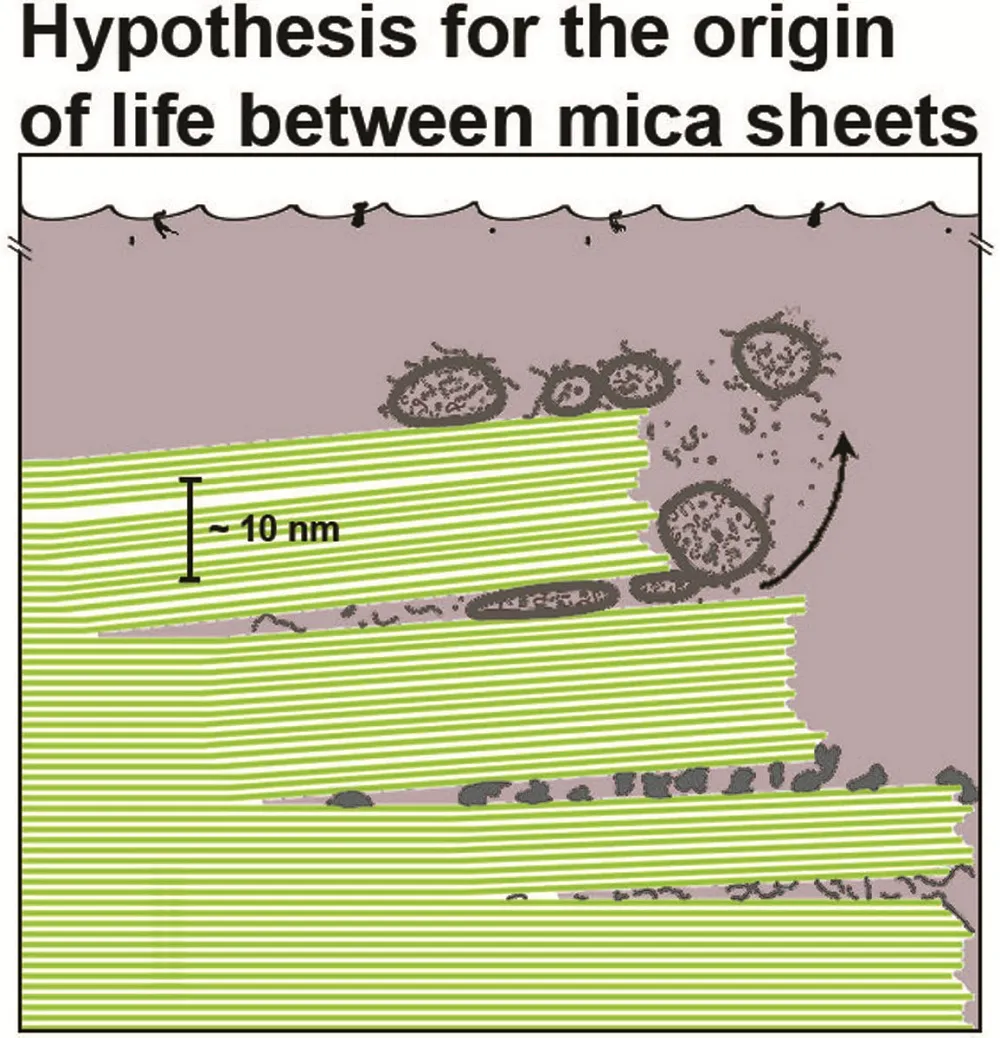
ScienceLives puts people under the microscope, which is appropriate for Helen Hansma, since her most important research discoveries have been made under the microscope. Hansma's most exciting research breakthrough came when she was a grandmother and she came up with the idea that life might have originated between sheets of mica. Mica sheets bring three main "gifts" to the origin of life: the potassium ions that we need inside our cells, the spaces between the sheets provide shelter before there were cells, and a simple endless source of energy to make it all happen — this energy is the "work" mica sheets do when they move up and down, pushing around whatever is between them. Hansma's "Mica Hypothesis" for the origin of life evolved from her pioneering work on biological research with the atomic force microscope. After mothering her young kids for a decade, she became a mother of biological atomic force microscopy. She was fortunate to be in the right place at the right time to return to the lab after a decade away from it and she became a leader in this field. Hansma currently lives in both San Francisco and Santa Barbara. Learn more about Hansma's work in the press releases here and here, a video, a Behind the Scenes article, and in her ScienceLives ten questions below.
Name: Helen Greenwood Hansma Age: 65 Institution: University of California at Santa Barbara Field of Study: Biological Atomic Force Microscopy and the Origin of Life
What inspired you to choose this field of study? When I was taking second-year biology in high school, I collected algae ("pond scum") from a stream in Pennsylvania and looked at it under a microscope. It turned out to be Spirogyra, and it was quite awesome. I decided to be a biologist. The next year, I had a wonderful chemistry teacher who told me that biochemistry was the hot new field. Her advice sounded good to me and I decided to be a biochemist.
Fast-forward 46 years, to March 2007. I'm looking into the dissecting microscope in my home. I'm putting water on a piece of mica that my brother and I collected on a hike several months earlier. As I watch the water seep between the sheets of mica, it occurs to me: this might be a great place for the origin of life!
What is the best piece of advice you ever received? "Do the experiment as poorly as possible." The late physics professor, Herb Broida, supposedly gave this advice to his students and mentees. The idea is to try something out and see if it looks promising before investing lots of time and money in it. The promising things can be pursued with more care and the rest can be ignored. This was useful advice for pioneering the field of biological atomic force microscopy — to test various types of biological samples and imaging conditions and then to try to learn new science about the types of samples that gave useful images. It was also useful advice for doing simple experiments on mica and the origin of life in my kitchen.
What was your first scientific experiment as a child? Was it playing, or experimenting, when my dad gave me and my little brother surplus, drab-green electronics components to plug into each other as we sat on the kitchen floor? In general, when I was a child, I was more an observer and a lover of nature than an experimenter.
Sign up for the Live Science daily newsletter now
Get the world’s most fascinating discoveries delivered straight to your inbox.
What is your favorite thing about being a researcher? Working in the lab can be a lot of fun. I used to like collecting data in the morning and then sitting down and analyzing the data with a cup of coffee in the afternoon. Now, I like reading Science and Nature to seek out research articles in a wide range of fields that might be relevant to the Mica Hypothesis for the origin of life.
What is the most important characteristic a researcher must demonstrate in order to be an effective researcher? In my case, I need to trust myself. There was a time when everything in my research seemed to be going wrong and I told myself that this series of bad outcomes really went well beyond my deficiencies as a researcher. I persisted, and things obviously turned around in significant ways, or I wouldn't be answering this question to this audience now. Happily, I can't even remember the details of what was going wrong at that time.
What are the societal benefits of your research? My research on new applications for biological atomic force microscopy has had a lot of practical benefits, such as making the atomic force microscope into a useful tool for biological research, leading to medical and other scientific advances, and helping the economy by making the microscope into an instrument that is sold more widely, because it can be used for a wider variety of applications.
My Mica Hypothesis for the origin of life is an entertaining and thought-provoking piece of science that interests a wide audience. It provides new ways to understand how "irremediable complexity" was not necessary for the origin of life and its evolution.
Who has had the most influence on your thinking as a researcher? My thesis adviser, Ching Kung, is a most valuable scientific colleague. Recently, he had lots of good suggestions about mica and the origin of life, and then he had lots of good editorial suggestions for the drafts of the paper.
Helen Hansma of the University of California, Santa Barbara.
(Image credit: Helen Greenwood Hansma, UCSB)
What about your field or being a researcher do you think would surprise people the most? To me, the most amazing thing about my career as a researcher is how differentit has been from the trajectory of an arrow shot from a bow! It has been much more like a river, with rapids and meandering stretches and dry places; sometimes with great beauty and sometimes awfully drab. From undergrad research through the beginning of my career, I did research on: the interactions of zinc with organic molecules; separating different forms of the amino acid lysine; cholesterol-fed guinea pigs; biochemistry of behavior in paramecia; and trying to find where LDL ('bad cholesterol') binds to human skin cells in petri plates. Then there was a long dry stretch when my kids were little and my research didn't get funded — I hadn't published enough, but I didn't 'perish'; I just did other things while I raised the kids: teaching yoga; teaching hands-on science in my kids' elementary school; self-publishing a spiritual diary; and making about 1,000 mandala nightlights that were sold through a yoga catalog. And then I had the good fortune (and talent!) to become a pioneer in using the atomic force microscope for biological research and to 'invent' the mica hypothesis for the origin of life.
If you could only rescue one thing from your burning office or lab, what would it be? I hope my choice would focus on the safety of the people in the lab. I have a bit of evidence supporting this, because there was a brief time when we thought our home might be in danger from a wildfire. My only thought was to walk to the beach with the kids and the cockatiel – the beach was about a block away. Later I realized I had forgotten about the hamster in the bathroom, and still later I realized that I would be very sad to lose the family photographs. Research-wise, my valuables are on hard drives and discs in a couple of different places.
What music do you play most often in your lab or car? I don't tend to listen to music, but now I listen to "lite rock" on my car radio. It was playing on the car radio after I rented the car to some astrophysics visitors for several weeks last year. (I was living in San Francisco at the time, while the astrophysicists were renting my car and part of my home in Santa Barbara.) I've kept it on the radio station, and listen to the music more or less.
Editor's Note: This research was supported by the National Science Foundation (NSF), the federal agency charged with funding basic research and education across all fields of science and engineering. Any opinions, findings, and conclusions or recommendations expressed in this material are those of the author and do not necessarily reflect the views of the National Science Foundation. See the ScienceLives archive.