















Afraid of Needles? Poke-Free Acupuncture Works Just as Well

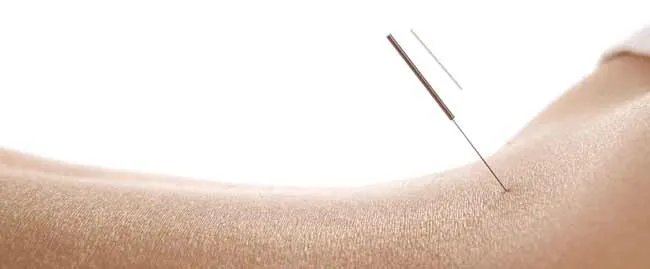
Acupuncture performed with blunt needles that don't puncture the skin has been shown to work just as well as the traditional, skin-penetrating kind. And yes — they both really do work.
Those are the conclusions of a study by Swedish researchers published March 23 in the scientific journal PLoS ONE. In the study, "sham acupuncture," as it's often called, turned out to be equally as effective as the real deal in alleviating the nausea of cancer patients undergoing radiation therapy.
In sham acupuncture, patients think they're receiving genuine acupuncture therapy but, in actuality, the needles being used to treat them aren't piercing their skin.
This does not prove that acupuncture is baloney. In fact, another finding of the study was that both acupuncture methods – genuine as well as simulated – worked much better at reducing nausea and vomiting than treatments involving no needlework at all. Past studies in the United States and Germany arrived at the same conclusion: Acupuncture, real or fake, works.
Why should that be the case? "There's a lot of debate about it," said Richard Deyo, a clinical physician and professor of medicine at Oregon Health and Science University who has studied sham acupuncture.
There are two main schools of thought. The first revolves around the idea that "this is all a placebo effect, and acupuncture is simply a compelling and persuasive placebo that patients benefit from," Deyo told Life's Little Mysteries, a sister site to LiveScience. If it's all just psychological and patients believe they are receiving real acupuncture, he explained, then it doesn't matter whether needles are breaking skin or not.
"The other explanation would be that even if you're not penetrating the skin, maybe you're stimulating 'acupoints' in a way that has a physiological response similar to that used in traditional acupuncture," Deyo said. In other words, putting pressure on established acupuncture hot spots may influence "energy flow" just as well as pricking them does.
Get the world’s most fascinating discoveries delivered straight to your inbox.
Deyo leans toward the first explanation: "I think that acupuncture and its effects may be placebo effects. But if this form of therapy offers patients relief – and, indeed, studies show that simulated and real acupuncture both worked better than the care patients were getting from their primary care physicians – then we shouldn't argue too much about it."
Anna Enblom, lead author of the new study, agrees with Deyo's way of thinking. "The beneficial effects [probably come from] the patients' positive expectations and the extra care that the treatment entails," Enblom, a physiotherapist and researcher at the Osher Centre for Integrative Medicine at Karolinska Institutet in Sweden, said in a press release.
Karen Sherman, a behavioral biologist who studies alternative medicine at the Group Health Research Institute in Seattle, has co-authored a paper on sham acupuncture with Deyo. She leans toward the other argument. "A non-penetrating needle is only a placebo if the 'active ingredient' is skin penetration," Sherman told Life's Little Mysteries. "There are some types of acupuncture, traditionally used, that do not penetrate the skin." In particular, some Japanese techniques work by applying pressure rather than piercing skin, she said. "Are they all placebos? I do not think we know that yet."
All the experts agree on one point, however: Acupuncture seems to work for certain ailments, and that's great. "I don't use acupuncture myself but I have certainly made numerous referrals for patients who are interested in it for back pain," Deyo said.
This article was provided by Life's Little Mysteries, a sister site to LiveScience. Follow Natalie Wolchover on Twitter @nattyover

Natalie Wolchover was a staff writer for Live Science from 2010 to 2012 and is currently a senior physics writer and editor for Quanta Magazine. She holds a bachelor's degree in physics from Tufts University and has studied physics at the University of California, Berkeley. Along with the staff of Quanta, Wolchover won the 2022 Pulitzer Prize for explanatory writing for her work on the building of the James Webb Space Telescope. Her work has also appeared in the The Best American Science and Nature Writing and The Best Writing on Mathematics, Nature, The New Yorker and Popular Science. She was the 2016 winner of the Evert Clark/Seth Payne Award, an annual prize for young science journalists, as well as the winner of the 2017 Science Communication Award for the American Institute of Physics.