













The Secret Language of Whales Revealed
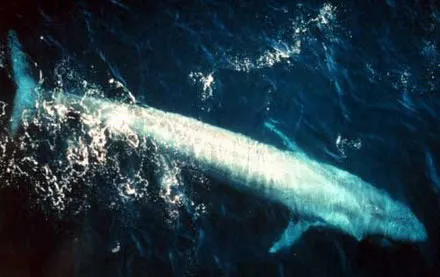
Deep below the ocean's surface, blue whales are singingóand for the first time, scientists think they know why. Researchers from the Scripps Institution of Oceanography recorded the sounds and say they offer new insight into the behavior of the passenger jet-sized animals.
- Video: Starving Whales
Using tags suctioned to the whales' bodies, researchers tracked the whales and found that as they feed, they send out calls to let each other know where they are, each group employing a different sound.
The noises play a similarly important role during mating season when males sing long, low-pitched songs to indicate their reproductive fitness to females. Females select mates based on size and estimate that by evaluating males' songs: Larger males can take in more air and hold notes longer.
The research appears in the January 25 issue of the Marine Ecology Progress Series journal.
A related study, also by Scripps researchers, found that there are distinct "dialects" of whale-speak in different regions of the ocean. The finding could have implications for preservation efforts.
The scientists used acoustic recordings to delineate nine population regions worldwide. They found the whales weren't evenly distributed, though: Populations using a "Type 1" call, for example, live within a narrow band of ocean hugging the North American coast, while whales that use a "Type 4" call are spread over a large swath of the Northern Pacific Ocean.
The second study was published in a recent issue of the Journal of Cetacean Research Management.
Get the world’s most fascinating discoveries delivered straight to your inbox.
The scientists say the dialect findings could help guide conservation efforts for blue whales, whose numbers dwindled to dangerously low levels before whaling moratoria were enacted: There were once an estimated 200,000 to 300,000 in the Southern Hemisphere, but today that number is closer to 1,000, Scripps scientist John Hildebrand told LiveScience.
"By listening to the animals," he said, "you can tell something about the areas in which they are interacting to breed and that's important to know for managing and conserving the animals."
- The World's Biggest Beasts
- Image Gallery: Small Sea Monsters
- Whales Set Deep-Sea Diving Record
- Grammar Revealed in the Love Songs of Whales
- All About Whales