













Army Developing Paralysis Beam
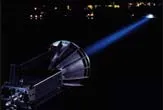
The U.S. Army is working on a modified 7.5-million-candlepower strobe light in hopes of creating a paralysis beam.
Although details are sketchy, it appears that U.S. government acquisition records call for contractor Peak Systems to ...
"...design and fabricate a light-based immobilisation system/deterrent device and integrate it with an unmanned aerial system. This will include any necessary medical research on frequency and amplitude modulation of high-intensity light that will cause immobilisation to all those within the beam."
The Peak Beam Systems device can apparently be pulsed with a strobe effect that has some effect on the human nervous system. The Maxa Beam shown above has quite a range, too. It can illuminate targets as far as 1.5 miles away.
The Maxa Beam is small enough to be hand-held, which is a vital factor in the US Army's selection of the device. The ultimate goal is to mount the device on a UAV (Unmanned Aerial Vehicle) for crowd-control.
The idea of a paralysis beam is an old science fiction favorite. A early version can be found in the excellent 1958 novel The Mechanical Monarch, by E.C. Tubb. In the story, the para-beam is also installed on a roaming device - the frightful metamen:
Curt skidded to a halt, staring wildly at the advancing figure of the metaman, and darted to one side. Blue fire streamed through the air where he had stood a moment before. It swung, lifted and Curt felt his legs go numb and almost lifeless as the blue ray stabbed past him, missing him by a fraction. ...Again the blue ray sent coldness through him, slowing his reflexes and chilling his blood with the touch of paralysis... (Read more about the para-beam)
I also recall Robert Heinlein using the idea in his earlier 1940 story Methuselah's Children; in that story, he described paralysis bombs that delivered a paralyzing beam when set off.
This device also may remind fans of classic Star Trek of a device that appeared in the 1965 episode Dagger of the Mind - the neural neutralizer.
Get the world’s most fascinating discoveries delivered straight to your inbox.
Check out these other beam-related stories:
Read more about the Paralyzing floodlight.
(This Science Fiction in the News story used with permission from Technovelgy.com - where science meets fiction.)