













Jellyfish Attacks With Stealth

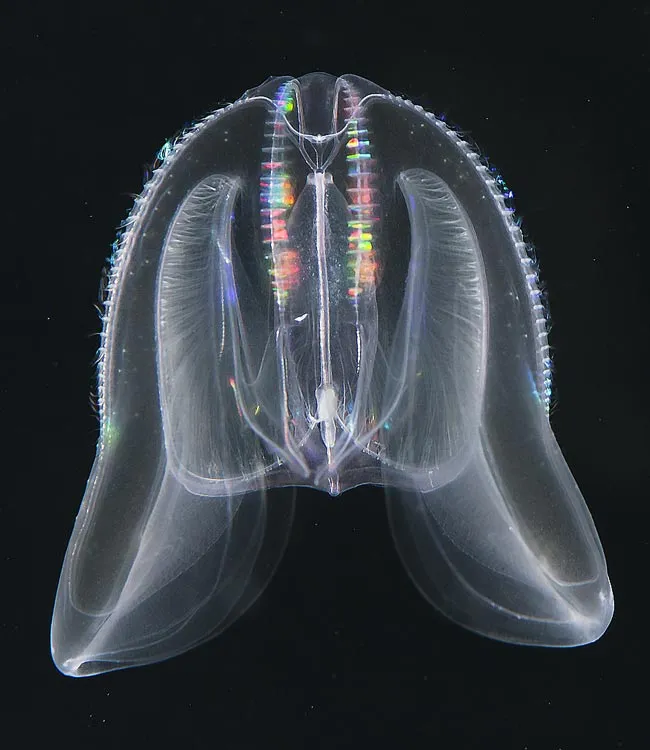
When you think of stealthy marine predators, a creature commonly called the sea walnut probably doesn't come to mind. However, new research shows the gelatinous blob hunts as effectively as a small, but much more sophisticated fish.
Stealth is the secret.
Mnemiopsis leidyi, as it's formally called, is a ctenophore, a group of simple animals often described as jellyfish that propel themselves using tiny hairs, called cilia. The animal also uses a different set of cilia to create a feeding current, gently sucking its prey – often tiny crustaceans called copepods measuring about 0.04 inches (1 millimeter) long – onto sticky cells in its mouth. Mnemiopsis can measure anywhere from 0.04 to 5 inches (1 millimeter to 12.7 centimeters) long.
However, if the copepods' antennae detect a slight change in the current, they'll jump away before Mnemiopsis can close the lobes of its mouth region around them.
"The trick to getting them there is to sneak up on the copepods so they don't realize they are already completely surrounded by these lobes," study researcher Sean Colin, a marine biologist at Roger Williams University in Rhode Island, told LiveScience. "That's what we showed: The disturbance or deformation in the water doesn't reach levels detected by the copepods until they are in that region."
Collin and his colleagues studied the flow of water Mnemiopsis generated by videotaping the creatures in the lab. They then calculated the disturbance created in the water by the cilia near its mouth and compared this with the level of disturbance that would warn the tiny crustaceans to escape. They found that in most scenarios, the disturbance was so low that the copepods would remain blissfully unaware until it was too late.
These jellyfish are native to the Atlantic Coast of the Americas, but they can be successful, even devastating, when introduced elsewhere. In the 1980s they showed up in the Black Sea, most likely transported by ships, and multiplied. Within a few years, the Black Sea's anchovy fishery collapsed. Mnemiopsis was one of the culprits, since it both competes with the filter-feeding fish for food and also consumes anchovy eggs and larvae.
Get the world’s most fascinating discoveries delivered straight to your inbox.
Mnemiopsis has also established itself elsewhere, including the eastern Mediterranean, the Caspian Sea, the Adriatic Sea, the Baltic Sea, parts of the North Sea, and elsewhere, according to the scientists.
Its feeding strategy is part of its success, according to Colin.
"It's a versatile predator," he said. "The way it feeds allows it to really take advantage or capitalize on a whole range of prey types."
While Mnemiopsis may prefer the tiny crustaceans, even in its natural environment it eats a variety of small floating animals, called zooplankton, he said.
