













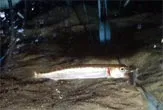
When threatened, minnows bunch together, swim slower and make quick darting movements to fake out their predators. How close they group together and how often they dart depends on the level of the threat. Is it just one pike fish or many? Are they far away or dangerously near?
But sometimes vision isn't enough to tell the minnows these things, so the small fish rely on another tactic: They sniff the water for scents of their predators.
A new study, detailed in the October issue of the journal Animal Behavior, reveals that a minnow's sense of smell is so sophisticated that it can pick out the odor of a single predator pike fish among many. The discovery adds to a long list of amazing animal senses that make humans seem woefully unaware of their surroundings by comparison.
The nose knows
Researchers from the University of Saskatchewan in Canada exposed small schools of minnows to water containing chemicals shed by pikes. The pikes were housed separately and researchers collected water from each tank to make test mixtures.
In one case, minnows were exposed to two different batches of pike-scented water: both contained equal volumes (60 milliliters), but one batch was made with the scent of two pikes, and another with twelve. The minnows reacted more strongly to the two-pike mixture, because it contained more chemicals-per-pike. This demonstrated that the fish can use smell to gauge how far away a pike is, because, in the wild, a concentrated pike smell would almost certainly mean pike were nearby.
Next, the researchers exposed minnows to either 60 ml of pike essence, made from 12 pikes, or 10 ml made from two pikes. (In this second experiment, the volumes of the two test mixtures were different, but the concentration of chemicals-per-pike was the same: both mixtures contained 5 ml of pike water from each tank.)
Get the world’s most fascinating discoveries delivered straight to your inbox.
This time, the minnows reacted more strongly to the 12-pike mixture than the two-pike one, proving they could distinguish between individual pike.
Classically conditioned
All the minnows used in the experiment were collected from lakes that contained pikes. This was important because minnows, like many fish, don't have an innate knowledge of which predators to avoid when they are born. It's something the fish have to learn, either by trial-and-error, such as a near escape from a predator fish, or by example. When the skin of a minnow is torn open, unique chemicals are released that put other minnows on high-alert.
Minnows mark other fish as dangerous using a type of learning called "classical conditioning." The Russian scientist Ivan Pavlov discovered classical conditioning when he trained dogs to associate the sound of a bell with food. After a few trials, the dogs would salivate to the sound of the bell even when no food was given.
In the case of minnows, they learn to associate both the smell of broken minnow-flesh and the odor of predator pikes with danger. But where Pavlov's dogs required numerous trials before the connection between bell and food finally clicked, minnows require only a single predator exposure and the lesson is learned for life.
"If you want to survive, the selection pressure to learn as efficiently as possible is right there and it's very high," study team member Maud Ferrari told LiveScience.
"Maybe some animals don't [learn] and those animals don't survive and reproduce," she said.
- Top 10 Animal Senses that Humans Don't Have
- Predators Prefer Dimwitted Prey
- How We Smell