













Odd Evolution: Crickets Lose Their Song
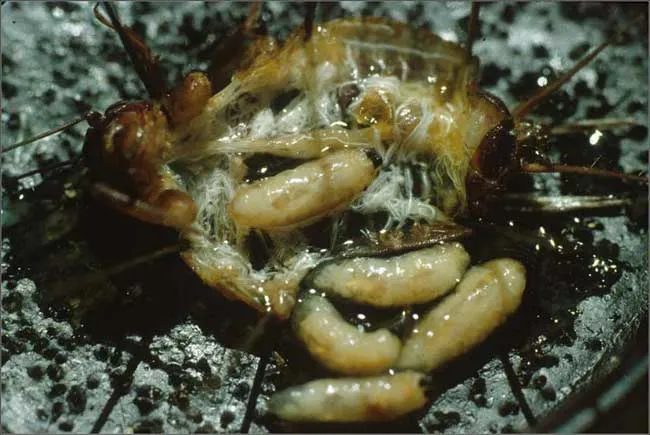
In just a few generations, the male crickets on Kauai underwent a drastic genetic change that rendered them incapable of belting out courtship songs, according to a new study.
Typically, male field crickets sport curved wings, and by rubbing a sharp ridge of one wing with a rough part of the other, the cricket produces a mating call.?
But this serenade also attracts a parasitic fly. Once the insect spots a singing cricket, it deposits larvae onto the cricket. The larvae burrow into the cricket's body, where they mature and subsequently kill the cricket as they emerge from its body.
Researchers led by Marlene Zuk, of the University of California, Riverside, have monitored the crickets on Kauai since 1991. With each visit, the team heard fewer and fewer singing crickets. Then, in 2003 they realized the crickets were abundant but 90 percent of the males had flat wings.
The scientists figure that the quiet mutation protects the crickets from the parasitic fly.
But how do they attract females? Turns out, the flat-winged male crickets have altered their behavior so they can mate successfully. The song-less males rely on the few male crickets with "normal" wings. By congregating around a serenading male, the silent crickets enable females to find and mate with them.??
"Instead, the behavior of the flatwings allows them to capitalize on the few callers that remain, and thus escape the fly and still reproduce," Zuk said. "This is seeing evolution at work."
Get the world’s most fascinating discoveries delivered straight to your inbox.
- Well-fed Crickets Seek Sex Incessantly, Die Young
- Grammar Revealed in the Love Songs of Whales
- How Mosquitoes Find a Mate: Lots of Whining
- Birds Cut Rivals Off in Mating Songs
- Top 10 Secret Weapons
Jeanna Bryner is managing editor of Scientific American. Previously she was editor in chief of Live Science and, prior to that, an editor at Scholastic's Science World magazine. Bryner has an English degree from Salisbury University, a master's degree in biogeochemistry and environmental sciences from the University of Maryland and a graduate science journalism degree from New York University. She has worked as a biologist in Florida, where she monitored wetlands and did field surveys for endangered species, including the gorgeous Florida Scrub Jay. She also received an ocean sciences journalism fellowship from the Woods Hole Oceanographic Institution. She is a firm believer that science is for everyone and that just about everything can be viewed through the lens of science.