















Bizarre New Robot Jumps and Rolls
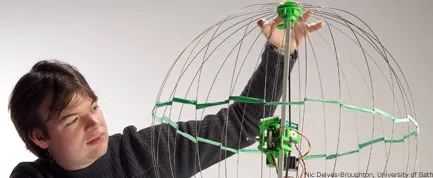
A robot that can jump like a grasshopper and roll like a ball might be the next best thing for space exploration. The "Jollbot" is the first robot with the ability to leap over obstacles and roll over smoother terrain, said engineer Rhodri Armour and colleagues from the University of Bath's Center for Biomimetic & Natural Technologies in England. The machine, announced last week, is a desirable candidate for surface surveys of planets or moons, he said, because of these advantages:
- The Jollbot's spherical build allows it to roll in any direction, giving it the maneuverability of wheels without the problem of overturning or getting stuck in potholes.
- Its cage-like surface is flexible and small — weighing less than two pounds — meaning it won’t get damaged easily after high jumps and is therefore less expensive than other conventional exploration robots.
- Its jumping capabilities are controlled by electrical motors that slowly store the energy needed to spring into a leap, mimicking the natural movement of grasshoppers that follow a "pause and leap" motion by storing muscle energy in spring-like elements, then rapidly releasing the energy to make the jump.
The robot gets ready to jump by squashing itself slowly — storing energy in the process — and then releases that energy all at once, Armour said, springing upwards in the air to almost 20 inches. Scientists are currently researching ways to improve the Jollbot's engineering so that it can power itself in space, such as including a stretchy skin of solar cells on the outside of the robot, and robotic control sensors to enable it to sense its environment.
- Video – See How Jollbot Works
- Video – Another Jumping Robot Inspired by Grasshoppers
- Vote for Your Favorite Robot
Get the world’s most fascinating discoveries delivered straight to your inbox.