The AMouse artificial mouse is a robot with two active whisker arrays -- made from real mouse whiskers.
Part of the intent in building the robot mouse is to study biological models of mouse behavior and to investigate the interplay between different sensory modalities (visual and somatosensory). Science fiction fans, of course, know the real use of this research -- to make Ray Bradbury's robot cleaning mice come to life.
The AMouse robot consists of three basic systems: an omnidirectional camera (A) and its artificial whisker sensors (B) which are mounted on a mobile Khepera platform (C).
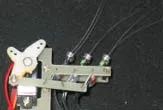
In setting up the whisker array (see picture below), the researchers noted that rats can move their whiskers separately in two dimensions, but mostly they move them in synchrony and in a forward/backward sweep. The selected design for the whisker array moves all whiskers synchronously in one dimension, which closely approximates the typical rat whisker motion.
Each AMouse whisker is plugged directly into a capacitor microphone at the front of the robot. This capacitor can detect vibrations up to 3000 vibrations per second. The process imitates the way a real mouse uses its whiskers to sense, via the nerves in its nose.
Sign up for the Live Science daily newsletter now
Get the world’s most fascinating discoveries delivered straight to your inbox.
Moving on its caterpillar tracks, the AMouse is programmed to proceed until it senses an obstacle; it then alters direction until it finds its way around it. But the robot can also sense acceleration and ground vibrations using its whiskers.
In his 1950 story There Will Come Soft Rains (collected in his classicMartianChronicles),sciencefictionGrandmaster RayBradbury wrote about a fully automated house with little cleaning robots:
Out of warrens in the wall, tiny robot mice darted. The rooms were acrawl with the small cleaning animals, all rubber and metal. They thudded against chairs, whirling their mustached runners, kneading the rug nap, sucking gently at hidden dust.
(Read more about Ray Bradbury's robot mouse)
All we need to do is get these researchers together with the folks from iRobot (makers of the Roomba and Scooba cleaning robots), and we'll be all set!
Bill Christensen catalogues the inventions, technology and ideas of science fiction writers at his website, Technovelgy. He is a contributor to Live Science.