













Dinosaur Had Horns the Size of Baseball Bats
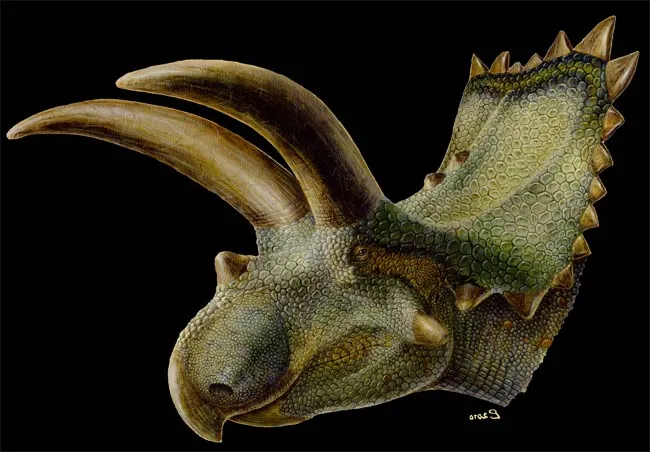
A tubby dinosaur sporting horns each the length of a baseball bat roamed what is now Mexico some 72 million years ago.
Remains of the plant-eating dinosaur, now called Coahuilaceratops magnacuerna, were unearthed from the Cerro del Pueblo Formation in Coahuila, Mexico. Fossils belonging to both an adult and juvenile of the species were unearthed at the site.
When alive, the dinosaur would have been about the size of a rhinoceros, weighing 4 to 5 tons (3,600 to 4,500 kilograms), with horns estimated to be 3 to 4 feet long (about 1 meter). The horns are considered the longest of any ceratopsids, a group of plant-eating horned dinosaurs whose members include the famous Triceratops.
Like other horned dinosaurs, Coahuilaceratops probably used its headgear to attract mates and fight with rivals of the same species.
"Being one of the largest herbivores in its ecosystem, adult Coahuilaceratops probably didn't have to worry about large tyrannosaur predators," said researcher Andrew Farke of the Raymond M. Alf Museum in Claremont, Calif.
The new species, announced today, will be detailed in the book "New Perspectives on Horned Dinosaurs" to be released next week by Indiana University Press.
Monster storms
Get the world’s most fascinating discoveries delivered straight to your inbox.
Mark Loewen, a paleontologist with the Utah Museum of Natural History and lead author of the study, described the arid, desert terrain where the dinosaur was recovered as nothing like Mexico during the Late Cretaceous (97 million to 65 million years ago). At that time, due to high global sea levels, the region was a humid estuary with lush vegetation, much like the present-day Gulf Coast.
The high sea level created an interior seaway that split North America into a western landmass called Laramidia and an eastern one called Appalachia. Coahuilaceratops lived at the southernmost tip Laramidia.
Many dinosaur bones in the area are covered with fossilized snails and marine clams, suggesting the dinosaurs lived adjacent to the seashore.
Ancient ecosystem
In addition to Coahuilaceratops, the research team found remains of two other horned dinosaurs, two duck-bill dinosaurs, as well as the remains of carnivores, including large tyrannosaurs (smaller, older relatives of T. rex) and more diminutive Velociraptor-like predators armed with sickle-claws on their feet.
In fact, some of the sites in the area appear to represent mass death events, perhaps associated with storms such as today's hurricanes that occur in the region.
"Sitting near the southern tip of Laramidia, this region may have been hammered by monstrous storms," said study researcher Scott Sampson, a paleontologistat the Utah Museum of Natural History. "If so, such periodic cataclysms likely devastated miles of coastline, killing off large numbers of dinosaurs."
But that's not how Coahuilaceratops died. "This was found with several individuals, but we don't think a hurricane killed these guys," Loewen told LiveScience. "Hurricanes came through and destroyed some of the dinosaurs. The actual one we're announcing didn't die that way."
In all, the discoveries paint a picture of a diverse, ancient ecosystem strewn with plant- and meat-eating dinosaurs, possibly representing a previously unknown assemblage of species, the researchers say.
"Rather than focusing only on individual varieties of dinosaurs, we are attempting to reveal what life was like in Mexico 72 million years ago, and understand how the unique ecosystem of Mexico relates to ecosystems to the north at the time," Loewen said.
- 25 Amazing Ancient Beasts
- Gallery: Drawing Dinosaurs
- Dino Quiz: Test Your Smarts
Jeanna Bryner is managing editor of Scientific American. Previously she was editor in chief of Live Science and, prior to that, an editor at Scholastic's Science World magazine. Bryner has an English degree from Salisbury University, a master's degree in biogeochemistry and environmental sciences from the University of Maryland and a graduate science journalism degree from New York University. She has worked as a biologist in Florida, where she monitored wetlands and did field surveys for endangered species, including the gorgeous Florida Scrub Jay. She also received an ocean sciences journalism fellowship from the Woods Hole Oceanographic Institution. She is a firm believer that science is for everyone and that just about everything can be viewed through the lens of science.