Mystery of World's Biggest Beasts Possibly Solved

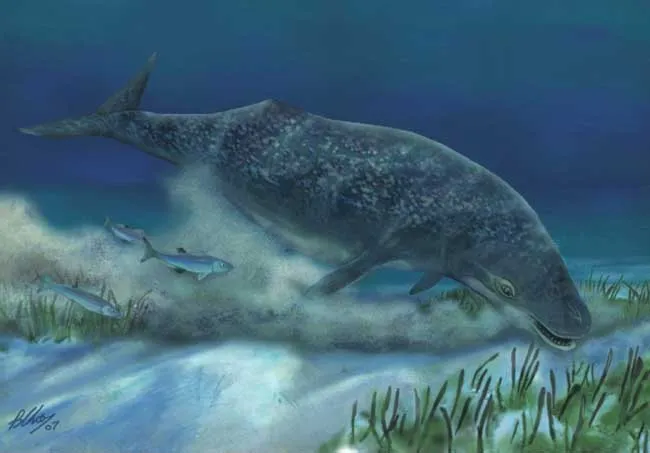
The origins of the largest animals in the world, the baleen whales, might be rooted in the mud, which they potentially sucked up like vacuum cleaners, analysis of a bizarre extinct dwarf whale now suggests.
The baleen whales include the largest animal to have ever lived, the blue whale. Instead of teeth, they use baleen to feed — plates with frayed edges in the upper jaw that filter seafood from the water.
To help solve the mystery of how these giants of the deep came to live off the smallest animals in the sea, scientists investigated the 25-million-year-old fossil of Mammalodon colliveri, a primitive 10-foot-long whale, found near the coastal town of Torquay in southeast Australia. The fact that Mammalodon was just a third or less the size of its larger ancestors suggests it was a dwarf.
"The seas off southern Australia were a cradle for the evolution of a variety of tiny, weird whales that seem to have lived nowhere else," said researcher Erich Fitzgerald, a paleobiologist at Museum Victoria in Australia.
Mammalodon was a slower, more rotund whale that lived in relatively warm shallow waters, with lots of sea urchins, mollusks, a whole variety of invertebrates, and corals, although probably not coral reefs. "There were also giant sharks, far larger than the great white," Fitzgerald said.
This whale had a short, blunt snout and reduced front teeth, and Fitzgerald's analysis revealed it had considerably developed lip muscles and the kind of wear on its other teeth that comes from exposure to sand grains. These adaptations suggest Mammalodon was a bottom-feeding mud-slurper.
"You see features like this in beluga whales," Fitzgerald explained. "They use their tongue and lip muscles to suck prey off the seafloor."
Get the world’s most fascinating discoveries delivered straight to your inbox.
This mud grubbing might have served as the roots to the filter feeding of today's baleen whales. In the past, researchers had speculated baleen whales evolved their feeding technique by first snagging food out of the water with their teeth, eventually developing baleen to capture lots of small prey en masse.
"That's a pretty big evolutionary change," Fitzgerald said.
In contrast, "sucking prey from a sandy, muddy bottom makes sense to me as a simpler evolutionary step, going from filtering food using teeth to filter feeding out of the water," Fitzgerald said. "Charles Darwin made that same speculation in 'On the Origin of Species.'"
These new findings, detailed online Dec. 22 in the Zoological Journal of the Linnean Society, "are the first compelling hard evidence that some of the earliest baleen whales were suction feeders," Fitzgerald told LiveScience. Still, he cautioned "at the moment, there's not evidence that shows that suction feeding is primitive for baleen whales as a whole. This new fossil evidence merely indicates now it's a stronger possibility."
"The story is still evolving, just as the whales did, so there will be more to come on this," he concluded.
- 25 Amazing Ancient Beasts
- Dangers in the Deep: 10 Scariest Sea Creatures
- Gallery: World's Biggest Beasts