













Catastrophe Killed Dinosaur Herd, New Species Emerges

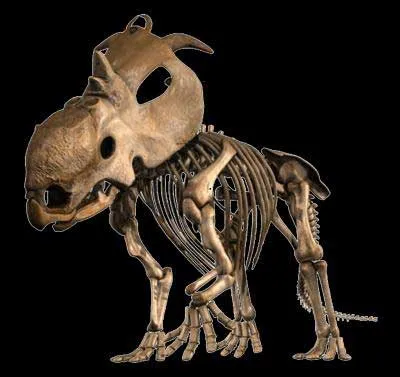
A catastrophic event 72.5 million years ago left a herd of giant, horned dinosaurs buried to become fossils. Now scientists have identified the extinct creatures as a new species.
The fossils, found in Northwest Alberta, Canada, revealed a herd of so-called ceratopsian dinosaurs that perished together. The animals are characterized by a bony frill on the back of the skull ornamented with smaller horns.
Parts of at least 27 individual animals were recovered at the site.
These dinosaurs also had large bony structures above their nose and eyes, which lends them their name: Pachyrhinosaurus (thick-nosed lizard). These structures probably supported horns of keratin, said researcher Philip Currie, Canada research chair of dinosaur paleobiology at the University of Alberta, who was involved in the excavations.
The new species of Pachyrhinosaurus is closely related to Pachyrhinosaurus canadensis, which is known from younger rocks near Drumheller and Lethbridge in southern Alberta, Currie said. The newfound species is a smaller animal with many differences in the ornamental spikes and bumps on the skull.
The adults of both species have massive bosses, or protuberances, of bone in the positions where other horned dinosaurs (like Centrosaurus and Triceratops) have horns. However, juveniles of the new species resemble juveniles of Centrosaurus in having horns rather than bosses.
Northwest Alberta was not previously known for dinosaur material. In the 1970s, the Royal Tyrrell Museum of Palaeontology in Alberta began to lead excavations and studies of the Pipestone Creek bone bed there. The naming of the new species, Pachyrhinosaur lakustai, honors Al Lakusta, a now retired science teacher in Grande Prairie, Alberta.
Get the world’s most fascinating discoveries delivered straight to your inbox.
"The density of the Pipestone Creek bonebed is exceptional and surpasses many of Alberta's other ceratopsian bonebed sites," Currie said. "The preservation of the material is outstanding and was easy to collect. The number of bones, from all age groups, made complex investigations possible regarding behavior and growth patterns."
The site contains fossils from young and old individuals, allowing researchers to describe individual variations and growth patterns, investigate the possibility of sexual dimorphism, and hypothesize on a herding lifestyle.
With this new species, researchers will now have more data to give a better understanding of the ancient life and ecosystems in northwestern Alberta in the Cretaceous period, Currie said.
The study of the Pachyrhinosaurs is detailed in a book, "A New Horned Dinosaur from an Upper Cretaceous Bone Bed in Alberta," by Currie, Wann Langston, Jr. and Darren H. Tanke (NRC Press, 2008).
"Ongoing cooperation between Grande Prairie Regional College, the Royal Tyrrell Museum and the University of Alberta has uncovered many additional sites and fossils in our region," said Jack O'Toole, chair of the Pipestone Creek Dinosaur Project.
Andrew Neuman, executive director of the Royal Tyrrell Museum, explained the importance of the Pipestone Creek site. "Working on a previously unknown site that is abundant in dinosaur material shows how rich the entire province of Alberta is in paleontological resources," he said.
- Dino Quiz: Test Your Smarts
- Avian Ancestors: Dinosaurs That Learned to Fly
- Image Gallery: Dinosaur Fossils
