















How the Real 'Loch Ness Monster' Swam
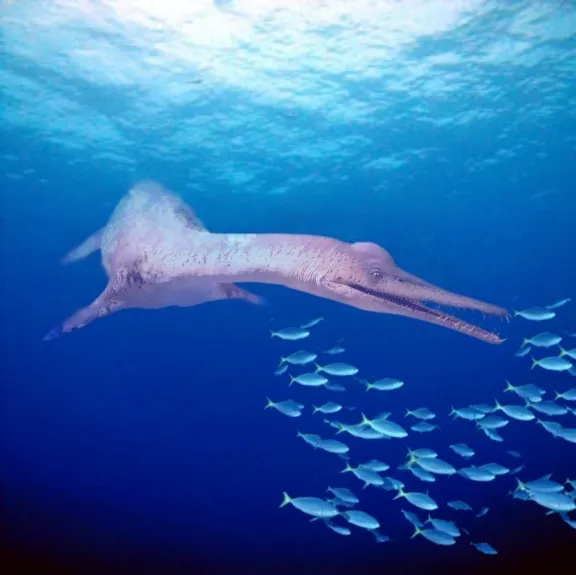
A pair of scientists dove right in to figure out how a dinosaur-era lookalike of the fabled Loch Ness paddled its fins.
The creature, a Plesiosaur, was a real-life, long-neck, fish-eating reptile with powerful jaws. It died out along with the dinosaurs. Some speculate the Loch Ness Monster is a descendent of the Plesiosaur, though mainstream scientists, who doubt the very existence of Nessie, say the Plesiosaur is indeed extinct.
Either way, the Plesiosaur had four awkward-looking fins protruding from its whale-sized body, and scientists have been unable to figure out how it used them to maneuver through the water well enough to rule the seas in the dinosaur era.
"There is a long controversy about how Plesiosaurs swam," said Kenneth Carpenter, a paleontologist at the Denver Museum of Nature and Science who led the research.
Human Plesiosaurs
So, armed with plastic recreations of the flippers of the marine reptile, the husband and wife team of Brian and Julia Reed jumped into a pool and swam in tandem.
One hypothesis was that the Plesiosaur used its flippers as oars on the surface of the water. Another, called the sea lion model, proposed the fish hunter pulled its fins up close to its body as it swam. The new research supported neither idea. The Reeds found that the easiest way to get around was by paddling all four fins at the same time.
Get the world’s most fascinating discoveries delivered straight to your inbox.
"We concluded that it was by using all four arms at once -- like a bird with four wings," Carpenter told LiveScience.
In much the same way as birds bob up and down as they move forward in flight, the Plesiosaur moved gently up and down as it flew through the water, the results suggests. One key to how the fins moved comes from measurements of the reptiles joints in fossils.
"The limitation of the socket of the Plesiosaur is nothing like that of human, and is closest to that of a sea turtle," Carpenter said. "Next time you have chicken wings take a look at the bone on the end of a drumstick. The white cap is cartilage that keeps bone from rubbing on bone and it leaves a mark that remains on fossils."
Even though soft tissue is rarely preserved, researchers can take the measurements of how far in any direction the socket can move before it exceeds the mark of the cartilage. This range-of-motion evidence directly contradicts the theory that Plesiosaurs swam like sea lions, by bringing their flippers up against their bodies. Plesiosaurs couldn't have made that motion, Carpenter and his colleagues concluded.
Next step: Speed
The possible speed of the animal as it swam is an even more complicated matter that Carpenter and his colleagues are just beginning to analyze. By reconstructing the volume of muscle on the limbs they hope to figure out the amount of power and force provided by each arm.
"Speed's a tough one, but I think we can approximate force and get a rough idea on speed, at least to within about 25 percent," Carpenter said.
It is unusual in modern science to use humans rather than a computer to model a dead animal's movement. Carpenter maintains that doing and seeing is an important part of gathering evidence.
"It's a case of garbage in and garbage out. In a computer model you can make anything possible -- you can manipulate anything," he said. "We didn't want to interject our bias or preconceived notions."
The preliminary results have been published in the Journal of Vertebrate Paleontology. A full analysis is expected in 2006.