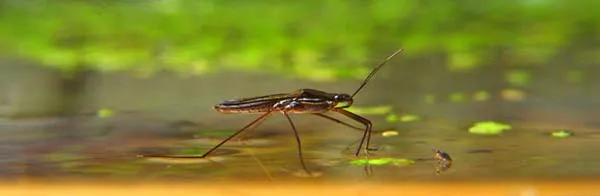
The amazing water strider doesn't just walk on water. It skips across it with the grace of an Olympic skater and the power of a hockey player. The insect dances up and down to avoid being submerged by raindrops, and it can pack 15 times its body weight without sinking.
Until now, scientists thought this seemingly Biblical ability was due to a wax secreted on the insect's legs combined with surface tension, a property of water that makes its boundary behave something like stretched Saran Wrap for small things.
But new research finds the water strider's legs are covered with microscopic hairs that trap tiny air bubbles, allowing the insect to simply float.
The discovery was made by Xuefeng Gao and Lei Jiang of the Chinese Academy of Sciences and will be detailed in the Nov. 4 issue of the journal Nature.
The effect is like water off a duck's back, Lei told LiveScience.
The discovery could lead to new water-resistant textiles, the researchers say. "But our finding might be more helpful in designing innovative miniature aquatic devices with drag-reducing [properties] and fast propulsion," Lei said.
Microscopic images of the insect's legs revealed that the otherwise invisible hairs, called microsetae, are oriented in one direction and involve several layers. The needle-shaped microsetae are each less than 3 micrometers in diameter (a human hair is 80-100 micrometers wide).
Sign up for the Live Science daily newsletter now
Get the world’s most fascinating discoveries delivered straight to your inbox.
The microsetae are scored with grooves measured in nanometers, even smaller units that represent billionths of a meter.
Air gets trapped in the spaces among the microsetae and nanogrooves to form an air cushion, which prevents the legs from getting wet, Lei explained. "Duck feathers are a similar matter, but they are not as effective as the striders' legs to achieve super water-repellence."
Scientists call the hairy legs superhydrophobic.
To rule out wax and surface tension as a viable water-walking technique, the researchers created an artificial strider's leg and coated it with wax. It worked well enough to support a couch-potato strider, but "but not to enable it to glide or dart around rapidly on the surface."
Water striders flit about quickly by using their legs like oars, according to a discovery last year by MIT mathematician John Bush and colleagues. The MIT team used dye in lab water and high-speed video cameras to record vortices created as the striders strode.
It is critical that water striders legs not get wet, "in order to avoid penetrating the surface during their rowing stroke," said David Hu, who worked on the MIT research. "If they do happen to fall through, they must generate forces ten times their body weight to return to the surface."
In an email interview, Hu said today's result is "consistent with our 2003 study."
The image above shows a side-view of a strider's leg making a dimple on water (a). Microscopic images show the spindly hairs (b), and the tiny groves on a hair (c).
Robert is an independent health and science journalist and writer based in Phoenix, Arizona. He is a former editor-in-chief of Live Science with over 20 years of experience as a reporter and editor. He has worked on websites such as Space.com and Tom's Guide, and is a contributor on Medium, covering how we age and how to optimize the mind and body through time. He has a journalism degree from Humboldt State University in California.