













Secret Ingredient in Ancient Mortar: Sticky Rice
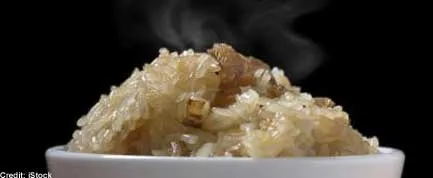
Sticky rice, a staple in many modern Asian dishes, was also the secret ingredient in super-strong mortar used in China some 1,500 years ago, a new study suggests.
The sweet-rice mixture was probably the world's first composite mortar, according to the American Chemical Society.
Mortar, a paste used to bind and fill gaps between bricks, stone blocks and other construction materials, remains the best available material for restoring ancient buildings. Builders used the material to construct important structures like tombs, pagodas and city walls, some of which still exist today.
The super-strong mixture is made by combining sticky rice soup with a standard mortar ingredient called slaked lime, or limestone that has been heated to a high temperature and exposed to water, said study researcher Bingjian Zhang, a professor at the Department of Chemistry at Zhejiang University in China.
"Analytical study shows that the ancient masonry mortar is a kind of special organic-inorganic composite material," Zhang said. "The inorganic component is calcium carbonate, and the organic component is amylopectin, which comes from the sticky rice soup added to the mortar."
The secret ingredient that makes the mortar so strong and durable is amylopectin, a type of polysaccharide, or complex carbohydrate, found in rice and other starchy foods, the scientists determined. The mortar's potency is so impressive that it can still be used today as a suitable restoration mortar for ancient masonry.
To determine whether sticky rice can aid in building repair, Zhang and colleagues prepared lime mortars with varying amounts of sticky rice and tested their performance compared with traditional lime mortar.
Get the world’s most fascinating discoveries delivered straight to your inbox.
"The test results of the modeling mortars show that sticky rice-lime mortar has more stable physical properties, has greater mechanical strength, and is more compatible, which make it a suitable restoration mortar for ancient masonry," the researchers write in the American Chemical Society (ACS) monthly journal, Accounts of Chemical Research.
In fact, the mortar works so efficiently as a bonding agent that some of the structures that were built using it remain strong enough to shrug off the effects of modern bulldozers and powerful earthquakes.