













130-Million-Year Old Proteins Still Present in Dinosaur-Age Fossil

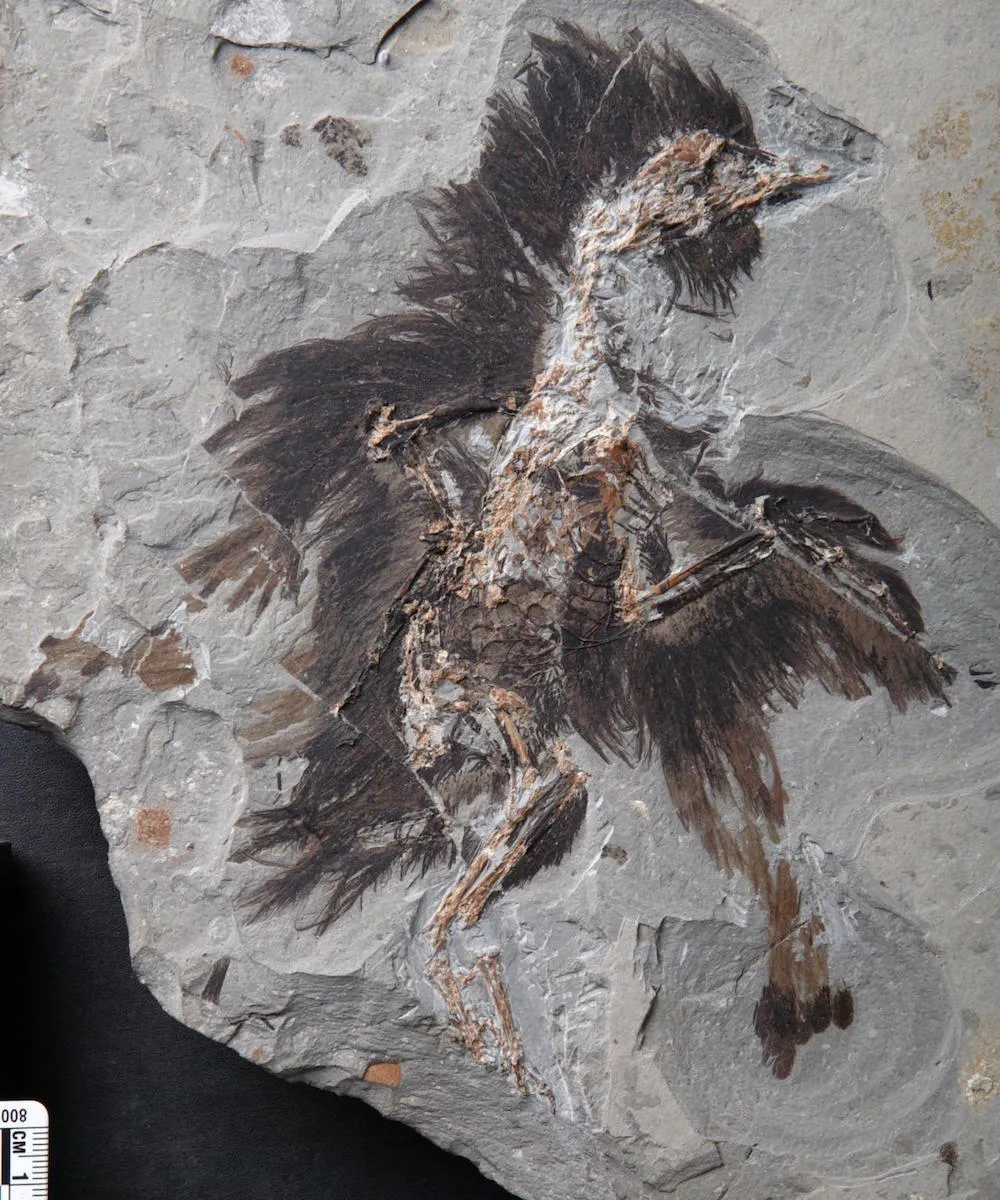
Microscopic pigment structures and proteins that graced the feathers of a Cretaceous-age bird are still present in its 130-million-year-old fossil, a new study finds.
The results, which confirm the oldest evidence of the structural protein beta-keratin, show that molecules can survive in their original state for hundreds of millions of years without fossilizing, and that researchers can use modern techniques to identify them, the researchers said. [In Photos: Wacky Fossil Animals from Jurassic China]
The tiny and ancient structures were found on Eoconfuciusornis, a crow-size early bird that lived in what is now northern China during the early Cretaceous. Eoconfuciusornis is one of the first birds known to have a keratinous beak and no teeth. (Not all avian predecessors were toothless. For instance, Archaeopteryx, a transitional animal between dinosaurs and birds, had sharp teeth.)
The Eoconfuciusornis specimen came from the Jehol Biota in northern China, a site known for its well-preserved fossils. The specimen is currently housed in China's Shandong Tianyu Museum of Nature, the world's largest dinosaur museum, according to a 2010 Guinness World Records award.
At first, the researchers suspected that the fossil held pigment structures called melanosomes. However, to make sure that the tiny structures weren't simply microbes that had accrued over the millennia, they had to do a number of tests, said Mary Schweitzer, a professor of biology at North Carolina State University with a joint appointment at the North Carolina Museum of Natural Sciences. Schweitzer co-authored the study with researchers from the Chinese Academy of Sciences.
"If these small bodies are melanosomes, they should be embedded in a keratinous matrix, since feathers contain beta-keratin," Schweitzer said in a statement. "If we couldn't find the keratin, then those structures could as easily be microbes, or a mix of microbes and melanosomes," which would lead to inaccurate predictions of pigmentation.
To learn more, Schweitzer and her colleagues used scanning and transmission electron microscopy to get a better view of the fossilized feathers' surfaces and internal structures. In addition, using a technique called immunogold labeling, the scientists attached gold particles to antibodies. These gold antibodies then bind to specific proteins (in this case, keratin), which makes them visible under an electron microscope.
Get the world’s most fascinating discoveries delivered straight to your inbox.
In addition, the scientists used high-resolution imaging to map the copper and sulfur within the feathers. The sulfur was broadly distributed, as would be expected in a keratinous material, as "the keratin protein family incorporates high concentrations of amino acids rich in sulfur," the researchers wrote in the study, published online yesterday (Nov. 21) in the journal Proceedings of the National Academy of Sciences.
In contrast, copper is found in melanosomes but not in keratin. After the mapping analysis, the researchers found the copper only in the fossil melanosomes, they said. This indicates that the Eoconfuciusornis specimen has 130-million-year-old melanosomes, and that it wasn't contaminated during its decomposition and fossilization, the researchers said.
"This study is the first to demonstrate evidence for both keratin and melanosomes, using structural, chemical and molecular methods," said study author Yanhong Pan, a researcher at the Nanjing Institute of Geology and Palaeontology at the Chinese Academy of Sciences. "These methods have the potential to help us understand — on the molecular level — how and why feathers evolved in these lineages."
This isn't the first time that researchers have found ancient structures within fossils. Schweitzer and her colleagues have also found an 80-million-year-old blood vessel belonging to a duck-billed dinosaur, and collagen proteins from a Tyrannosaurus rex. Despite these discoveries, it would be extremely challenging to use these findings to clone a dinosaur, she said.
Original article on Live Science.

Laura is the managing editor at Live Science. She also runs the archaeology section and the Life's Little Mysteries series. Her work has appeared in The New York Times, Scholastic, Popular Science and Spectrum, a site on autism research. She has won multiple awards from the Society of Professional Journalists and the Washington Newspaper Publishers Association for her reporting at a weekly newspaper near Seattle. Laura holds a bachelor's degree in English literature and psychology from Washington University in St. Louis and a master's degree in science writing from NYU.