 Live Science Plus






Potentially Dazzling Perseid Meteor Shower Peaks This Week
You are now subscribed
Your newsletter sign-up was successful
Want to add more newsletters?

Delivered Daily
Daily Newsletter
Sign up for the latest discoveries, groundbreaking research and fascinating breakthroughs that impact you and the wider world direct to your inbox.

Once a week
Life's Little Mysteries
Feed your curiosity with an exclusive mystery every week, solved with science and delivered direct to your inbox before it's seen anywhere else.

Once a week
How It Works
Sign up to our free science & technology newsletter for your weekly fix of fascinating articles, quick quizzes, amazing images, and more
Delivered daily
Space.com Newsletter
Breaking space news, the latest updates on rocket launches, skywatching events and more!
Once a month
Watch This Space
Sign up to our monthly entertainment newsletter to keep up with all our coverage of the latest sci-fi and space movies, tv shows, games and books.
Once a week
Night Sky This Week
Discover this week's must-see night sky events, moon phases, and stunning astrophotos. Sign up for our skywatching newsletter and explore the universe with us!
Join the club
Get full access to premium articles, exclusive features and a growing list of member rewards.
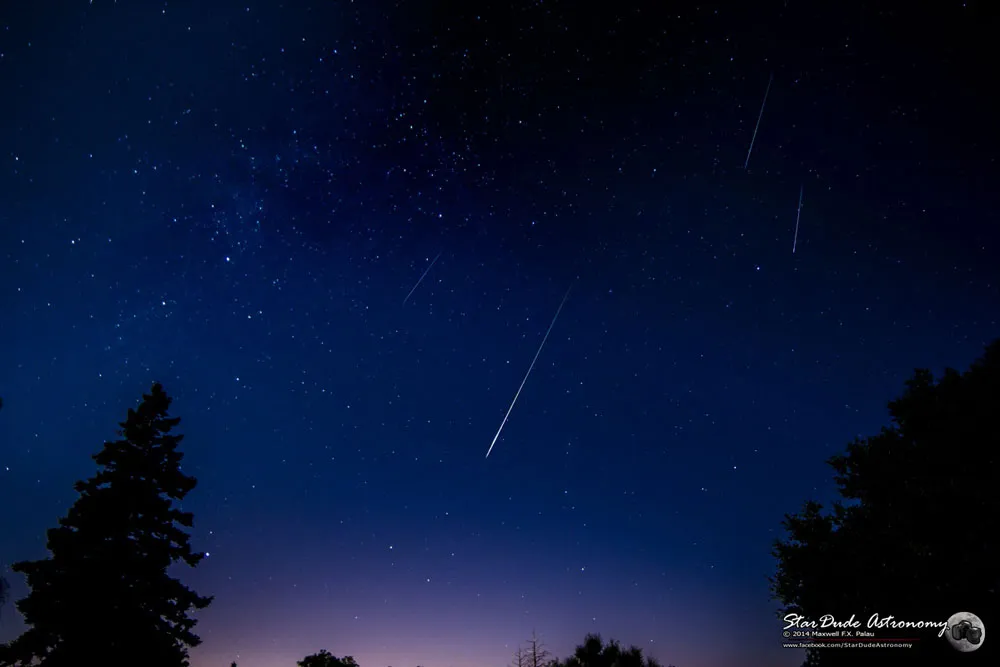
The annual Perseid meteor shower will reach its peak this week, giving amateur skywatchers with clear dark skies a potentially dazzling celestial light show.
Luckily for those watching the skies, there will be a new moon, allowing for maximum darkness just when the Perseid meteor shower will be is at its best. The meteor shower's peak occurs during the overnight hours of Wednesday (Aug. 12) and Thursday (Aug. 13). No fancy equipment is required; just a lawn chair and your naked eyes will be enough to see the "shooting stars."
While showers are hard to forecast, astronomers with the Royal Astronomical Society believe there will be at least one meteor every few minutes. A NASA advisory for the 2015 Perseid meteor shower predicted up to 100 meteors per hour.
According to the Royal Astronomical Society, French astronomer Jeremie Vaubaillon further predicted there could be a brief outburst at about 2:40 p.m. EDT (6:40 p.m. UTC). It won't be visible in North America, however, as the daytime skies will be too bright at that time.

Meteor showers occur when the Earth plows into small particles in space left behind by a comet or asteroid. In this case, the Perseids come from the tail of Comet Swift-Tuttle (whose last visit to Earth was in 1992). They are named after the constellation Perseus, the direction from where they appear to radiate.
If it's cloudy those nights, there still is a chance to catch a few Perseids. While there will be fewer shooting stars to see, the Perseids extend from about July 17 to Aug. 24. Meteor showers occur several times during the year, with another prominent display happening in November when the Leonid shower occurs.
Editor's note: If you catch a neat photo of the meteor shower and watn to share it for a possible story or gallery, send images and comments in to managing editor Tariq Malik at spacephotos@space.com.com.
Follow Elizabeth Howell @howellspace, or Space.com @Spacedotcom. We're also on Facebook and Google+. Original article on Space.com.
