













Gallery: California's Deep-Diving Elephant Seals

Extraordinary Divers

Elephant seals are deep-diving marine mammals, with the ability to swim to extreme depths of more than 5,000 feet (1,500 meters) beneath the surface of the sea.
These animals also have surprisingly high levels of naturally produced carbon monoxide — a noxious gas that is deadly at high concentrations — in their blood, according to a new study. In fact, the amount of carbon monoxide found in the blood of these large mammals is roughly the same as that in people who smoke 40 or more cigarettes each day, researchers say.
Scientists suspect the high levels of carbon monoxide could protect elephant seals from injury during their deep dives.
Elephant Seals Up Close

Michael Tift, a comparative physiologist at the Scripps Institution of Oceanography at the University of California, San Diego, with elephant seals at the Año Nuevo State Reserve in California. (NMFS permit # 14636)
Hold Your Breath!

Elephant seals can dive more than 5,000 feet (1,500 meters) beneath the surface of the sea, holding their breath and conserving oxygen for impressively long periods of time.
Beach Dwellers

While elephant seals appear to have elevated levels of carbon monoxide in their bloodstreams, the concentration of the gas is not so high as to cause harm.
In this photo, researcher Michael Tift studies elephant seals near Santa Cruz, California (NMFS permit #14636).
Get the world’s most fascinating discoveries delivered straight to your inbox.
Say Cheese!

Elephant seals, seen here on the Farallon Islands off the coast of California, live in harems, with one male mating with many females.
Marine Gymnastics
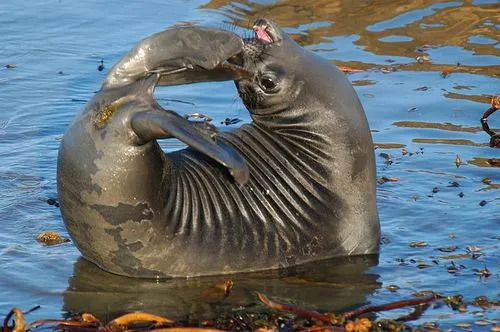
A northern elephant seal (Mirounga angustirostis) pup performs some impressive acrobatics at the Monterey Bay National Marine Sanctuary, located along California's central coast.

Denise Chow was the assistant managing editor at Live Science before moving to NBC News as a science reporter, where she focuses on general science and climate change. Before joining the Live Science team in 2013, she spent two years as a staff writer for Space.com, writing about rocket launches and covering NASA's final three space shuttle missions. A Canadian transplant, Denise has a bachelor's degree from the University of Toronto, and a master's degree in journalism from New York University.