













Eureka! Bacteria Have the Midas Touch

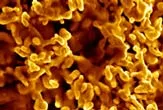
Scientists have discovered that a lowly bacteria that has the Midas touch—it appears to turn dissolved metal into solid gold.
The bacteria, called Ralstonia metallidurans, was identified by Frank Reith of Australian National University and his colleagues as the common denominator among bacteria comprising a dried organic biofilm found on the surface of gold grains collected from a park and gold mines in southern New South Wales and northern Queensland, Australia.
The gold was found in association with pyrite (or fool's gold) in quartz and arsenopyrite.
Reith then isolated and grew more of the bacteria in the lab and used a scanning electron microscope to observe gold precipitation in the presence of the microbe. It took just eight hours for a small grain to form.
Testing a theory for how gold grains form when it starts out dissolved in a liquid solution, he confirmed that the bacteria play an important role in the formation of this type of gold nugget. Others thought the grains might come out of solution by some other chemical or leftover process.
"A unique attribute of R. metallidurans is that it is able to survive in concentrations of gold that would kill most other micro-organisms," Reith said.
It is still unknown exactly how the bacteria help to precipitate the gold grains, but is possible that the microbe screens out the gold as part of an effort to detoxify its immediate environment. Metals like gold are toxic to most bacteria.
Get the world’s most fascinating discoveries delivered straight to your inbox.
The finding, published in the latest issue of the journal Science, could suggest opportunities for bio-processing of gold ores, Reith said.
Other researchers had observed gold grains in association with microbes, but no one had found strong evidence for it. And some scientists with Argonne National Laboratory and the University of Wisconsin-Madison reported in 2000 that certain bacteria also found in a biofilm play a role in the precipitation of zinc sulfide minerals.
- The Biggest Popular Myths
- Gold-plated Bacteria are First 'Cellborgs'
- Gold Probes Could Reveal Cancer in Your Body
- Talking Bacteria, and How to Shut Them Up
- Black Gold: Where the Oil Is

Robin Lloyd was a senior editor at Space.com and Live Science from 2007 to 2009. She holds a B.A. degree in sociology from Smith College and a Ph.D. and M.A. degree in sociology from the University of California at Santa Barbara. She is currently a freelance science writer based in New York City and a contributing editor at Scientific American, as well as an adjunct professor at New York University's Science, Health and Environmental Reporting Program.