
 Live Science Plus



Quaking Aspen: Trees of the Mountain West

Quaking aspen

Quaking aspen (Populus tremuloides) is the most widely dispersed tree in North America. It is found growing across the northern regions of the United States and Canada from the Atlantic to the Pacific Oceans. Groves of quaking aspen trees are also found growing in the high mountains of central Mexico, as well as in mountainous regions as far north as the Arctic Circle.
Shorter days

Each autumn, the shortening of the hours of daylight and the return of near freezing weather triggers the breakdown of chlorophyll, the chemical that gives plants their green color. As the green fades, the quaking aspen forests decorate their mountainous landscapes with spectacular displays of shades of yellow with occasional splashes of orange and red.
Standing tall

Quaking aspens, with their tall, straight trunks, stand alongside the endless miles of meandering forest roads like sentinels guarding the entrance into a high-mountain magical kingdom.

Golden portrait

And when discovered on a prairie at the base of an ancient volcano, a grove of quaking aspen becomes a palette of golden colors upon one of ol' Jack Frost's magnificent natural autumn portraits.
Fluttering leaves

The name "quaking" comes from the fluttering action of the trees' heart-shaped leaves when blown by the wind. This fluttering action is caused by the flattened petioles of the leaves. (Petioles are the stalks that attach the leaf blade to the stem.) The yellow-green color of the 1.5- to 3-inch (4- to 7.6-centimeter) leaf surface has an underside color of contrasting silver. The edge of each leaf is finely serrated.
Living high
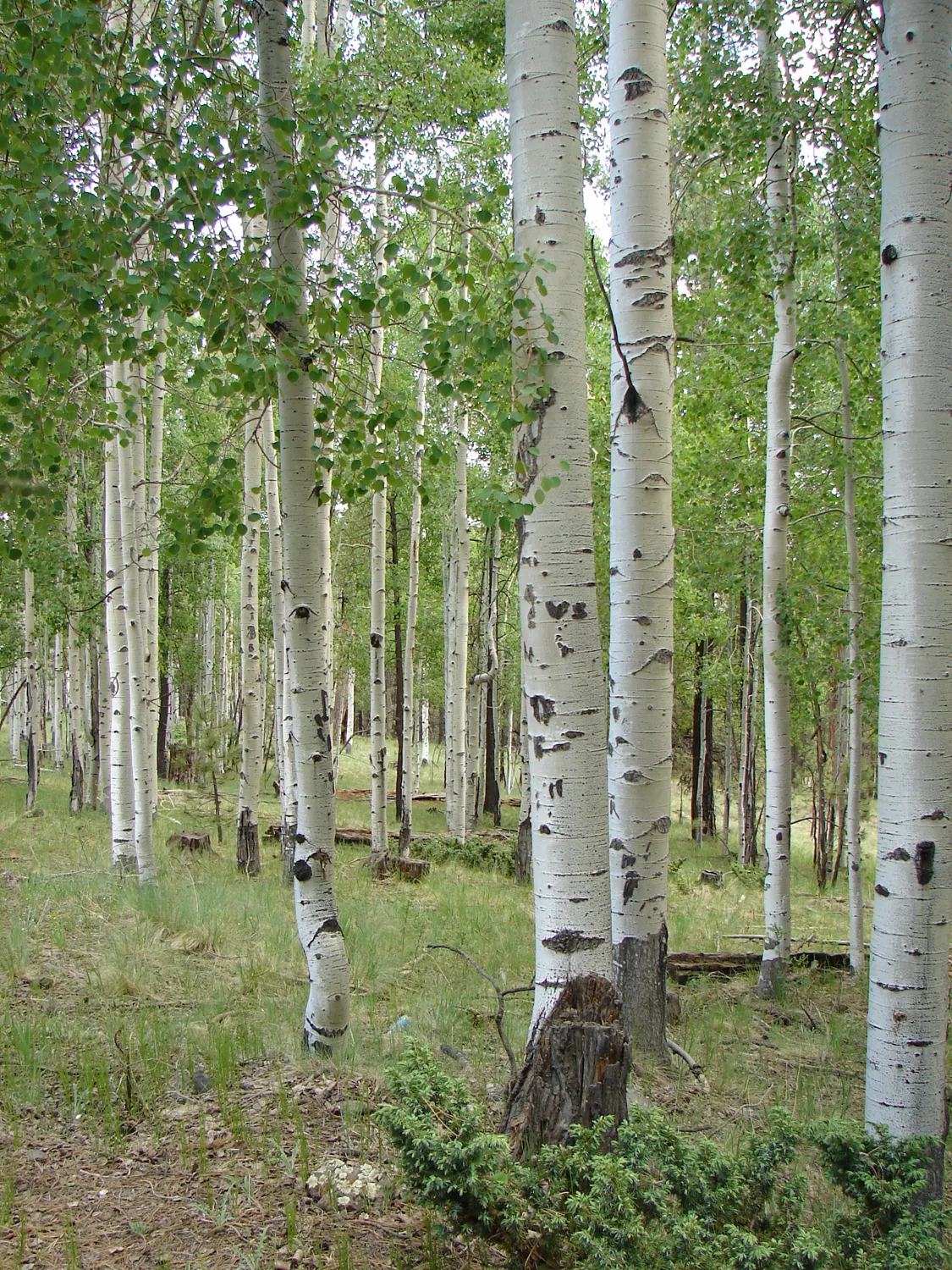
Quaking aspen are members of the willow family, Salicaceae. In the western mountains of the United States quaking aspen grow best at the 5,000- to 12,000-foot (1,500- to 3,700-meter) elevation range. Quaking aspen seldom grow below an elevation of 1,500 feet (460 m) due to the mildness of the winter found at this level. They are a short-lived species, having an average lifespan of 75 to 100 years.
Best of both worlds

Quaking aspen trees generally grow to a height of about 50 feet (15 m) with a spreading crown of 25 feet (7.6 m). Larger species known as "old growth aspen" that measure some 100 feet (30.5 m) tall and 3 feet (1 m) in diameter have been found in the Rocky Mountains of Colorado and New Mexico. They are a fast-growing tree that prefers a moist, slightly acidic soil. Quaking aspen grow best when the summers are relatively dry with abundant sunshine and when winters see heavy snowfall that reinvigorate the forest soil, resulting in rapid spring and summer growth.
Get the world’s most fascinating discoveries delivered straight to your inbox.
Smooth operator

The bark of the quaking aspen is unique in its smooth texture and light gray or off-white color. Some refer to the color as greenish-white. Shallow furrows that look like horizontal lines often appear. Old aspen often have bark that has split, leaving furrows that are dark gray. Since quaking aspens self-prune their lower branches, eye-shaped black scars are common on the lower trunk.
Unique character

There are both male and female aspen trees. During the time that both male and female trees flower, the male anthers and the female stigmas are both reddish in color adding to the unique character of the quaking aspen tree. Seeds are dispersed by the wind and only remain viable for two or three weeks. They require a moist environment and full sunlight to sprout.
Cloning network

But most quaking aspen trees reproduce asexually by producing clones of the original tree from an ever-spreading root network. Groves of quaking aspen are really the stems of one of the Earth's largest living organisms. Thousands of quaking aspen trees that are genetically identical to each other can be joined underground by a single root network that can continue to reproduce and live for hundreds if not thousands of years.
Returning home

Because of this root suckering method of reproducing, quaking aspens are often the first to re-establish a forest environment after a forest fire or a man-made forest clearing. As the forest of aspens continues to grow, they begin to provide shade for the forest floor which is necessary for new conifers to sprout. Over time a new conifer forest will grow often replacing the aspen stand.
