













'Odd Little Creature' Skips Sex and Eats DNA

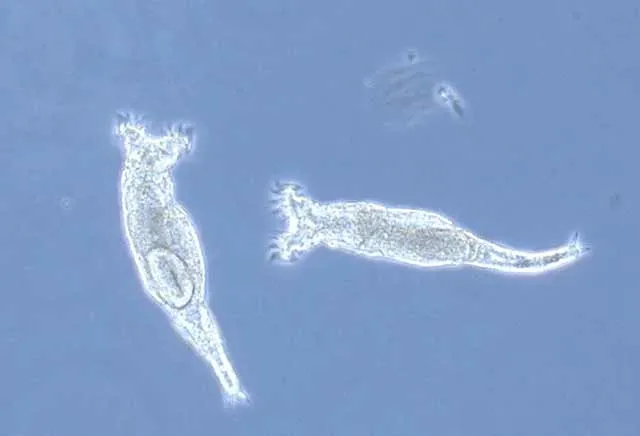
The tiny, all-female bdelloid rotifers have endured the past 80 million years without sex. New research shows that gobbling up foreign DNA from other simple life-forms might be the asexual animal's secret to survival.
In the study, scientists discovered that up to 10 percent of the active genes in microscopic bdelloids comes from bacteria and other organisms like fungi and algae. The finding adds to "the weirdness of an already odd little creature," said Alan Tunnacliffe, a University of Cambridge professor and lead author of the study.
"We don't know how the gene transfer occurs, but it almost certainly involves ingesting DNA in organic debris, which their environments are full of," Tunnacliffe explained in a statement. "Bdelloids will eat anything smaller than their heads!"
Many asexual creatures are thought to be doomed to extinction due to the lack of genetic diversity and build-up of mutations that often come with reproducing from just one parent's DNA. But bdelloids have managed to avoid such pitfalls of asexual life, diversifying into at least 400 species.
One of the critters' more remarkable qualities is their ability to withstand extreme dehydration, which could be, in part, thanks to the alien DNA. The new study found that some of the foreign genes are activated when the bdelloids begin to dry out in their ephemeral aquatic homes. These genes also might be behind powerful antioxidants thought to protect bdelloids from the by-products of drying out.
"These antioxidants have not yet been identified, but we think that some of them result from foreign genes," Tunnacliffe added.
Bdelloids' success could also be attributed to their potent DNA repair mechanisms, which seem to have evolved thanks to a duplicate set of genes, according to research detailed in 2008 in the journal Proceedings of the National Academy of Sciences.
Get the world’s most fascinating discoveries delivered straight to your inbox.
The new findings were detailed in the journal PLoS Genetics Thursday (Nov. 15).
Follow LiveScience on Twitter @livescience. We're also on Facebook & Google+.
