 Live Science Plus






Sun Unleashes Huge Solar Plasma Wave
You are now subscribed
Your newsletter sign-up was successful
Want to add more newsletters?

Delivered Daily
Daily Newsletter
Sign up for the latest discoveries, groundbreaking research and fascinating breakthroughs that impact you and the wider world direct to your inbox.

Once a week
Life's Little Mysteries
Feed your curiosity with an exclusive mystery every week, solved with science and delivered direct to your inbox before it's seen anywhere else.

Once a week
How It Works
Sign up to our free science & technology newsletter for your weekly fix of fascinating articles, quick quizzes, amazing images, and more
Delivered daily
Space.com Newsletter
Breaking space news, the latest updates on rocket launches, skywatching events and more!

Once a month
Watch This Space
Sign up to our monthly entertainment newsletter to keep up with all our coverage of the latest sci-fi and space movies, tv shows, games and books.

Once a week
Night Sky This Week
Discover this week's must-see night sky events, moon phases, and stunning astrophotos. Sign up for our skywatching newsletter and explore the universe with us!
Join the club
Get full access to premium articles, exclusive features and a growing list of member rewards.
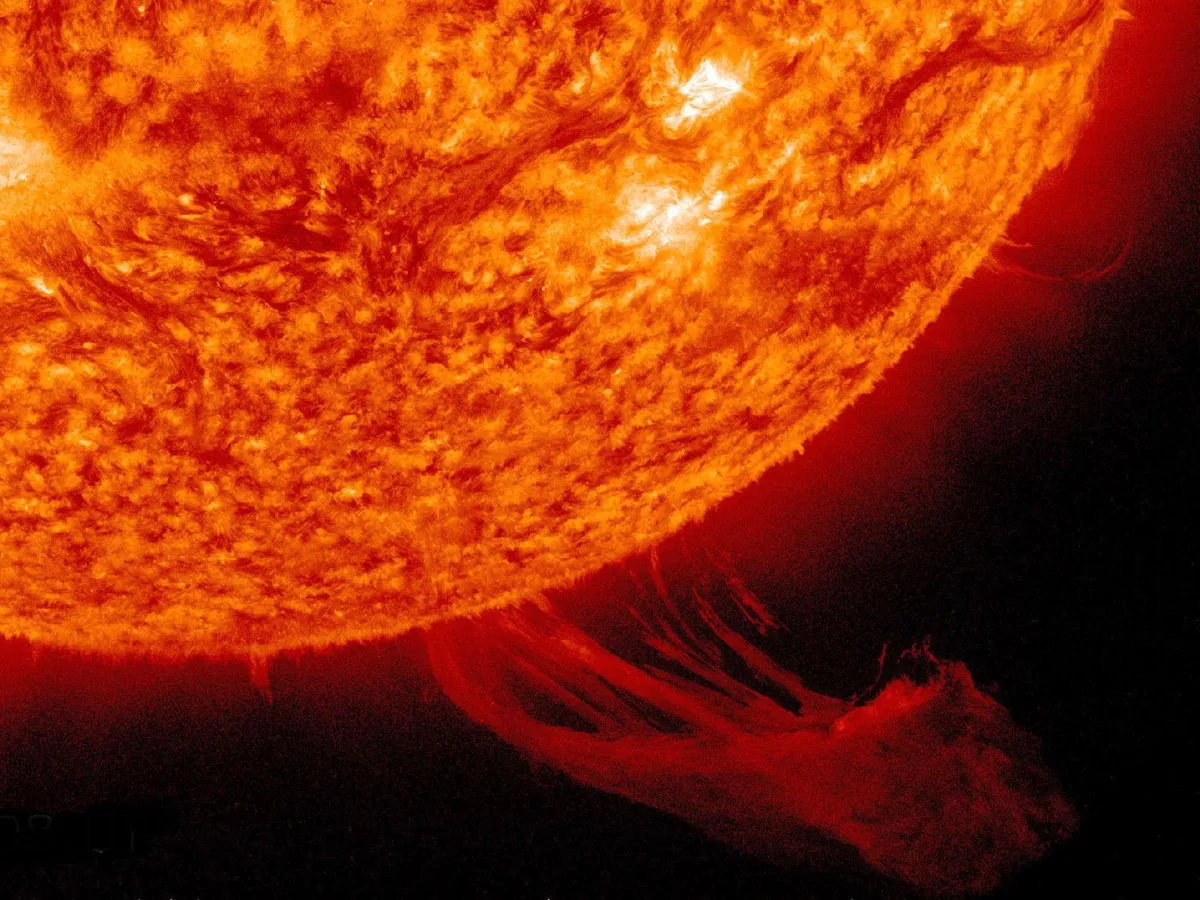
A giant wave of super-hot solar plasma larger than the Earth erupted from the sun on Friday (Oct. 19) in a spectacular display captured by a NASA spacecraft.
The huge solar prominence occurred at 4:15 a.m. EDT (0815 GMT) and was recorded in amazing detail by the high-definition cameras aboard NASA's Solar Dynamics Observatory before escaping the sun.
"Once it started breaking away, the process only took 10 hours before it was out of sight," NASA media specialist Steele Hill explained in a photo description. "The prominence stretched out many times the size of Earth."
The Solar Dynamics Observatory showed the solar prominence as a wispy red-orange wave stretching out from the lower right section of the sun. The image was recorded in the 304 Angstrom wavelength of extreme ultraviolet light, according to Hill.
Prominences are eruptions of charged solar plasma that appear to arc out away from the sun's edge, or limb, in spacecraft and telescope views. The structures are shaped by extreme magnetic field. Some loop-like prominences are short-lived, lasting only a few minutes. Others can be more stable, lasting hours or days, NASA scientists have said in the past.
NASA's Solar Dynamics Observatory is one of several spacecraft keeping a constant watch on the sun to track major solar flares, eruptions other space weather events. The sun is currently in an active phase of its 11-year solar weather cycle and is expected to reach its peak activity in 2013.
The current solar weather cycle is known as Solar Cycle 24. The Solar Dynamics Observatory has been tracing the sun's weather activity since the probe's launch in 2010.
This story was provided by SPACE.com, a sister site to LiveScience. Follow SPACE.com on Twitter @Spacedotcom. We're also on Facebook and Google+.

