
















Huge Earthquake Triggered Other Quakes Worldwide

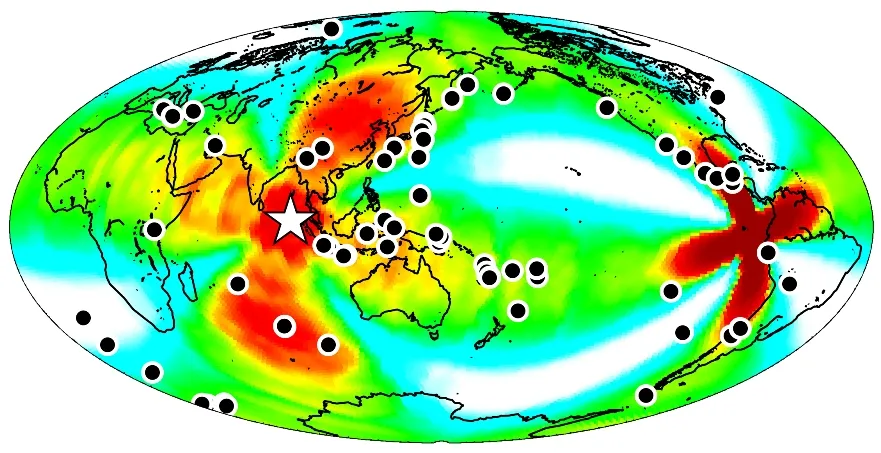
On April 11, a massive magnitude 8.6 earthquake shook the floor of the Indian Ocean off Sumatra. It wasn't just unusual because of its size — the 10th largest quake in the last century — it also set off a series of quakes around the world for up to six days afterward, according to a study published today (Sept. 26) in the journal Nature.
"Until now, we seismologists have always said, 'Don't worry about distant earthquakes triggering local quakes,'" said Roland Burgmann, an earth and planetary scientist at UC Berkeley, in a statement. "This study now says that, while it is very rare — it may only happen every few decades — it is a real possibility if the right kind of earthquake happens."
The study found that some quakes were triggered within a few hours, while in other places the seismic waves from the Sumatran quake primed temblors to happen for up to six days later.
The findings should remind those living in seismically active areas that the risk from a large earthquake could persist, even on the opposite side of the globe, for more than a few hours, the study scientists said.
Another study also published today suggests that the quake marks the birth of a new tectonic plate beneath the Indian Ocean.
The temblor was caused by plates slipping past each other, in what's called a strike-slip earthquake. (California's San Andrea fault is perhaps the most famous example of a strike-slip fault.)
"This was one of the weirdest earthquakes we have ever seen," Burgmann said in the statement. "It was like the 1906 San Francisco earthquake, a strike-slip event, but it was huge — 15 times more energetic."
Get the world’s most fascinating discoveries delivered straight to your inbox.
The Sumatran earthquake led to a 7.0 quake in Baja California and quakes in Indonesia and Japan, but none of these caused much damage. Worldwide, the seismologists found five times the expected number of quakes during the six days following April 11.
One possible mechanism for the delayed action is that the East Indian Ocean quake triggered a cascade of undetectable micro-quakes on certain faults that led to larger ruptures later on, according to a UC Berkeley release on the study.
Researchers looked at other recent large earthquakes and found that there was only a small increase in the number of earthquakes immediately afterward. That could be due to the unique nature of the Sumatran quake, which generated waves that traveled just under the Earth's surface and were energetic enough to affect distant fault zones.
Reach Douglas Main at [email protected]. Follow him on Twitter @Douglas_Main. Follow OurAmazingPlanet on Twitter @OAPlanet. We're also on Facebook and Google+.
