 Live Science Plus


You are now subscribed
Your newsletter sign-up was successful
Want to add more newsletters?

Delivered Daily
Daily Newsletter
Sign up for the latest discoveries, groundbreaking research and fascinating breakthroughs that impact you and the wider world direct to your inbox.

Once a week
Life's Little Mysteries
Feed your curiosity with an exclusive mystery every week, solved with science and delivered direct to your inbox before it's seen anywhere else.

Once a week
How It Works
Sign up to our free science & technology newsletter for your weekly fix of fascinating articles, quick quizzes, amazing images, and more

Delivered daily
Space.com Newsletter
Breaking space news, the latest updates on rocket launches, skywatching events and more!

Once a month
Watch This Space
Sign up to our monthly entertainment newsletter to keep up with all our coverage of the latest sci-fi and space movies, tv shows, games and books.

Once a week
Night Sky This Week
Discover this week's must-see night sky events, moon phases, and stunning astrophotos. Sign up for our skywatching newsletter and explore the universe with us!
Join the club
Get full access to premium articles, exclusive features and a growing list of member rewards.
A molecular dance of sorts between two proteins in the eye lens can create either perfect vision or cloudy cataracts.
By applying physics and biology to the complexities of vision, scientists discovered even a slight change in the interaction between proteins that make up the lens of the eye can lead to a protein clumping and in turn cataract formation, the world's leading cause of blindness.
There is currently no known way to reverse the "protein aggregation" process once it has begun. Every year, nearly 5 million people undergo cataract surgery, which involves replacement of the cloudy lenses with artificial ones.
This work could shed light on other protein aggregation diseases (such as Alzheimer’s disease) and may one day lead to methods for stabilizing protein interactions and thus preventing cataracts and other similar diseases.
The eye lens is made up of densely packed crystallin proteins whose arrangement is such that the lens is transparent to visible light. For various reasons, including exposure to ultraviolet light and age-related factors, the proteins "misbehave" and clump together. Instead of passing through the now-compromised lens, light gets scattered. The result is cloudy vision or blindness.
Previous research has shown that the interactions between the three major crystallin proteins that make up the eye lens are key to cataract formation.
Anna Stradner of the University of Fribourg in Switzerland and her colleagues studied the interactions of two of these proteins using both lab experiments and computer simulations.
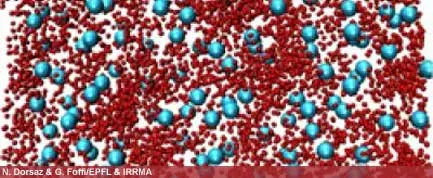
They modeled the proteins as spheres with varying levels of attraction and repulsion, from no mutual attraction in which the two proteins just separated to very strong attraction in which the protein spheres clumped together. When the attraction forces were just right, the spheres stayed uniformly mixed—clear vision.
“By combining experiments and simulations it became possible to quantify that there had to be a weak attraction between the proteins in order for the eye lens to be transparent,” said study researcher Giuseppe Foffi of the Institute for Numerical Research in the Physics of Materials in Switzerland. “Our results indicate that cataracts may form if this balance of attractions is disrupted, and this opens a new direction for research into cataract formation.”
The results, reported in the Nov. 9 issue of the journal Physical Review Letters, suggest in the future these properties could be tweaked to prevent clumping or even reverse the clumping process once it has begun.
- Scientists Envision Growing Human Eyeballs
- Video: Implant Helps Blind Cats See
- Top 10 Mysterious Diseases

