 Live Science Plus





Modeling the Impact of Severe Space Weather
You are now subscribed
Your newsletter sign-up was successful
Want to add more newsletters?

Delivered Daily
Daily Newsletter
Sign up for the latest discoveries, groundbreaking research and fascinating breakthroughs that impact you and the wider world direct to your inbox.

Once a week
Life's Little Mysteries
Feed your curiosity with an exclusive mystery every week, solved with science and delivered direct to your inbox before it's seen anywhere else.

Once a week
How It Works
Sign up to our free science & technology newsletter for your weekly fix of fascinating articles, quick quizzes, amazing images, and more
Delivered daily
Space.com Newsletter
Breaking space news, the latest updates on rocket launches, skywatching events and more!

Once a month
Watch This Space
Sign up to our monthly entertainment newsletter to keep up with all our coverage of the latest sci-fi and space movies, tv shows, games and books.

Once a week
Night Sky This Week
Discover this week's must-see night sky events, moon phases, and stunning astrophotos. Sign up for our skywatching newsletter and explore the universe with us!
Join the club
Get full access to premium articles, exclusive features and a growing list of member rewards.
This Research in Action article was provided to LiveScience in partnership with the National Science Foundation.
A space-weather analog to a monumental hurricane, coronal mass ejections can wreak havoc on Earth. These jets of ionized atoms and molecules, called plasma, and magnetic forces that come with them are expelled outward from the sun toward Earth, potentially affecting aviation, electrical grids and satellite performance.
However, because of the sun's distance from the Earth and few observing instruments, solar storms cannot currently be predicted. Similarly, until recently, solar models and models of the Earth's upper atmosphere could not fully replicate the complexity of interactions occurring between these ejections and the Earth's ionosphere and magnetosphere.
The magnetosphere — a zone of charged particles far above the Earth's surface that results from the deflective nature of our planet's magnetic field — protects the ionosphere and upper atmosphere from coronal mass ejections, also called CMEs, by impeding the flow of energy and momentum from the incoming ions and magnetic forces.
Scientists at the National Science Foundations's National Center for Atmospheric Research and the Center for Integrated Space-Weather Modeling developed the Coupled Magnetosphere Ionosphere Thermosphere model, which can track a variety of the chemical components that can be ejected from the ionosphere into the magnetosphere during space weather events. In combination with observational data provided by satellites like NASA's Advanced Composition Explorer, this model can more realistically characterize the upper atmosphere, both in its standard, steady state and when disruptions caused by solar-weather phenomena such as CMEs occur.
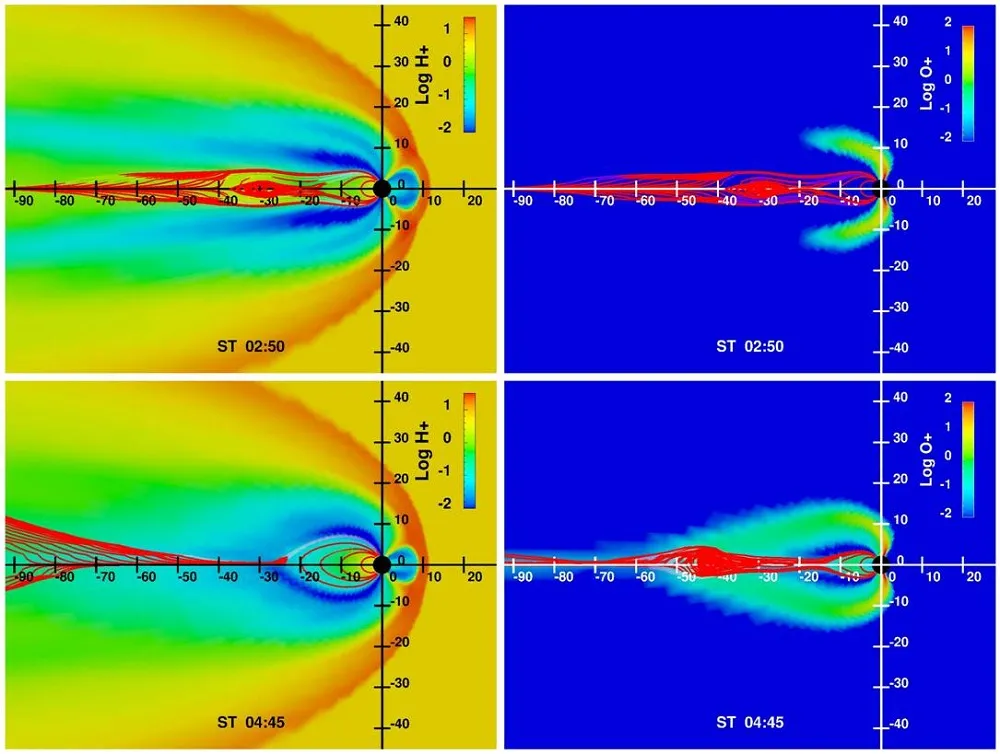
The above image shows model-simulation results; charged oxygen ions ejected from the ionosphere can lead to multiple substorms, a brief, explosive disturbance in the magnetosphere that releases stored energy into the ionosphere.
The images on the right show results from a baseline simulation, without any oxygen ions flowing out of the ionosphere, under an idealized, steady, magnetic field. Under those conditions, the simulation yields a single magnetospheric substorm before entering a more stable configuration.
The images on the left show oxygen ions flowing into the tail of the magnetosphere, also called the magnetotail. In such simulations, once the ions reach the magnetotail, a decrease in the local magnetic reconnection rate prevents the simulated magnetosphere from returning to the more stable state, resulting in a second substorm event.
New model simulations, space physicist Michael Wiltberger of theNational Center for Atmospheric Research said, show for the first time that out-flowing oxygen ions may play an important role in how the magnetosphere responds to the fluxes of energetic, charged particles from severe space weather.
Such an understanding will offer an improved view of the dynamic charged-material exchanges generated during magnetic storms and the resulting effects on Earth's technological systems.
Editor's Note: Any opinions, findings, and conclusions or recommendations expressed in this material are those of the author and do not necessarily reflect the views of the National Science Foundation. See the Research in Action archive.
