













What's Shakin'? Insects Break it Down To Be Heard

Bugs don't just buzz and chirp to communicate. A new study finds that they also vibrate.
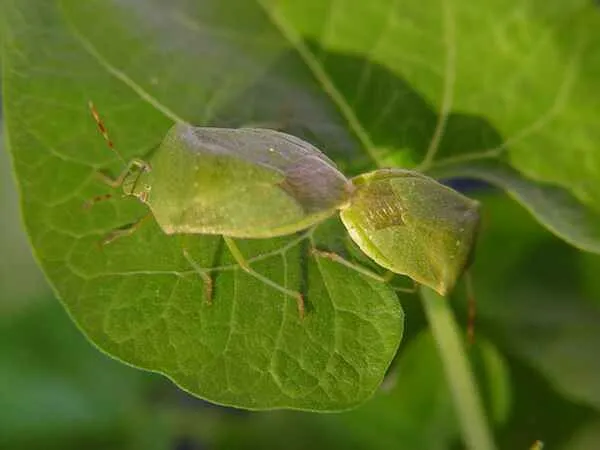
Vegetation-dwelling stinkbugs and burrower bugs use their leafy habitats for more than food and shelter, according to the study presented today (Nov. 18) in Cancun, Mexico, at the second Pan-American/Iberian Meeting on Acoustics. The insects use plants as a medium for communication, drumming on leaves and stems or shaking their bodies wildly to send signals to other bugs.
Using plants as the buggy equivalent of a tin-can telephone makes sense, said study researcher Andrej Cokl of the National Institute of Biology in Slovenia.
"Plants are the most natural and usual surrounding of most insects," Cokl wrote in an e-mail to LiveScience.
The researchers used an optical laser to capture the tiny vibrations caused by insects just a half-inch (1.2 centimeters) long. They let more than 21 species of stinkbugs and burrower bugs free on plants in their lab, and then measured the tremors that each insect created.
The insects displayed a wide array of vibration-producing methods, from fluttering their abdomens to shaking their entire bodies to tapping their front legs on the plant surface. Different species had different vibration patterns, limiting cross talk. Male and females of the same species also had distinct calls. For example, the researchers reported, female southern green stinkbugs call out with relatively long vibrations spaced far apart, while males call out with short bursts of vibration spaced closer together.
To find out what the insects could hear, the researchers also examined the structure of the insects' vibration receptors in their legs and nervous systems, finding that they're most effective at low frequencies. Most vibration communications occurred at 100 hertz, or 100 cycles per second. The vibrations aren't loud enough to be detected by the human ear, but if they were, the vibration would register: The lowest pitch the human ear can detect is 20 hertz.
Get the world’s most fascinating discoveries delivered straight to your inbox.
The findings are important to understanding the social world of insects, Cokl said. Because stinkbugs and burrower bugs are agricultural pests, he said, the findings might also be useful for keeping them away from valuable crops.

Stephanie Pappas is a contributing writer for Live Science, covering topics ranging from geoscience to archaeology to the human brain and behavior. She was previously a senior writer for Live Science but is now a freelancer based in Denver, Colorado, and regularly contributes to Scientific American and The Monitor, the monthly magazine of the American Psychological Association. Stephanie received a bachelor's degree in psychology from the University of South Carolina and a graduate certificate in science communication from the University of California, Santa Cruz.