













US life expectancy drops dramatically due to COVID-19
It's the largest drop in life expectancy in at least 40 years.

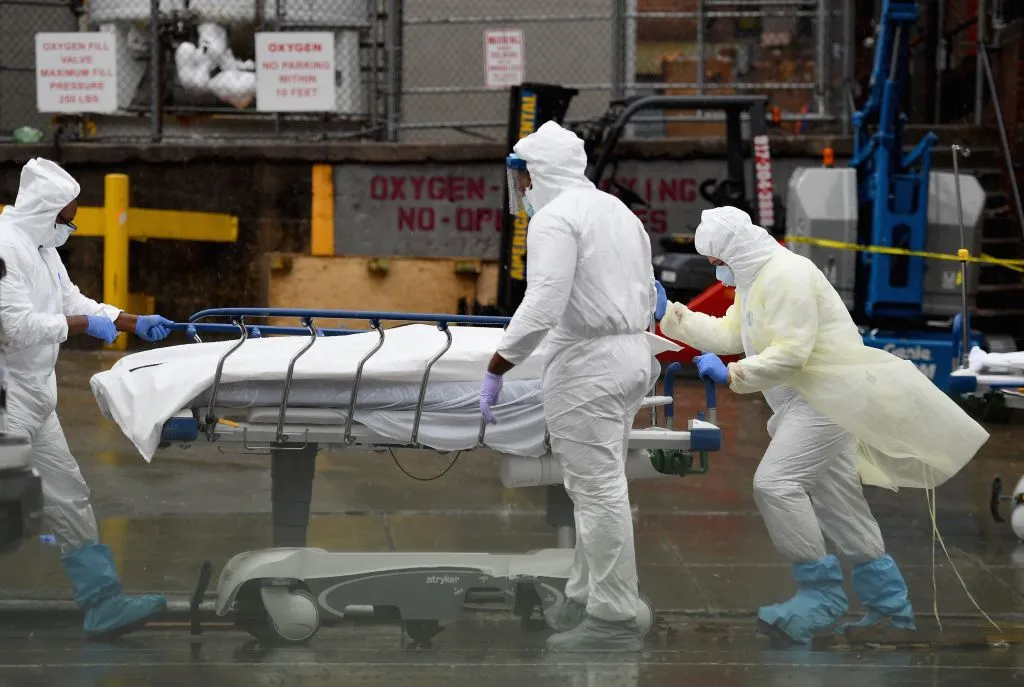
U.S. life expectancy just dropped by more than a year — the largest decline in decades — as a result of the sheer number of deaths from COVID-19, according to estimates from a new study.
The study researchers project that, due to the COVID-19 pandemic, the average U.S. life expectancy in 2020 will drop by 1.13 years, bringing it to 77.48 years, according to the study, published Thursday (Jan. 14) in the journal Proceedings of the National Academy of Sciences. That's the largest single-year decline in life expectancy in at least 40 years, and it would bring the country's life expectancy down its lowest level since 2003, the researchers said.
Life expectancy in the U.S. rarely declines, and when it does, it makes headlines. Most recently, U.S. life expectancy declined by 0.1 years in 2015, 2016 and 2017 — a trend that was attributed to rises in "deaths of despair," including drug overdose and suicide. The new estimated decline due to COVID-19 is 10 times greater.
Related: 10 ways COVID-19 changed the world
What's more, the study showed even larger declines in 2020 among Black and Latino communities, which have been hit particularly hard by the pandemic. Overall, nearly 400,000 deaths have been attributed to COVID-19 in the U.S., according to the Johns Hopkins virus dashboard.
The study projected life expectancy for Black people will drop by 2.1 years, to 72.78 years, and life expectancy for Latino people will drop by 3.05 years, to 78.77 years. In contrast, the life expectancy for white people is projected to decline by 0.68 years to 77.84 years.
"Our study analyzes the effect of this exceptional number of deaths on life expectancy for the entire nation, as well as the consequences for marginalized groups," study co-author Theresa Andrasfay, a postdoctoral fellow at the University of Southern California, said in a statement. "The COVID-19 pandemic's disproportionate effect on the life expectancy of Black and Latino Americans likely has to do with their greater exposure through their workplace or extended family contacts, in addition to receiving poorer health care, leading to more infections and worse outcomes."
Get the world’s most fascinating discoveries delivered straight to your inbox.
The researchers estimated U.S. life expectancy at birth using four scenarios — one in which the COVID-19 pandemic didn't happen, and three scenarios that used COVID-19 death projections for 2020 from the Institute for Health Metrics and Evaluation.
Related content
The larger reductions in life expectancy for Black and Latino populations was in part due to "a disproportionate number of deaths at younger ages for these groups," study co-author Noreen Goldman, a professor of demography and public affairs at Princeton University, said in the statement. "These findings underscore the need for protective behaviors and programs to reduce potential viral exposure among younger individuals who may not perceive themselves to be at high risk."
It's important to note that life expectancy at birth is an estimate of how long a population of people would live if they were to experience the death rates seen in a given period (in this case, in 2020), the authors said.
Although COVID-19 vaccines may significantly reduce transmission this year, the researchers don't anticipate life expectancy to immediately bounce back in 2021.
"While the arrival of effective vaccines is hopeful, the U.S. is currently experiencing more daily COVID-19 deaths than at any other point in the pandemic," Andrasfay said. "Because of that, and because we expect there will be long-term health and economic effects that may result in worse mortality for many years to come, we expect there will be lingering effects on life expectancy in 2021."
Originally published on Live Science.

Rachael is a Live Science contributor, and was a former channel editor and senior writer for Live Science between 2010 and 2022. She has a master's degree in journalism from New York University's Science, Health and Environmental Reporting Program. She also holds a B.S. in molecular biology and an M.S. in biology from the University of California, San Diego. Her work has appeared in Scienceline, The Washington Post and Scientific American.