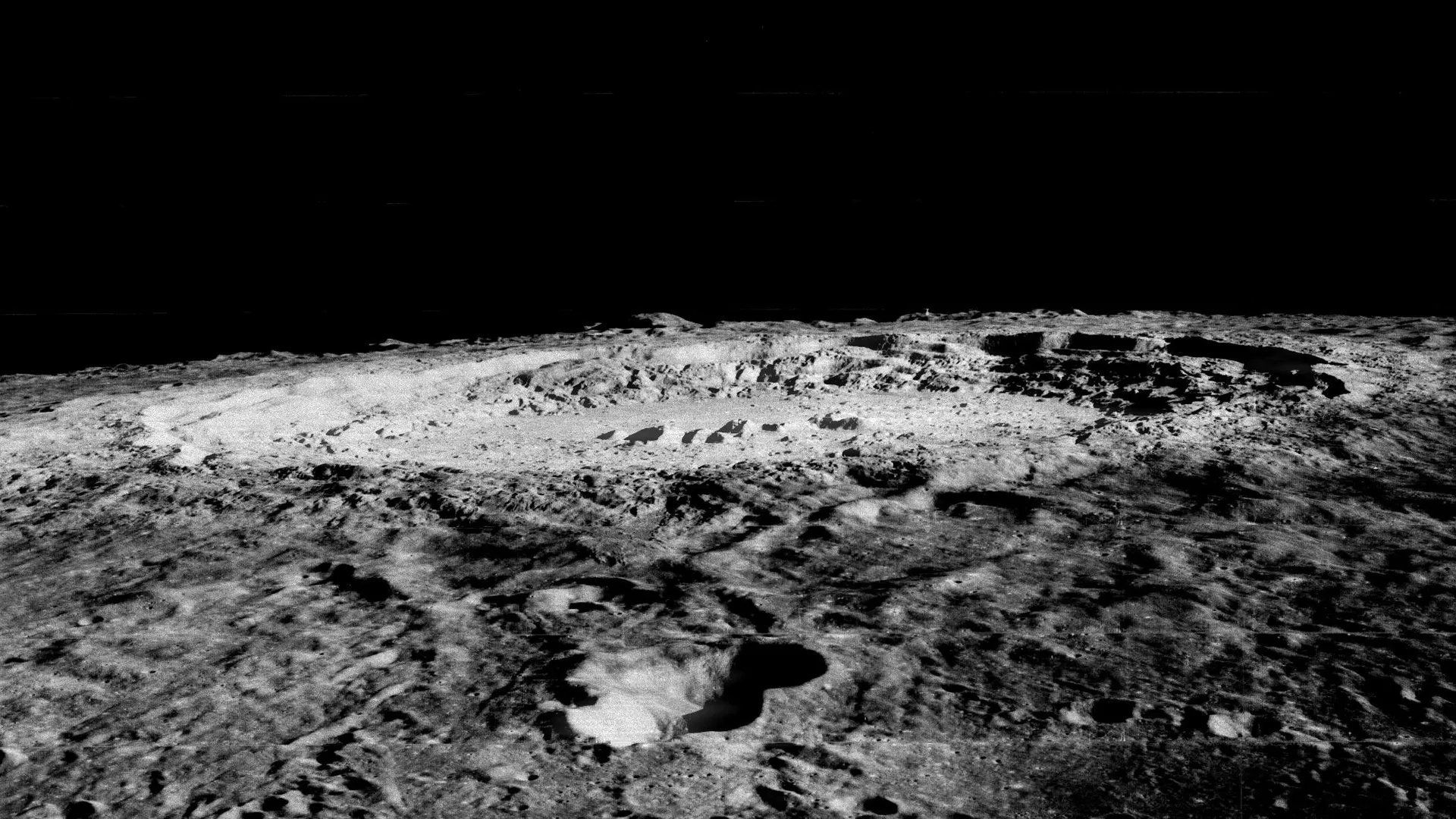
Part of the moon's surface is much older than experts previously thought, with many of the craters pockmarking the iconic "man in the moon" predating that landform by hundreds of millions of years, new research finds.
The moon itself is just over 4.5 billion years old. It formed when a huge asteroid or planetary body slammed into the young Earth, throwing chunks of rock and dust into orbit. However, determining the age of the lunar surface has been tricky, as various methods return different results.
One method, crater counting, involves simply tallying up the number of impacts on the lunar surface and estimating how long it would take to accrue all those scars; the moon lacks the erosion and plate tectonics that erase craters on Earth, so the surface stays relatively unchanged over millennia. But crater counting doesn't always correspond with the dating results that scientists get from directly studying the moon rocks returned by the crewed Apollo missions to the moon.
Now, researchers have painstakingly correlated the dating results from moon rock samples with the sites from which they were collected, effectively correcting the errors between the two methods.
A photo of the moon's Mare Imbrium taken from Apollo 17 in 1972. Left of center is the Pytheas crater. Near the top is the Copernicus crater.
(Image credit: NSSDC)
"What we have done is to show that large portions of the lunar crust are around 200 million years older than had been thought," study researcher Stephanie Werner, a geologist at the University of Oslo's Centre for Planetary Habitability, said in a statement. The research, which the authors presented this week at the Goldschmidt geochemistry conference in France, has been accepted for publication in The Planetary Science Journal.
The researchers examined samples returned from the lunar surface by the Apollo, Luna and Chang'e missions, and then tallied the craters around the sites where these rocks were originally found in order to properly correlate the ages. Then, they generalized that information across the lunar surface to get better age estimates of areas where the only information comes from crater count, not rock samples.
Sign up for the Live Science daily newsletter now
Get the world’s most fascinating discoveries delivered straight to your inbox.
One area that was older than expected was the Mare Imbrium. This crater, now filled with smooth lava flows, makes up the right eye of the "man in the moon." Instead of being 3.9 billion years old, this crater dates back 4.1 billion years, the researchers reported.
"This is an important difference," Werner said. "It allows us to push back in time an intense period of bombardment from space, which we now know took place before extensive volcanic activity that formed the 'Man in the Moon' patterns. … As this happened on the Moon, the Earth was almost certain to have also suffered this earlier bombardment too."
This research could help scientists pinpoint the geology that may have set the stage for the rise of life on Earth — and perhaps on Mars, Audrey Bouvier, an experimental planetologist at the University of Bayreuth in Germany, said in a statement.
"Such a heavy bombardment period must have affected the origin and early evolution of life on Earth and potentially other planets such as Mars," said Bouvier, who was not involved in the study. "Bringing back rock samples from Jezero Crater on Mars will be the next giant leap forward to search for signs of ancient life on another planet in the Solar System."
Stephanie Pappas is a contributing writer for Live Science, covering topics ranging from geoscience to archaeology to the human brain and behavior. She was previously a senior writer for Live Science but is now a freelancer based in Denver, Colorado, and regularly contributes to Scientific American and The Monitor, the monthly magazine of the American Psychological Association. Stephanie received a bachelor's degree in psychology from the University of South Carolina and a graduate certificate in science communication from the University of California, Santa Cruz.