Get the world’s most fascinating discoveries delivered straight to your inbox.
You are now subscribed
Your newsletter sign-up was successful
Want to add more newsletters?
Join the club
Get full access to premium articles, exclusive features and a growing list of member rewards.
An account already exists for this email address, please log in.
'Catastrophic' SpaceX Starship explosion tore a hole in the atmosphere last year in 1st-of-its-kind event, Russian scientists reveal
A new study from Russian scientists claims that the unexpected detonation of SpaceX's Starship rocket during a test flight in November 2023 tore an "ionospheric hole" in the upper atmosphere. It is the first time this type of hole has been created by a human-caused explosion.
Starship launched on its second test flight on Nov. 18, 2023. Around 8 minutes later, the rocket's second stage exploded in the upper atmosphere and briefly opened up an ionospheric hole.
(Image credit: TIMOTHY A. CLARY/AFP via Getty Images)
The high-altitude explosion of one of SpaceX's supersized Starship rockets last year temporarily ripped a hole in the upper atmosphere, a new study from Russian scientists shows. It is the first time this type of atmospheric disturbance has been created by a human-caused explosion, the researchers say.
On Nov. 18, 2023, SpaceX launched its superheavy Starship rocket — the largest and most powerful rocket ever built — for the second time ever from SpaceX's Starbase test and manufacturing facility in Boca Chica, Texas.
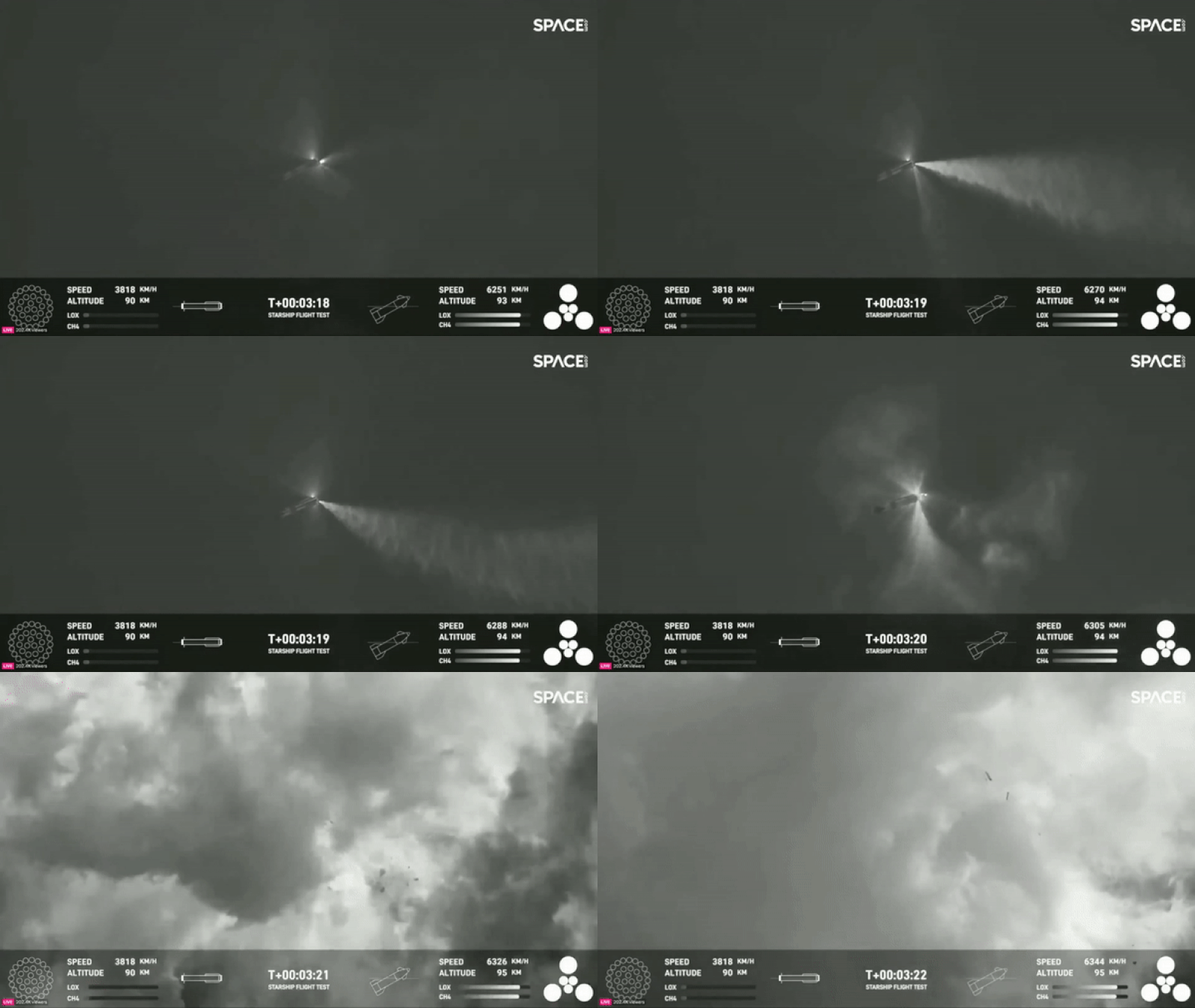
Around 4 minutes after liftoff, the rocket's first stage — the large, lower part that contains the main engines — detached from the upper part of the rocket as planned but unexpectedly exploded shortly afterward, before it could land back on Earth. Then, another 4 minutes later, the rest of the rocket blew up in a larger "rapid unscheduled disassembly" around 93 miles (150 kilometers) above the ground, when a fire started as the rocket vented liquid oxygen. The company's founder and CEO Elon Musk later said that the rocket would have made it to orbit if it had been carrying a proper payload.
In the new study, published Aug. 26 in the journal Geophysical Research Letters, researchers revealed that the second explosion temporarily created a large hole in the ionosphere — the part of the atmosphere between 50 and 400 miles (80 and 650 kilometers) above Earth's surface where gases have been ionized, or stripped of electrons, and turned into plasma.
"Usually, such holes are formed as a result of chemical processes in the ionosphere due to interaction with engine fuel," study lead author Yury Yasyukevich, an ionosphere physicist at the Russian Academy of Sciences' Institute of Solar-Terrestrial Physics (ISTP), said in a translated article from the Russian state media site TASS. This is the first known time that an ionospheric hole has been created by a "catastrophic phenomena" such as a human-made explosion, he added.
Multiple satellites and international ground-based stations observed the disturbance, which lasted for 30 to 40 minutes before the affected part of the ionosphere fully recovered, the researchers wrote. The peak size of the hole remains unclear.
Get the world’s most fascinating discoveries delivered straight to your inbox.
Video footage of the rocket's first stage unexpectedly exploding shortly after successfully separating from the second stage.
(Image credit: SpaceX/Space.com)
Human-caused ionospheric holes are nothing new. Scientists have long known that chemicals in rocket fuel, such as carbon dioxide and water vapor, can react with ionized oxygen atoms, causing them to temporarily recombine — or turn back into regular oxygen atoms — leaving a gap, or hole, in the plasma sea within the ionosphere.
SpaceX's Falcon 9 rockets are particularly prone to creating ionospheric holes, either during the separation of the rockets' first and second stages shortly after launch or when the rockets dump their fuel during reentry. When the atoms within these holes reionize and turn back into plasma, they release red aurora-like light, creating bright, blood-red light shows in the night sky that astronomers have dubbed SpaceX auroras.
But in this case, the ionospheric hole was created "due to the shock wave generated by the Starship explosion," which temporarily scattered the free electrons within the ionosphere, essentially stripping the plasma of its normal properties, the researchers wrote. Any of the rocket's fuel not immediately burned up in the explosion "might have reinforced the depletion and extended its duration," they added — but it was not the primary cause of the hole. As a result, there was no aurora-like light show once the plasma returned.
Starship rising above Boca Chica, TX shortly after launch on Nov. 18, 2023.
(Image credit: SpaceX)
The researchers said that the effects of ionospheric holes are poorly understood and require further research but added that novel ionospheric phenomena like this provide a rare chance to learn more about the plasma-filled region of our upper atmosphere.
"Analyzing the data and understanding their nature, we understand more deeply the structure of the ionosphere, [and] the nature of the phenomena that occur in it," Yasyukevich told TASS.
A similar ionospheric hole did not occur after the April explosion because the incident happened at a much lower altitude, meaning its shock waves did not reach the ionosphere, the researchers noted.
Harry is a U.K.-based senior staff writer at Live Science. He studied marine biology at the University of Exeter before training to become a journalist. He covers a wide range of topics including space exploration, planetary science, space weather, climate change, animal behavior and paleontology. His recent work on the solar maximum won "best space submission" at the 2024 Aerospace Media Awards and was shortlisted in the "top scoop" category at the NCTJ Awards for Excellence in 2023. He also writes Live Science's weekly Earth from space series.