













NASA satellite crash not source of mysterious flash of light above Ukraine capital, agency claims
A blinding flash of light set off air raid alerts across Ukraine’s capital city. Officials at first thought it was a falling NASA satellite, but the space agency has said it isn’t.

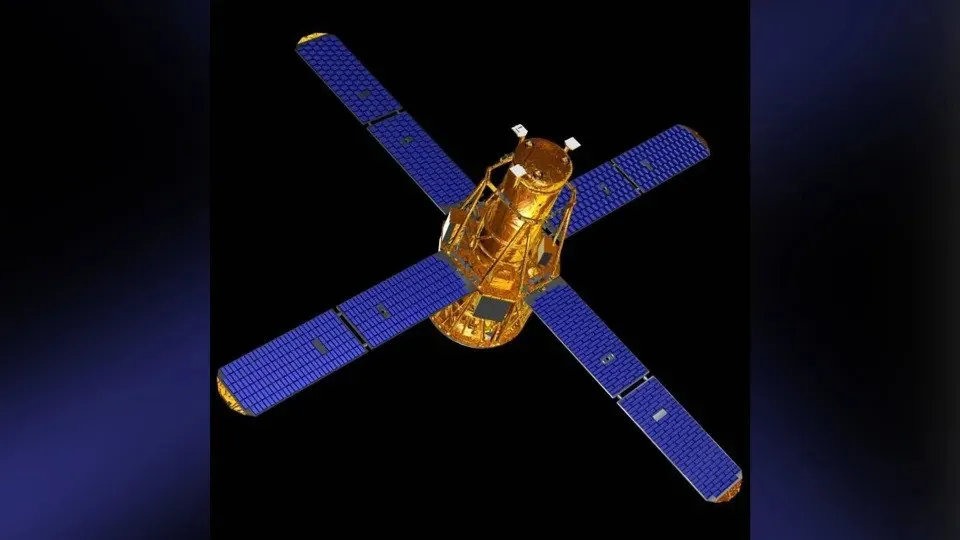
NASA has denied claims made by Kyiv’s city authorities that a mysterious, dazzling flash of light above Ukraine’s capital was caused by one of its defunct satellites tumbling to Earth.
The bright flash, which was seen over the city at around 10 p.m. local time (3 p.m. EDT), prompted the city’s authorities to turn on air raid alerts. Citing early data, Serhiy Popko, the head of the city’s military administration, said on Telegram that the "phenomenon was the result of a Nasa space satellite falling to Earth."
Some flash in Kyiv reported. Possible meteor or some space thing falling. Red Alert declared aftermath. pic.twitter.com/kHnJt9WNn4April 19, 2023
But NASA later refuted this, saying that at the time the flash occurred, its satellite — the dead, 660-pound (300 kilograms) Reuven Ramaty High Energy Solar Spectroscopic Imager (RHESSI) satellite — was still in orbit.
Related: US shoots down UFOs over Lake Huron and Canada
“One more time: the bright flash seen over Kyiv has NOTHING TO DO with the reentry of NASA's RHESSI satellite, whose orbit doesn't come within thousands of kilometers of Ukraine,” Jonathan McDowell, an astronomer at the Harvard Smithsonian Center for Astrophysics in Massachusetts, wrote on Twitter.
RELATED STORIES
NASA's most up-to-date prediction suggest the satellite hurtled through our atmosphere at 8:50 p.m. EDT on Wednesday, April 19 (12:50 a.m. UTC on Thursday, April 20), plus or minus 1 hour. The space agency hasn’t announced that the satellite has landed yet, or where. McDowell, who has been tracking the falling space junk, said that RHESSI’s possible debris field could fall over anywhere from southern South America, to northern Africa, Central Asia or China.
The mysterious flash above Kyiv has filled Ukrainian social media with popular memes and conspiracy theories — many speculating that aliens aboard UFOs were the cause of the light in the sky. It is not the first time mysterious objects have been seen over the country, but Ukraine’s space agency has said (in Ukrainian) that the flash was likely from a meteorite exploding into a fireball as it entered Earth’s atmosphere.
Get the world’s most fascinating discoveries delivered straight to your inbox.
RHESSI was launched into a low-Earth orbit by the Pegasus XL rocket in 2002. The satellite used a spectrometer that detected X-rays and gamma rays — high-energy waves from the sun that are largely blocked by Earth's atmosphere — to capture data on eruptions from the sun in the form of solar flares and coronal mass ejections (CMEs).
The satellite is just one of many potentially hazardous pieces of space junk that have made headlines after tumbling uncontrollably out of orbit. Four of China's Long March 5B boosters — the workhorses of the country's growing space program — fell to Earth between 2020 and 2022, raining debris down on the Ivory Coast, Borneo and the Indian Ocean. In 2021 and 2022, debris from falling SpaceX rockets smashed into a farm in Washington state and landed on a sheep farm in Australia.
Space agencies around the world try to keep tabs on the more than 30,000 largest pieces of this junk, but many more pieces of debris are simply too small to monitor.

Ben Turner is a U.K. based writer and editor at Live Science. He covers physics and astronomy, tech and climate change. He graduated from University College London with a degree in particle physics before training as a journalist. When he's not writing, Ben enjoys reading literature, playing the guitar and embarrassing himself with chess.