Get the world’s most fascinating discoveries delivered straight to your inbox.
You are now subscribed
Your newsletter sign-up was successful
Want to add more newsletters?
Join the club
Get full access to premium articles, exclusive features and a growing list of member rewards.
An account already exists for this email address, please log in.
This impossibly massive black hole wasn't very hungry during the dawn of time
Using the James Webb Space Telescope, astronomers have discovered an improbably huge black hole near the dawn of time, which doesn't seem to be eating near as much as it should.
Using the James Webb Space Telescope (JWST), astronomers have spotted a supermassive black hole at "cosmic dawn" that seems to be impossibly massive. The confusion comes from the fact that it doesn't seem like this giant void was feasting on much surrounding matter during that time — but, in order to reach its immense size, one would expect it to have been ravenous when time began.
The feeding supermassive black hole, which powers a quasar at the heart of the galaxy J1120+0641, was seen as it was when the universe was just around 5% of its current age. It also has a mass that is over a billion times that of the sun.
While it is relatively easy to explain how closer, and thus more recent, supermassive black holes have grown to have billions of solar masses, the merger and feeding processes that facilitate such growth are expected to take something like a billion years. That means finding such supermassive black holes existing before the 13.8 billion-year-old universe was a billion years old is a real dilemma.
Since it began operations in the summer of 2022, the JWST has proved particularly efficient at spotting such challenging black holes at cosmic dawn.
One theory surrounding the early growth of these voids is that they were engaged in a feeding frenzy called an "ultra-effective feeding mode." However, the JWST's observations of the supermassive black hole in J1120+0641 showed no particularly efficient feeding mechanism in the material in close vicinity to it. This finding casts doubt on the ultrafast feeding supermassive black hole growth mechanism and means scientists may know even less about the early evolution of the cosmos than they realized.
"Overall, the new observations only add to the mystery: Early quasars were shockingly normal," team leader and Max Planck Institute for Astronomy (MPIA) post-doctoral researcher Sarah Bosman said in a statement. "No matter in which wavelengths we observe them, quasars are nearly identical at all epochs of the universe."
Sign up for the Live Science daily newsletter now
Get the world’s most fascinating discoveries delivered straight to your inbox.
A timeline of the universe. Finding supermassive black holes billions of years after the Big Bang is expected, but discovering them around the time the first stars formed is more surprising.
Around 20 years ago, before the JWST and other telescopes began finding troubling supermassive black holes in the early universe, astronomers had assumed that the supermassive black holes at the hearts of galaxies grew gradually in lockstep with the processes that led to galactic growth.
In fact, there are limits to how fast a black hole can grow — limits these cosmic titans actually help set themselves.
Because of the conservation of angular momentum, matter can't fall directly into a black hole. Instead, a flattened cloud of matter called an accretion disk is formed around the black hole. Further, the immense gravity of the central black hole gives rise to powerful tidal forces that create turbulent conditions in the accretion disk, heating it and causing it to emit light across the electromagnetic spectrum. These emissions are so bright they often outshine the combined light of every star in the surrounding galaxy. The regions in which all this happens are called quasars, and they represent some of the brightest celestial objects.
This brightness has another function, too. Despite not having mass, light does exert pressure. That means that the light emitted by quasars pushes on surrounding matter. The faster the black hole powering the quasar feeds, the greater the radiation pressure and the more likely the black hole is to cut off its own food supply and stop growing. The point at which black holes, or any other accretor, starve themselves by pushing away surrounding matter is known as the "Eddington limit."
That means supermassive black holes can't just feed and grow as fast as they like. Thus, finding supermassive black holes with masses as great as 10 billion suns in the early cosmos, especially less than a billion years after the Big Bang, is a real problem.
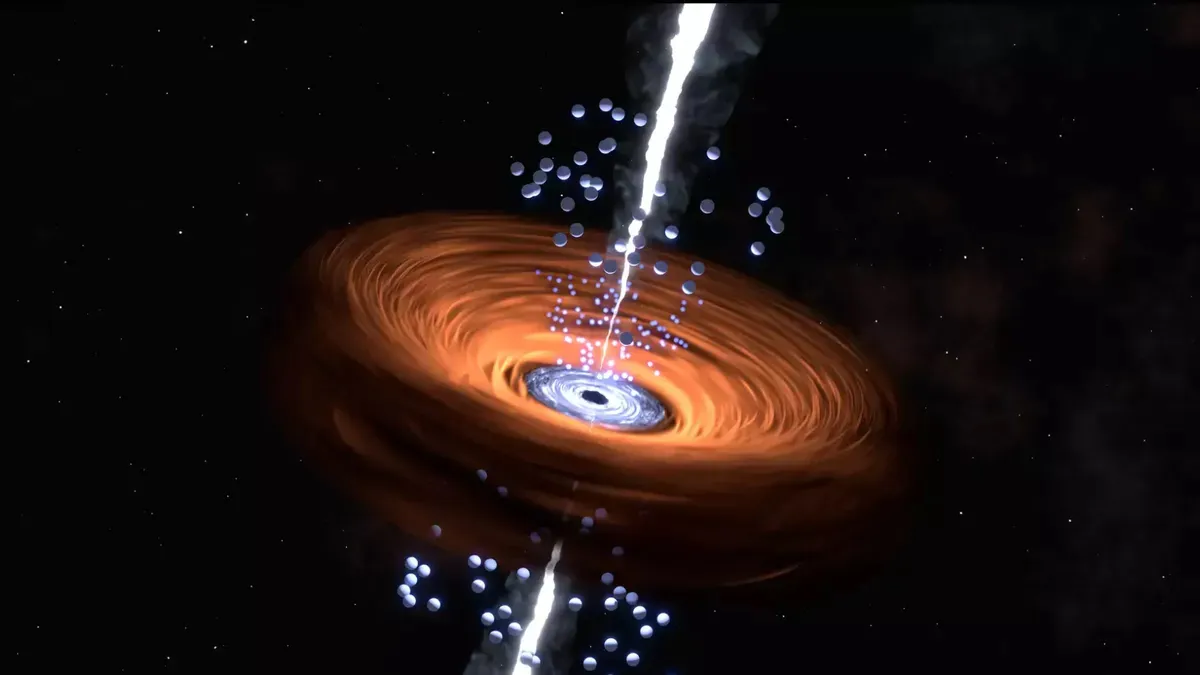
An illustration shows a feeding supermassive black hole. How did early examples of these objects get so big so soon after the Big Bang?
(Image credit: NRAO/AUI/NSF, S. Dagnello)
Astronomers need to know more about early quasars to determine whether early supermassive black holes were able to overcome the Eddington limit and become so-called "super-Eddington accretors."
To do this, in January 2023, the team focused the JWST's Mid-Infrared Instrument (MIRI) on the quasar at the heart of J1120+0641, located 13 billion light-years away and seen as it was just 770 million years after the Big Bang. The investigation constitutes the first mid-infrared study of a quasar that existed at cosmic dawn.
The spectrum of light from this early supermassive black hole revealed the properties of the large, ring-shaped "torus" of gas and dust that circles the accretion disk. This torus helps guide matter to the accretion disk, from where it is gradually fed to the supermassive black hole.
MIRI observations of this quasar showed that the cosmic supply chain functions similarly to that of "modern" quasars closer to Earth that therefore exist in later epochs of the universe. That's bad news for proponents of the theory that an enhanced feeding mechanism led to the quick growth of early black holes.
Additionally, measurements of the region around the supermassive black hole, where matter swirls at almost the speed of light, conformed with observations of the same regions of modern quasars.
The JWST observations of this quasar did reveal one major difference between it and its modern counterparts. The dust in the torus around the accretion disk had a temperature of around 2,060 degrees Fahrenheit (1,130 degrees Celsius), which is around 100 degrees hotter than the dust rings around supermassive black hole-powered quasars seen closer to Earth.
The research favors another method of early supermassive black hole growth that suggests these cosmic titans got a head start in the early universe, forming from black hole "seeds" that were already massive These heavy seeds would have had masses at least a hundred thousand times that of the sun, forming directly via the collapse of early and massive clouds of gas.
The team's research was published on June 17 in the journal Nature Astronomy.
Robert Lea is a science journalist in the U.K. who specializes in science, space, physics, astronomy, astrophysics, cosmology, quantum mechanics and technology. Rob's articles have been published in Physics World, New Scientist, Astronomy Magazine, All About Space and ZME Science. He also writes about science communication for Elsevier and the European Journal of Physics. Rob holds a bachelor of science degree in physics and astronomy from the U.K.’s Open University