Get the world’s most fascinating discoveries delivered straight to your inbox.
You are now subscribed
Your newsletter sign-up was successful
Want to add more newsletters?
Join the club
Get full access to premium articles, exclusive features and a growing list of member rewards.
An account already exists for this email address, please log in.
James Webb telescope measures the starlight around the universe's biggest, oldest black holes for 1st time ever
Astronomers using the James Webb Space Telescope have separated the light of a quasar from the light of its surrounding stars, offering unprecedented insight into how the universe's oldest black holes grew.
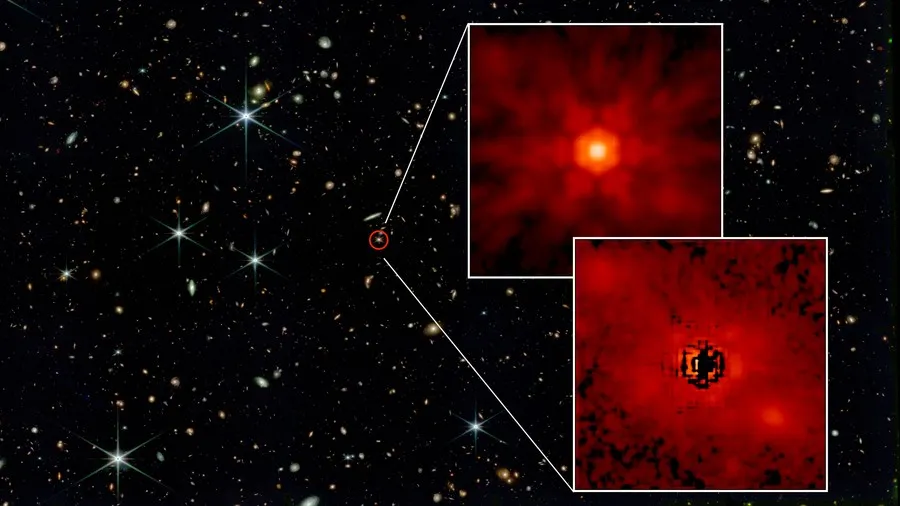
A James Webb Telescope image shows the J0148 quasar circled in red. Two insets show, on top, the central black hole, and on bottom, the stellar emission from the host galaxy.
Using the James Webb Space Telescope (JWST), astronomers have gotten the first-ever look at the light of ancient stars shining around some of the biggest, brightest and oldest black holes in the universe.
Quasars — galactic cores containing active supermassive black holes — are among the most ancient things in the universe. As dust and gas accelerate toward the quasar's central black hole, the quasar emits such bright radiation — typically a thousand times brighter than the entire Milky Way — that astronomers have a hard time observing the fainter light of stars in the quasar's galaxy. This makes it challenging to study the galaxy's shape and mass.
But for the first time, researchers at MIT have managed to unpick this mixture of signals and detect the faint stellar light from stars in galaxies around some of the oldest quasars in the universe. Their results, published May 6 in The Astrophysical Journal, reveal that, relative to their host galaxies, these ancient supermassive black holes are around 100 times bigger than their counterparts in the nearby universe.
These results were possible thanks to JWST's superior sharpness and resolution. Over 120 hours of telescope time, the team observed six quasars, all estimated to be around 13 billion years old — some of the oldest objects in the universe.
"The quasar outshines its host galaxy by orders of magnitude," lead study author Minghao Yue, a postdoctoral scholar at MIT, said in a statement. "And previous images were not sharp enough to distinguish what the host galaxy with all its stars looks like."
Using the improved data from JWST, the team managed to untangle the signals in these ancient galaxies by modeling which light appeared to be coming from a point source (the quasar), and which light seemed to be originating from a more diffuse source (the surrounding stars). With the relative brightnesses in hand, the team then estimated the masses of each quasar and its host galaxy.
Sign up for the Live Science daily newsletter now
Get the world’s most fascinating discoveries delivered straight to your inbox.
An illustration of a quasar emitting exceptionally bright light as matter falls into its maw.
(Image credit: NASA/JPL-Caltech)
They calculated that the average mass ratio of quasar to galaxy was 1:10, compared with 1:1,000 for younger supermassive black holes in the nearby universe. But the explanation for why these ancient black holes are so massive isn't immediately apparent.
A standard black hole forms when a star runs out of fuel and undergoes gravitational collapse, triggering a supernova. The resulting black hole then gradually consumes material throughout its lifetime, growing over time.
"These black holes are billions of times more massive than the sun, at a time when the universe is still in its infancy," study co-author Anna-Christina Eilers, an assistant professor of physics at MIT, said in the statement. "Black holes in the early universe seem to be growing faster than their host galaxies."
According to the standard pathway for black hole formation, these black holes simply shouldn't have had enough time to get as big as they are, raising the possibility of alternative formation methods.
One proposed mechanism is "direct collapse." In this model, instead of a star collapsing to generate a black hole, a giant cloud of dust and gas collapses, bypassing the star stage completely. In theory, this could generate much larger black holes — known as direct-collapse black holes — giving them an evolutionary head start to become supermassive earlier than conventionally possible. Although it's still a theory, in 2023 astronomers announced the first candidate for a galaxy containing a direct-collapse black hole.
Although the origins of these unexpectedly large black holes is still unknown, this work gives scientists insight into the development of these galaxies and quasars in the early universe.