













'Like nothing we've seen before': James Webb telescope spies a mysterious asteroid-comet hybrid lurking past Jupiter
The James Webb telescope has focused its attention on an oddball space rock lurking between Jupiter and Neptune. The unusual "centaur," named 2060 Chiron, has features of both comets and asteroids.

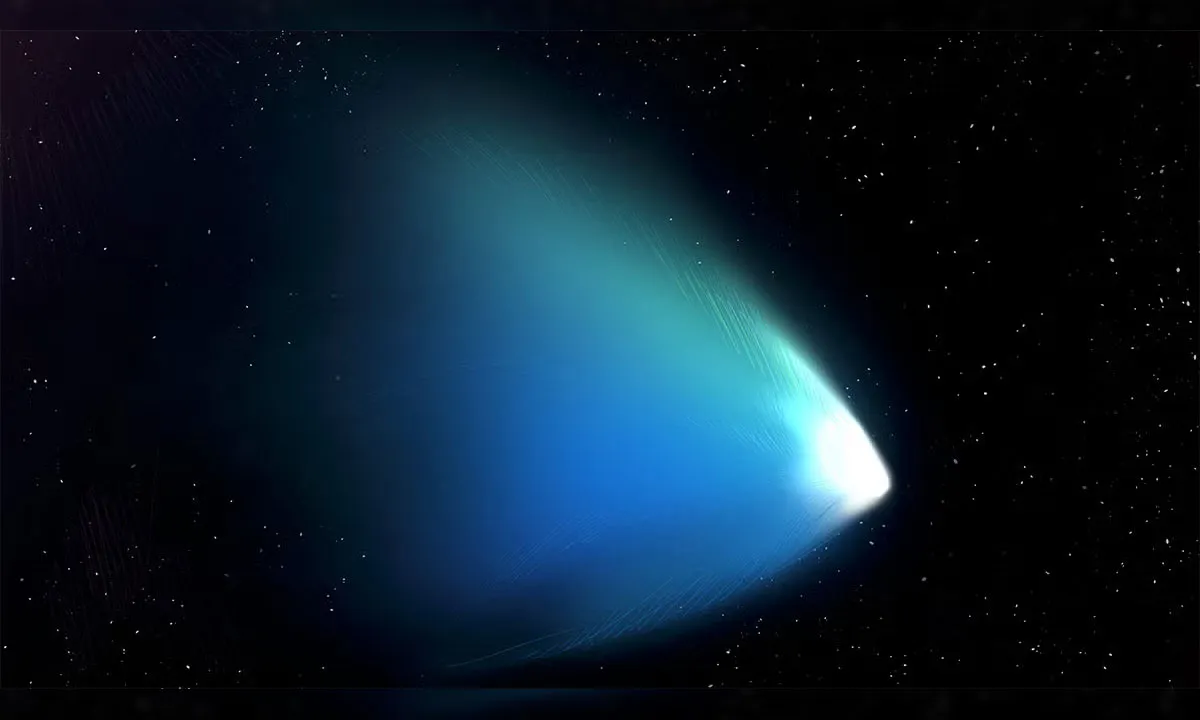
New James Webb Space Telescope (JWST) findings are giving scientists a fresh look at an "oddball" space rock that has features similar to both comets and asteroids.
Astronomers observing the hybrid, known as (2060) Chiron, detected frozen carbon dioxide and carbon monoxide in its icy nucleus, as well as carbon dioxide and methane in the surrounding gas cloud. The findings could help scientists better understand comets and centaurs — so named because they have properties of both asteroids and comets — and could offer a peek at the conditions in the early solar system.
Discovered in 1977, Chiron orbits the sun about once every 50 years, traveling in an oblong loop in the region between Jupiter and Neptune. In the new study, published Dec. 18 in the journal Astronomy and Astrophysics, researchers described their observation of the centaur on July 12, 2023 at a range of more than 18 times the distance from Earth to the sun.
Related: Comets played a 'major' role in making life on Earth possible, new study hints
The team found carbon dioxide and methane gases in Chiron's coma, the cloud of gas and dust around the nucleus. Though previous studies had detected carbon monoxide gas in the coma as well, the new JWST observations found carbon monoxide only in its frozen form on Chiron's surface. The finding suggests a complex scenario of gas emissions from different reservoirs on Chiron, the researchers wrote in the study. In general, carbon monoxide is more volatile, and therefore more likely than CO2 to sublimate, or transform directly from a solid on the surface to a gas released in the coma.
Detecting gas in our solar system
"These results are like nothing we've seen before," study co-author Charles Schambeau, a planetary scientist at the University of Central Florida (UCF), said in a statement. "Detecting gas comae around objects as far away from the sun as Chiron is very challenging, but JWST has made it accessible. These detections enhance our understanding of Chiron's interior composition and how that material produces the unique behaviors as we observe Chiron."
RELATED STORIES
Astronomers also detected water ice and lightweight carbon-containing molecules like ethane and propane for the first time on a centaur. Chiron could have picked up simpler molecules like carbon dioxide and water left by the nebula that formed our solar system, study co-author Noemi Pinilla-Alonso, a planetary scientist at UCF and the University of Oviedo in Spain, said in the statement. Objects like Chiron haven’t changed much since the solar system first formed, she said, so observing how they interact on Chiron could help scientists better understand the early solar system. Molecules like ethane and propane, meanwhile, likely formed when light hit the surface and reacted with the methane and water ice there.
Get the world’s most fascinating discoveries delivered straight to your inbox.
However, fully understanding the compositions of the nucleus and coma, and how they change during Chiron's orbit, will require additional data.
"We're going to follow up with Chiron," Pinilla-Alonso said in the statement. "It will come closer to us, and if we can study it at nearer distances and get better reads on the quantities and nature of the ices, silicates, and organics, we will be able to better understand how seasonal insolation variations and different illumination patterns can affect its behavior and its ice reservoir."

Skyler Ware is a freelance science journalist covering chemistry, biology, paleontology and Earth science. She was a 2023 AAAS Mass Media Science and Engineering Fellow at Science News. Her work has also appeared in Science News Explores, ZME Science and Chembites, among others. Skyler has a Ph.D. in chemistry from Caltech.