













Roe v. Wade overturned by Supreme Court
States can now set their own abortion laws.

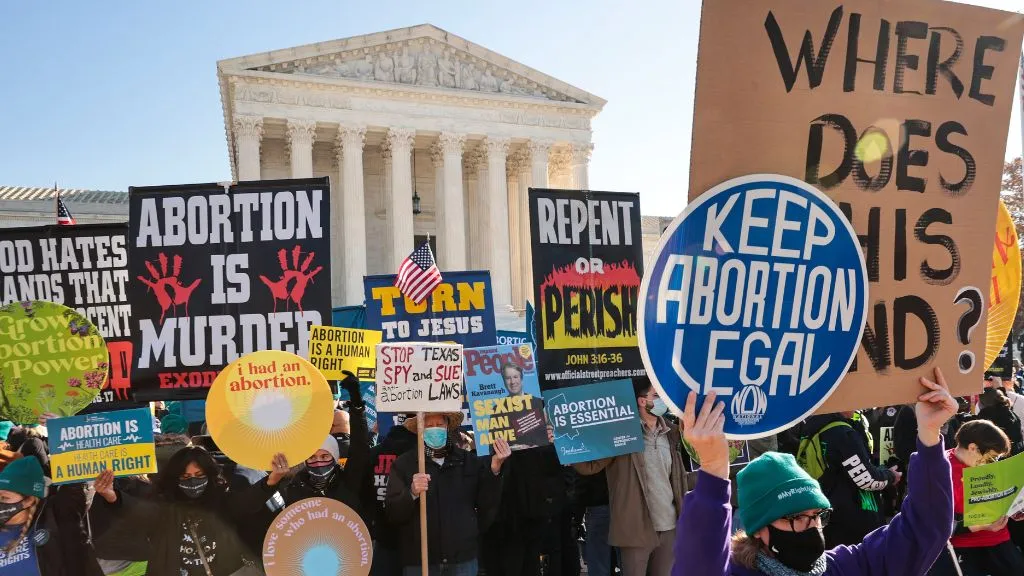
The U.S. Supreme Court has overturned Roe v. Wade in a ruling released Friday (June 24). In doing so, the justices eliminated the constitutional right to abortion that was established by the 1973 court case and later affirmed by a 1992 case called Planned Parenthood of Southeastern Pennsylvania v. Casey.
The newly decided case concerned a Mississippi law called the "Gestational Age Act" that was enacted in 2018, which banned nearly all abortions where the "probable gestational age of the unborn human" was determined to be 15 weeks or more, The New York Times reported. The Mississippi law allowed abortions beyond that point "only in medical emergencies or for severe fetal abnormality," and it offered no exception in cases of rape or incest, according to CNN.
After the law was signed in 2018, an abortion clinic called Jackson Women’s Health Organization — Mississippi's only licensed abortion clinic — swiftly sued, arguing that the law was unconstitutional under Roe and Casey. Those rulings had established that states cannot ban abortions prior to fetal viability — the point at which a fetus can survive outside the womb, which is roughly 23 to 24 weeks into pregnancy, CNN reported.
On this basis, a federal district court judge blocked the Gestational Age Act from being enforced in 2018, and the U.S. Court of Appeals for the Fifth Circuit affirmed his ruling in 2019. Mississippi then appealed the decision to the Supreme Court, launching the case known as Dobbs v. Jackson Women’s Health Organization, No. 19-1392, which was decided on Friday, according to the Times. ("Dobbs" refers to Thomas E. Dobbs, the state health officer of the Mississippi Department of Health.)
Related: Roe v. Wade FAQ: What if abortion rights law gets overturned?
Friday's decision closely resembles a leaked draft opinion first published by Politico in May, in which Justice Samuel Alito wrote that "Roe was egregiously wrong from the start" and should be overruled.
In the newly released opinion, Alito and the other five Republican-appointed justices voted in the majority (6-3) to uphold Mississippi's Gestational Age Act as constitutional, and five of the justices (5-3-1) argued that Roe and Casey should also be overturned. Although he voted with the majority, Chief Justice John G. Roberts Jr. wrote his own opinion, arguing that the Mississippi law could be upheld without the need to overturn Roe altogether, The Washington Times reported.
Get the world’s most fascinating discoveries delivered straight to your inbox.
The three Democrat-appointed justices — Justices Stephen Breyer, Sonia Sotomayor and Elena Kagan — wrote a joint dissenting opinion. "With sorrow — for this Court, but more, for the many millions of American women who have today lost a fundamental constitutional protection — we dissent," they wrote in their concluding paragraph.
The editors of the New England Journal of Medicine promptly condemned the court's decision in an NEJM article published the same day.
With the court's ruling, states can now set their own abortion laws. Thirteen states already have "trigger laws" on the books, which are abortion bans designed to take effect automatically or by quick state action if Roe no longer applies, according to the Guttmacher Institute, a nonprofit organization for sexual and reproductive health research and advocacy. Nine other states have pre-Roe bans on abortion, which are laws that ban abortion after six weeks — before many people know they are pregnant — and/or constitutional amendments that specifically bar the right to abortion.
RELATED STORIES
In all, 26 U.S. states are certain or likely to ban abortion now that Roe is overturned, according to the Guttmacher Institute.
President Joe Biden's administration has been preparing to respond to this anticipated ruling from the Supreme Court, according to CNN. Biden is considering a number of strategies to bolster abortion access in the wake of the ruling, including declaring a public health emergency through the Department of Health and Human Services, and using executive actions and Food and Drug Adminstration regulations to expand access to medication abortion — or pills designed to end a pregnancy in its early stages.
However, there's little Biden can do through executive action to fundamentally restore the federal right to abortion, CNN reported.
Originally published on Live Science.

Nicoletta Lanese is the health channel editor at Live Science and was previously a news editor and staff writer at the site. She is a recipient of the 2026 AHCJ International Health Study Fellowship, with a project focused on antibiotic stewardship practices in Japan and the U.S. They hold a graduate certificate in science communication from UC Santa Cruz and degrees in neuroscience and dance from the University of Florida. Beyond Live Science, Lanese's work has appeared in The Scientist, Science News, the Mercury News, Mongabay and Stanford Medicine Magazine, among other outlets. Based in NYC, she also remains involved in dance and performs in local choreographers' work.