













Warm ocean water is rushing beneath Antarctica's 'Doomsday Glacier,' making its collapse more likely
Warm seawater flowing into the glacier's underside could significantly accelerate the process of its collapse.

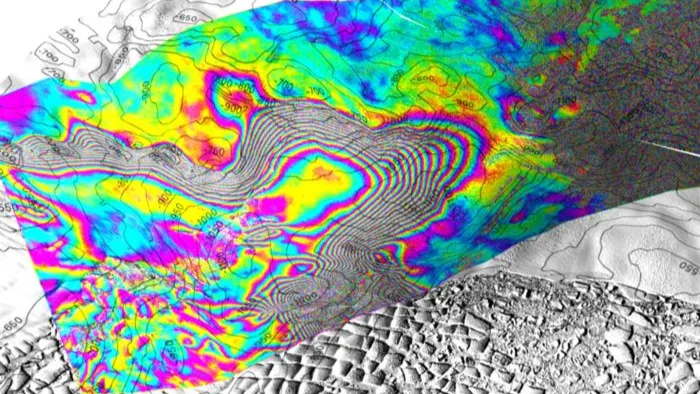
Antarctica's "Doomsday Glacier" is melting significantly faster than scientists previously thought, thanks to warm ocean water that is infiltrating miles beneath its surface, a new study has found.
The Thwaites Glacier, which is nicknamed the Doomsday Glacier because of its potential to massively increase sea levels, is located in West Antarctica and is roughly the size of Florida.
Previous research found that the glacier has been melting rapidly since the 1980s — contributing to a 4% rise in global sea levels with the loss of hundreds of billions of tons of ice. If the glacier completely melted, it could raise sea levels by as much as 2 feet (60 centimeters).
However, Thwaites Glacier also impacts sea levels because it acts as a natural dam preventing the surrounding ice of West Antarctica from sliding into the ocean. If the glacier were to collapse completely, sea levels could rise by up to 10 feet (3 meters).
Yet scientists have struggled to quantify the exact rate of the glacier's melting, in part because of the challenges of peering beneath its thick ice.
Now, new radar data has revealed that warm, high-pressure seawater has filtered through to the base of the vulnerable glacier. This means that Thwaites' risk of melting could be more severe than first thought. The researchers published their findings Monday (May 20) in the journal PNAS.
Related: Antarctica's 'Doomsday Glacier' is hemorrhaging ice faster than in the past 5,500 years
Get the world’s most fascinating discoveries delivered straight to your inbox.
"The worry is that we are underestimating the speed that the glacier is changing, which would be devastating for coastal communities around the world," study co-author Christine Dow, a professor of glaciology at the University of Waterloo, Ontario, said in a statement.
To find out what's going on beneath Thwaites' surface, the researchers created a high-resolution X-ray scan of the glacier using satellite radar data collected between March and June 2023. The data showed that the glacier's surface rises and falls by several centimeters as seawater flows in and out below.
RELATED STORIES
The picture they produced revealed that, as the daily tides ebb and flow from the glacier, warm seawater is sent deep inside the glacier for many miles. These inflows act to progressively melt Thwaites from the underside, producing fresh water that is washed out into the ocean as the tide retreats.
The researchers say this "vigorous melting" could contribute to significant sea level rise, as well as push the glacier further toward collapse. But quantifying the levels of these rises, and how close the point of no return is, requires more research.
"At the moment we don't have enough information to say one way or the other how much time there is before the ocean water intrusion is irreversible," Dow said. "By improving the models and focusing our research on these critical glaciers, we will try to get these numbers at least pinned down for decades versus centuries."

Ben Turner is a U.K. based writer and editor at Live Science. He covers physics and astronomy, tech and climate change. He graduated from University College London with a degree in particle physics before training as a journalist. When he's not writing, Ben enjoys reading literature, playing the guitar and embarrassing himself with chess.