














Base of Ocean Food Chain Is in Decline, Study Finds

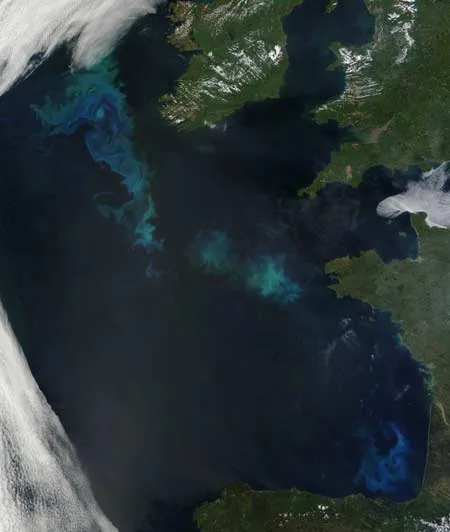
Across the globe, the microscopic plants at the base of the oceans' food chain have been disappearing over the past century at a rate of about 1 percent per year, researchers have found.
The decline of these tiny plants, called phytoplankton, has large significance because they produce half the organic matter on the planet and play an important role in Earth's carbon cycle.
"They support everything, including us," said Daniel Boyce, a doctoral student in marine biology at Canada's Dalhousie University and a member of the team that studied phytoplankton levels. "It seems the oceans are being stressed, and global climate change seems to be at the center of this shift."
The study documented a connection between rising sea surface temperatures and declines in phytoplankton, a phenomenon that was already well known, said study team member Boris Worm, a marine biologist at Dalhousie University in Halifax, Nova Scotia.
"What is new here is we are showing as temperature has increased over the last century, so have phytoplankton declined," he told OurAmazingPlanet. "The global link hasn't been defined before."
While previous research relied on satellite data, which present only a limited record, the Dalhousie researchers were able to look back as far as 1899 by using measurements of ocean transparency – an indicator of phytoplankton abundance – and direct measurements of chlorophyll pigment concentration. (Chlorophyll is a pigment in plants that absorbs light and gives them their green color.)
The researchers found that the strongest single predictor for phytoplankton levels was ocean surface temperature. The connection is actually indirect, according to Worm, because rising surface temperatures prevent mixing between the oceans' oxygen-rich upper layers, where phytoplankton are present, and the colder, more nutrient-rich waters below.
Get the world’s most fascinating discoveries delivered straight to your inbox.
The study, detailed in the July 29 issue of the journal Nature, found that rising surface temperatures were associated with declining phytoplankton in eight of 10 regions. Of the other two regions, the North Indian Ocean had a stable phytoplankton population and the South Indian Ocean showed growth.
The decline in phytoplankton seen around the poles, where it seems logical that increasing warmth would drive more growth, could be driven by increasing winds and ocean mixing, the researcher said.
Local factors such as polar melting and nutrient-rich runoff from agriculture also can influence the phytoplankton, Worm said.
"But all of these effects are unlikely to play out evenly on a global scale," he said. "The only driver we have that affects phytoplankton everywhere is ocean warming."
- The World's Biggest Oceans and Seas
- Marine Biodiversity Threatened, Study Finds
- Ocean Ecosystems Transforming Due to Climate Change
This article was provided by OurAmazingPlanet, sister site to LiveScience.
