















The oldest, brightest black holes in the universe were born from violent gas attacks, new study suggests
Some supermassive quasars formed within the first billion years after the Big Bang. Now, scientists know why.

Twinkling like cosmic lighthouses on a shore 13 billion light-years from Earth, quasars are some of the oldest, brightest relics of the early universe that astronomers can detect today.
Short for "quasi-stellar radio sources," quasars are gargantuan black holes that glow as brightly as galaxies and are millions to billions of times as massive as Earth's sun. Today, quasars exist at the centers of many large galaxies. But thanks to their exceptional luminosity, quasars have been tracked far across space-time, with roughly 200 of them identified as forming within the first billion years of our universe's history.
How could such massive objects form so early, when galaxies were sparse and large stars were exceptionally rare? The question has bedeviled researchers for more than two decades, since the first quasars were identified — and now, a new study published July 6 in the journal Nature, may provide a long-sought answer.
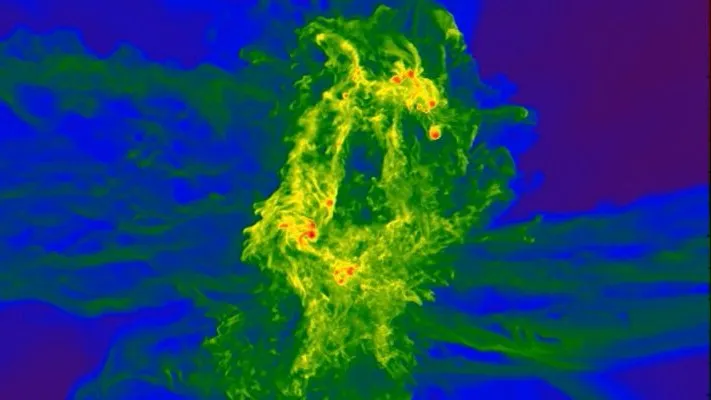
Using a computer simulation, researchers modeled star formation in the early universe, focusing on one of the rare junctures where two streams of cold, turbulent gas met. While streams of star-forming gas crisscross the universe like cosmic interstates today, the natural "clouds" or reservoirs where two streams met were exceedingly rare within the first billion years after the Big Bang, making them tempting but elusive areas of study.
In the simulation, two large "clumps" of star-forming gas amassed at the center of these streams over the course of millions of years. But, to the team's surprise, these clumps never coalesced into normal-size stars as previous models of the early universe predicted.
"The cold streams drove turbulence in the [gas] cloud that prevented normal stars from forming until the cloud became so massive it collapsed catastrophically under its own weight, forming two gigantic primordial stars," study co-author Daniel Whalen, a senior lecturer in cosmology at the University of Portsmouth in England, said in a statement. "One [star] was 30,000 solar masses and another was 40,000."
Previous studies estimated that a quasar must measure anywhere from 10,000 to 100,000 solar masses at its birth. If that's the case, both of the gargantuan primordial stars from the new simulation could be viable "seeds" for the universe's first quasars, the study authors wrote.
Get the world’s most fascinating discoveries delivered straight to your inbox.
In fact, it's feasible that both large stars could have collapsed into black holes almost instantly and then continued to gobble up gas as they grew into supermassive quasars like the ones scientists have detected in the early universe. As the monster black holes continue to grow, they could even merge, releasing a torrent of space-time ripples known as gravitational waves, the researchers wrote. It's possible that scientists could even detect these waves using special observatories in the coming decades, potentially confirming the results of the simulation.
Related stories
If confirmed, this research would overturn decades of thought on the formation of stars in the early universe. Prior studies suggested that large primordial stars could form only in extreme environments where external forces, like strong ultraviolet radiation, could prevent smaller stars from forming. This new simulation shows, however, that such exotic environments may not be necessary. The seeds of quasars could come about naturally where rare streams of cold gas meet.
"The first supermassive black holes were simply a natural consequence of structure formation in [the early universe] — children of the cosmic web," Whalen said.
Originally published on Live Science.

Brandon is the space / physics editor at Live Science. With more than 20 years of editorial experience, his writing has appeared in The Washington Post, Reader's Digest, CBS.com, the Richard Dawkins Foundation website and other outlets. He holds a bachelor's degree in creative writing from the University of Arizona, with minors in journalism and media arts. His interests include black holes, asteroids and comets, and the search for extraterrestrial life.