In the game of chess, a rook can move as many spaces as it can in one direction. Or, it can sit stone-still and guard the pieces around it, potentially holding its ground for an entire match — or thousands of years (whichever comes first).
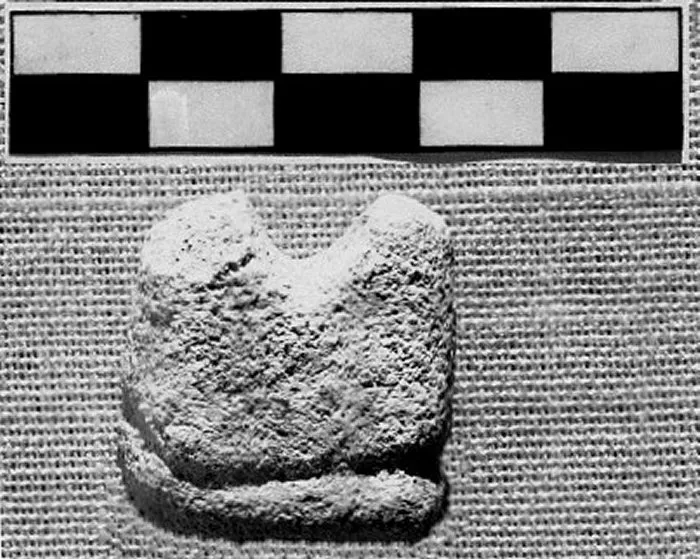
John Oleson, an archaeologist at the University of Victoria in British Columbia, Canada, believes he and his colleagues may have found one such rook that has been lying in the sand below an ancient trading post in Jordan since the seventh century. The stout sandstone figure, excavated from the ruins of an early Islamic settlement in 1991, has a rectangular body with two horn-like protrusions on top. While this may look far from the crenellated castle towers we call rooks today, it's spot-on for rooks in the earliest known chess sets, where those swift-moving pieces were shaped to evoke horse-drawn chariots. (The word "rook" comes from "rukh," the Persian word for chariot.)
If the tiny sandstone figure Oleson excavated is indeed a rook, it may be the single oldest chess piece ever discovered, dating to roughly 1,300 years ago.
"There are references to chess-playing in Islamic texts as early as A.D. 643, and the game was popular throughout the Islamic world," Oleson wrote in an abstract for a presentation on the piece. "Since the game probably was carried westward from India by the movement of merchants and diplomats, it is no surprise that early evidence for it should be found at a site" on a busy trade route like this one, he added in the presentation, which he delivered at the American Schools of Oriental Research 2019 meeting in San Diego last week.
Chess is believed to have originated in India about 1,500 years ago before quickly spreading westward and beyond. Oleson and his colleagues discovered the "rook" while excavating an ancient site called Humayma, which sits along a once-prominent trading route in southern Jordan that linked India to the Near East and Middle East. Humayma thrived over hundreds of years and in the shadows of many cultures; structures at the site include a Roman fort, Byzantine churches, early Islamic mosques and several stone tombs dating to as early as the first century.
It was in the early Islamic ruins, dating to the seventh century, where the researchers uncovered the rook.
Sign up for the Live Science daily newsletter now
Get the world’s most fascinating discoveries delivered straight to your inbox.
At that time, Oleson wrote, Humayma was home to the wealthy and powerful Abbasid family, who would eventually overthrow the leaders of the region and declare themselves caliphs (Islamic rulers considered successors to the prophet Muhammed). The family kept abreast of trends in Syria and Iraq, Oleson said, and it's plausible that they may have been early adopters of chess soon after it spread into those nearby nations.
While it's impossible to say for sure that the little, twin-horned figure is a rook, Oleson says it's the likeliest explanation, given the context of where it was excavated. The archaeologists will continue exploring Humayma for other related artifacts while keeping their expectations (wait for it) in check.
Brandon is the space / physics editor at Live Science. With more than 20 years of editorial experience, his writing has appeared in The Washington Post, Reader's Digest, CBS.com, the Richard Dawkins Foundation website and other outlets. He holds a bachelor's degree in creative writing from the University of Arizona, with minors in journalism and media arts. His interests include black holes, asteroids and comets, and the search for extraterrestrial life.