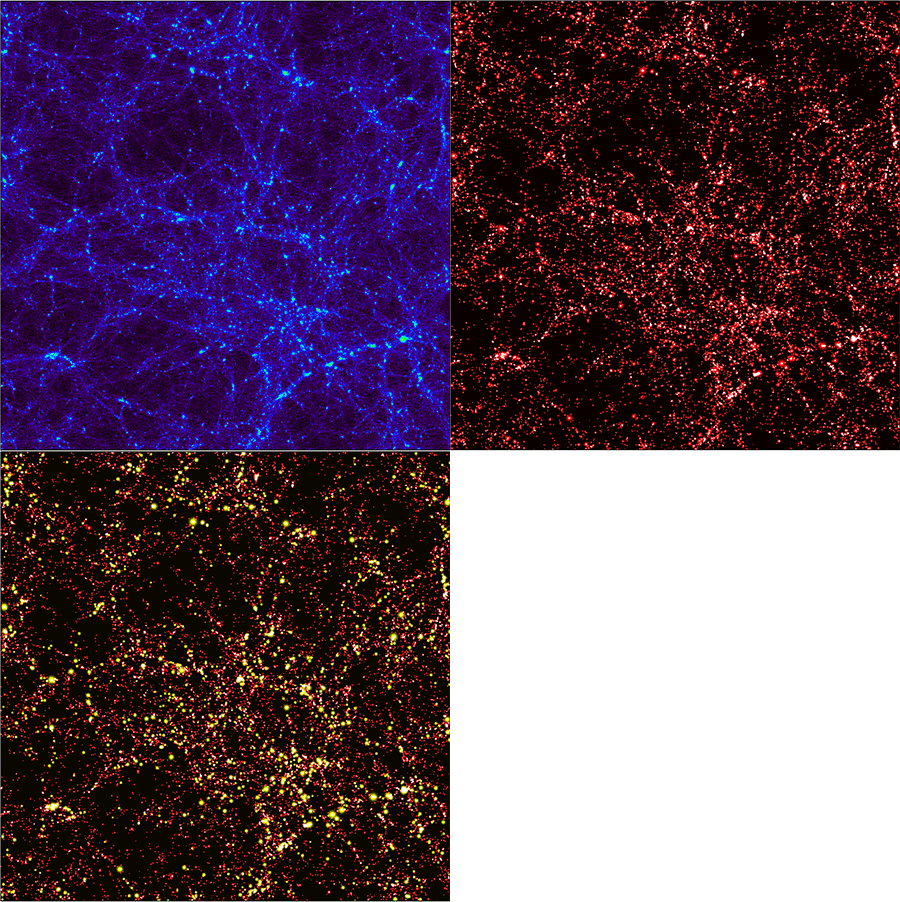
A new map of dark matter made using artificial intelligence reveals hidden filaments of the invisible stuff bridging galaxies.
The map focuses on the local universe — the neighborhood surrounding the Milky Way. Despite being close by, the local universe is difficult to map because it's chock full of complex structures made of visible matter, said Donghui Jeong, an astrophysicist at Pennsylvania State University and the lead author of the new research.
"We have to reverse engineer to know where dark matter is by looking at galaxies," Jeong told Live Science.
Dark matter is a mysterious, invisible substance that interacts with visible matter via gravity. Some researchers theorize that this invisible matter might consist of weakly interacting massive particles, or WIMPs, which would be very large (for subatomic particles, anyway) and electromagnetically neutral, so that they wouldn't interact with anything on the electromagnetic spectrum, such as light. Another idea withsome potential evidence to back it up is that dark matter might consist of ultralight particles called axions.
Whatever dark matter is, its effects are detectable in the gravitational forces permeating the universe. Mapping out an invisible gravitational force isn't easy, though. Typically, researchers do it by running large computer simulations, starting with a model of the early universe and fast-forwarding through billions of years of expansion and evolution of visible matter, filling in the gravitational blanks to figure out where dark matter was and where it should be today. This requires major computing power and significant amounts of time, Jeong said.
(Image credit: Hong et. al., Astrophysical Journal)
This new study takes a different approach. The researchers first trained a machine-learning program on thousands of computer simulations of visible matter and dark matter in the local universe. Machine learning is a technique that is particularly adept at picking out patterns from large datasets. The model universes in the study came from a sophisticated set of simulations called Illustris-TNG.
Sign up for the Live Science daily newsletter now
Get the world’s most fascinating discoveries delivered straight to your inbox.
After testing the machine-learning algorithm's training on a second set of Illustris-TNG universe simulations for accuracy, the researchers applied it to real-world data. They used the Cosmicflows-3 galaxy catalog, which holds data on the distribution and movement of the visible matter within 200 megaparsecs, or 6.5 billion light-years, of the Milky Way. That area includes more than 17,000 galaxies.
The result was a new map of dark matter in the local universe and its relationships to visible matter. In a promising finding, the machine-learning algorithm reproduced much of what was already known or suspected about the Milky Way's neighborhood from cosmological simulations. But it also suggested new features, including long filaments of dark matter that connect galaxies around the Milky Way to it and to one another.
This is important for understanding how galaxies will move over time, Jeong said. For example, the Milky Way and the Andromeda galaxies are expected to crash into each other in about 4.5 billion years. Understanding local dark matter's role in that collision could help address more precisely how and when that merger — and others — will occur.
"Now that we know the distribution of dark matter we can calculate more accurately the acceleration that will move the galaxies around us," Jeong said.
Stephanie Pappas is a contributing writer for Live Science, covering topics ranging from geoscience to archaeology to the human brain and behavior. She was previously a senior writer for Live Science but is now a freelancer based in Denver, Colorado, and regularly contributes to Scientific American and The Monitor, the monthly magazine of the American Psychological Association. Stephanie received a bachelor's degree in psychology from the University of South Carolina and a graduate certificate in science communication from the University of California, Santa Cruz.