Scientists may have observed the Higgs boson doing a new trick: creating pairs of muons.
When the Higgs boson was discovered at the Large Hadron Collider (LHC) in 2012, it was the final piece of Standard Model of particle physics puzzle, a particle that had been— long theorized to exist alongside quarks, electrons, neutrinos, muons, gluons, photons and the other known particles, but never before seen. Its role: the physical manifestation of the Higgs field, a feature of the universe that physicists believe endows particles with mass. Particles that wade through the field as if it were super-thick molasses, have greater mass than those that zip through more easily.
Another way to look at it: The greater the mass, the more strongly that elementary particle interacts, or couples, with the Higgs boson (and its field).
One way to prove a coupling between Higgs and other particles is to look at its decay products. The existence of the Higgs boson is fleeting — once it pops up, the particle "lives" for just 15.6 thousand-billion-billions (1.56x10^-22) of a second — almost immediately breaking apart into other particles.
Every time physicists spot a new Higgs-decay particle, that proves a "coupling" between the Higgs and the particles that come out of its decay, physicists say. And that coupling proves that the Higgs field does indeed imbue the emergent particle with mass.
That's why since the Higgs' discovery, researchers have been searching for hints of these decay products.
Get the world’s most fascinating discoveries delivered straight to your inbox.
Usually, the Higgs decays into more massive particles, like pairs of bottom quarks. But create enough Higgs bosons in the LHC and some of them should decay into the more lightweight particles to which it couples, like muons.
If the Higgs is decaying into two muons at the LHC, it's one of the rarest decays we could detect for the so-called "God particle." And it would prove muon-Higgs coupling for the first time — demonstrating once again that an elementary particle gets its mass from the Higgs field.
Right now, there's compelling but not yet overwhelming evidence that the Higgs is decaying into muon pairs in the LHC. Researchers working on data from the Compact Muon Solenoid (CMS), one of the LHC's several particle detectors, found an "excess" of muons flying around the LHC.
The LHC, an environment full of intense, colliding protons, has lots of ways of accidentally producing muons. Proving that the Higgs is decaying into muon pairs means finding a subtle signal of extra muons against lots of background noise.
The excess doesn't amount to much, Spiropulu told Live Science. Looking at the raw data, even with a trained eye, you might not think anything of it.
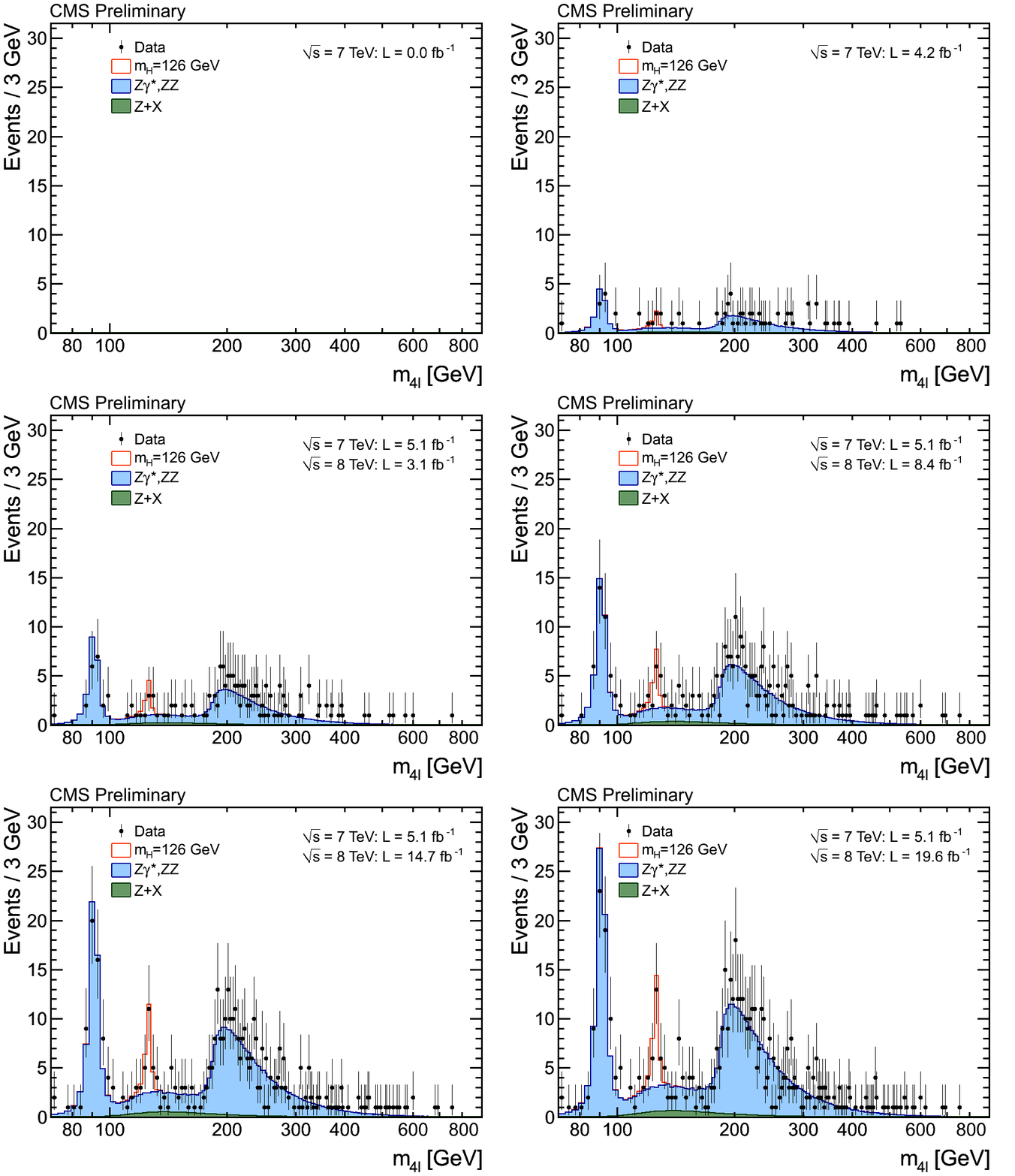
This figure rounds up the muon data that lead to the apparent detection. A tiny spike around 126 GeV on the x axis (the mass of a Higgs boson), hard to spot even with a trained eye, suggests that Higgs bosons were decaying into muon pairs in the detector.
(Image credit: CMS/CERN)
But with the aid of machine-learning algorithms, the researchers showed that this tiny crop of unexplained muons has just a 0.27% of emerging by random chance. Physicists call that level of certainty that they've found a signal and not just noise "three sigma."
Typically, a discovery isn't considered proven until it reaches "five sigma," equivalent to a 0.00006% chance of being an artifact of background noise. So Spiropulu was careful to say that a Higgs-muon coupling hasn't been proven yet.
Researchers working on ATLAS, a related LHC experiment, also found evidence for Higgs-muon coupling, but at just two sigma. That amounts to a 4.5% chance their signal was just background noise.
Still, the CMS discovery —— posted July 29 to the CMS website —— is reason to start getting excited. If more data pushes the confidence level to five sigma, Spiropulu said, it could help confirm an exponential relationship between the mass of a Higgs decay product and how often the boson decays into that particle. Physicists believe that the frequency of the Higgs boson's decay into each particle it couples with can be predicted by the square of that particle's mass, so heavier particles turn up much more often. This finding could help prove that if the frequency matches the prediction.
Spiropulu said that the LHC is now probably pushing the limits of its sensitivity in terms of detecting lighter Higgs decay products. The collider certainly isn't powerful or sensitive enough to produce enough Higgs-electron decays for anyone to measure, for example. And it's nowhere near the level of equipment needed to measure coupling between the Higgs and ultralight neutrinos.
Future detectors will have an advantage over the LHC, she said. The collider was built big and blunt, blasting protons at each other and covering a wide energy range, because physicists didn't yet know the mass of the Higgs — a critical detail for producing the particle.
Future colliders might be fine-tuned to the Higgs mass, and produce enough events to turn up even rarer couplings. And as the detectors get more sensitive, she said, they may turn up discrepancies with the Standard Model, leading the way toward new physics ideas.
Rafi joined Live Science in 2017. He has a bachelor's degree in journalism from Northwestern University’s Medill School of journalism. You can find his past science reporting at Inverse, Business Insider and Popular Science, and his past photojournalism on the Flash90 wire service and in the pages of The Courier Post of southern New Jersey.