













6 Implications of Finding a Higgs Boson Particle

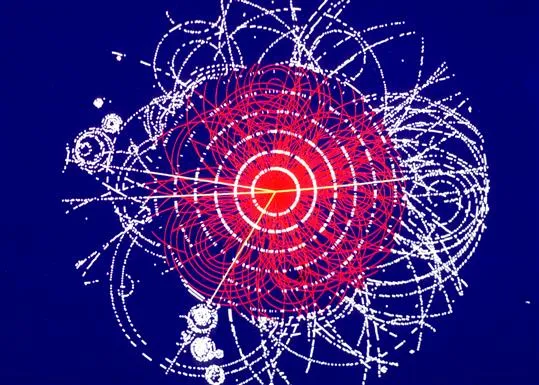
Physicists announced today (March 14) that a particle discovered at the world's largest atom smasher last year is a Higgs boson, a long-sought particle thought to explain how other particles get their mass.
Discovered at the Large Hadron Collider (LHC), where protons zip at near light-speed around a 17-mile-long (27 kilometers) underground ring beneath Switzerland and France, the Higgs boson particle is the last undiscovered piece of the puzzle predicted by the Standard Model, the reigning theory of particle physics.
Confirming a Higgs boson, physicists say, will have wide-reaching implications. Here are six of the biggest consequences:
1. The origin of mass
The Higgs boson has long been thought the key to resolving the mystery of the origin of mass. The Higgs boson is associated with a field, called the Higgs field, theorized to pervade the universe. As other particles travel though this field, they acquire mass much as swimmers moving through a pool get wet, the thinking goes.
"The Higgs mechanism is the thing that allows us to understand how the particles acquire mass," said Joao Guimaraes da Costa, a physicist at Harvard University who is the Standard Model Convener at the LHC's ATLAS experiment, last year when the discovery was announced. "If there was no such mechanism, then everything would be massless."
Confirming the particle is a Higgs would also confirm that the Higgs mechanism for particles to acquire mass is correct. "This discovery bears on the knowledge of how mass comes about at the quantum level, and is the reason we built the LHC. It is an unparalleled achievement," Caltech professor of physics Maria Spiropulu, co-leader of the CMS experiment, said in a statement last year. [Gallery: Search for the Higgs Boson] And, it may offer clues to the next mystery down the line, which is why individual particles have the masses that they do. "That could be part of a much larger theory," said Harvard University particle physicist Lisa Randall. "Knowing what the Higgs boson is, is the first step of knowing a little more about what that theory could be. It's connected."
Get the world’s most fascinating discoveries delivered straight to your inbox.
2. The Standard Model
The Standard Model is the reigning theory of particle physics that describes the universe's very small constituents. Every particle predicted by the Standard Model has been discovered — except one: the Higgs boson.
"It's the missing piece in the Standard Model," Jonas Strandberg, a researcher at CERN working on the ATLAS experiment, said last year of the particle announcement. "So it would definitely be a confirmation that the theories we have now are right."
So far, the Higgs boson seems to match up with predictions made by the Standard Model. Even so, the Standard Model itself isn't thought to be complete. It doesn't encompass gravity, for example, and leaves out the dark matter thought to make up 98 percent of all matter in the universe. [6 Weird Facts About Gravity]
"Clear evidence that the new particle is the Standard Model Higgs boson still would not complete our understanding of the universe," Patty McBride, head of the CMS Center at Fermilab, said today (March 14) in a statement. "We still wouldn't understand why gravity is so weak and we would have the mysteries of dark matter to confront. But it is satisfying to come a step closer to validating a 48-year-old theory."
3. The electroweak force
The confirmation of the Higgs also helps to explain how two of the fundamental forces of the universe — the electromagnetic force that governs interactions between charged particles, and the weak force that's responsible for radioactive decay — can be unified. [9 Unsolved Physics Mysteries]
Every force in nature is associated with a particle. The particle tied to electromagnetism is the photon, a tiny, massless particle. The weak force is associated with particles called the W and Z bosons, which are very massive.
The Higgs mechanism is thought to be responsible for this.
"If you introduce the Higgs field, the W and Z bosons mix with the field, and through this mixing they acquire mass," Strandberg said. "This explains why the W and Z bosons have mass, and also unifies the electromagnetic and weak forces into the electroweak force."
Though other evidence has helped buffer the union of these two forces, the Higgs discovery may seal the deal.
4. Supersymmetry
The theory supersymmetry is also affected by the Higgs discovery. This idea posits that every known particle has a "superpartner" particle with slightly different characteristics.
Supersymmetry is attractive because it could help unify some of the other forces of nature, and even offers a candidate for the particle that makes up dark matter. So far, though, scientists have found indications of only a Standard Model Higgs boson, without any strong hints of supersymmetric particles.
5. Validation of LHC
The Large Hadron Collider is the world's largest particle accelerator. It was built for around $10 billion by the European Organization for Nuclear Research (CERN) to probe higher energies than had ever been reached on Earth. Finding the Higgs boson was touted as one of the machine's biggest goals.
The newly announced finding offers major validation for the LHC and for the scientists who've worked on the search for many years.
"This discovery bears on the knowledge of how mass comes about at the quantum level, and is the reason we built the LHC. It is an unparalleled achievement," Spiropulu said in a statement last year. "More than a generation of scientists has been waiting for this very moment and particle physicists, engineers, and technicians in universities and laboratories around the globe have been working for many decades to arrive at this crucial fork. This is the pivotal moment for us to pause and reflect on the gravity of the discovery, as well as a moment of tremendous intensity to continue the data collection and analyses."
The discovery of the Higgs also has major implications for scientist Peter Higgs and his colleagues who first proposed the Higgs mechanism in 1964. The finding also shines a symbolic light on the boson's namesake, the late Indian physicist and mathematician Satyendranath Bose, who along with Albert Einstein, helped to define bosons. A class of elementary particles, bosons (which include gluons and gravitons) mediate interactions between fermions (including quarks, electrons and neutrinos), the other group of fundamental building blocks of the universe.
6. Is the universe doomed?
The Higgs boson discovery opens the door to new calculations that weren't previously possible, scientists say, including one that suggests the universe is in for a cataclysm billions of years from now.
The mass of the Higgs boson is a critical part of a calculation that portends the future of space and time. At around 126 times the mass of the proton, the Higgs is just about what would be needed to create a fundamentally unstable universe that would lead to a cataclysm billions of years from now.
"This calculation tells you that many tens of billions of years from now there'll be a catastrophe," Joseph Lykken, a theoretical physicist at the Fermi National Accelerator Laboratory in Batavia, Ill., said last month at the annual meeting of the American Association for the Advancement of Science.
"It may be the universe we live in is inherently unstable, and at some point billions of years from now it's all going to get wiped out," added Lykken, a collaborator on the CMS experiment.
Follow Clara Moskowitz on Twitter @ClaraMoskowitz. Follow LiveScience on Twitter @livescience, Facebook or Google+. Original article on LiveScience.com.
