















Human-size ammonites swam the Atlantic Ocean 80 million years ago
Fossils of the world's largest ammonites can be found on either side of the Atlantic.

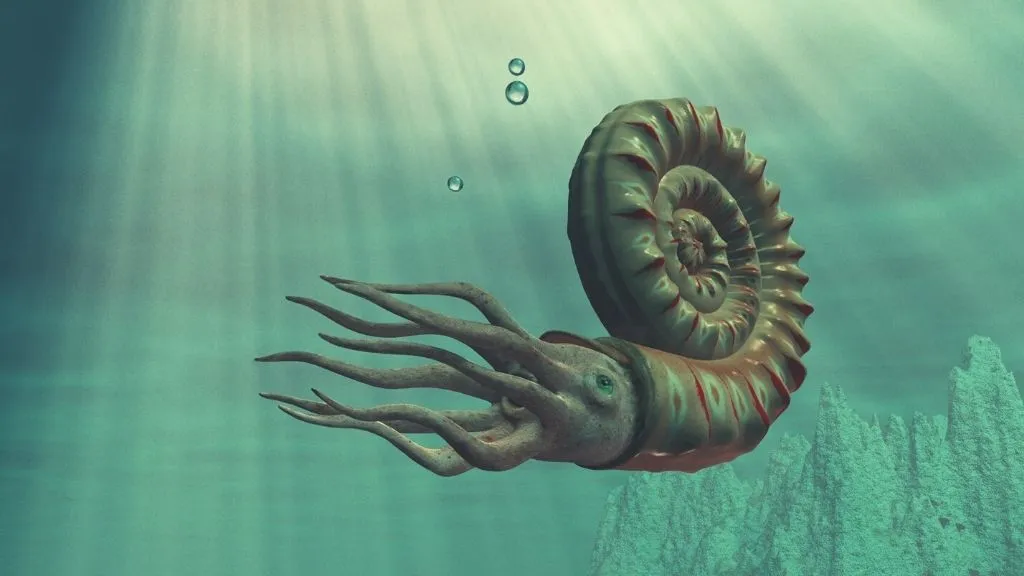
About 80 million years ago, human-size sea creatures with tentacle-like arms and coiled shells up to 6 feet (1.8 meters) wide glided through the Atlantic Ocean, a new study reveals.
These creatures were the world's largest ammonites, a group of shelled cephalopods that went extinct roughly 66 million years ago. The largest ammonite fossil ever discovered belongs to the species Parapuzosia seppenradensis; the fossil, which was found in Germany in 1895, has a gargantuan shell measuring 5.7 feet (1.7 m) across.
Although this famous fossil was uncovered more than a century ago, few ammonite fossils of similar size had been found until recently, which left big questions about how and when P. seppenradensis evolved to be such an impressive size.
Related: Ancient footprints to tiny 'vampires': 8 rare and unusual fossils
Now, in a new study, published Wednesday (Nov. 10) in the journal PLOS One, researchers filled in the evolutionary history of the massive cephalopod by examining 154 ammonite fossils, including a handful of historic specimens and more than 100 newfound fossils gathered from England and Mexico. Based on this analysis, they found that P. seppenradensis cropped up on both sides of the Atlantic Ocean about 80 million years ago and likely evolved from a smaller, related species called Parapuzosia leptophylla, which grew to be only 3.2 feet (1 m) wide.
"We have this world-famous fossil here in Germany, and now we can tell its story," said first author Christina Ifrim, a researcher for the Bavarian Natural History Collections and head of science at the Jura-Museum, a natural history museum in Eichstätt, Germany.
To piece together the history of the famed ammonite, which now stands on display at the Museum of Natural History in Münster, the team traveled to a field site about 25 miles (40 kilometers) north of Piedras Negras in northern Mexico.
Get the world’s most fascinating discoveries delivered straight to your inbox.
Huge deposits of Cretaceous marine sediment can be found at various locations in Mexico, including the field site the team visited, said Ana Bertha Villaseñor Martinez, a researcher in the Institute of Geology at the Universidad Nacional Autónoma de México, who was not involved in the study. Although giant ammonites have been uncovered in Mexico in the past, the study authors applied new techniques to understand how the creatures grew and developed throughout their lifespans, and how they evolved as a species over time, Villaseñor Martinez told Live Science in an email. In this way, the team has "improved the understanding of ammonites, in general," she said.
In a broad, dry riverbed at the Mexican field site, the team searched through layers of chalk, limestone, mud and clay and found 66 Parapuzosia specimens, including both the giant P. seppenradensis and the smaller P. leptophylla. The fossils measured between 0.3 and 4.8 feet (0.1 to 1.48 m) wide and represented different stages in the ammonite growth cycle.
"A small specimen doesn't look like a small version of this giant ammonite … they change during growth," Ifrim told Live Science. But these distinct growth stages were difficult to study in the past because of the dearth of specimens. With more specimens in hand, the team could see how P. seppenradensis and P. leptophylla each followed a distinct, five-stage growth cycle, where their shells grew steadily and their morphology changed, she said.

The largest ammonite fossil ever found measures about six feet across.
In sorting through the various Parapuzosia specimens, the team also dated the layers of sediment from where the specimens appeared. They found that the P. leptophylla samples dated to the late Santonian age (86.3 million to 83.6 million years ago), a subdivision of the Upper Cretaceous. By comparison, P. seppenradensis appeared in younger sediments, dating later in the Santonian and early in the following time period, the Campanian (83.6 million to 72.1 million years ago). The oldest of these specimens reached only 3.2 feet wide, like P. leptophylla, but by the middle early Campanian, ammonites of more formidable sizes cropped up in the fossil record.
And it turned out, ammonites of comparable girth also could be found across the Atlantic, and at the same time period, the team found. "We did not expect to find (P.) seppenradensis and this ancestor on the other side of the Atlantic when we started the study," Ifrim said.
Related: Why did trilobites go extinct?
In the U.K., the team uncovered dozens of giant ammonite specimens at the base of a white chalk cliff in Sussex and more near the chalk cliffs of east Kent. Upon analyzing the samples, the team noticed, "'Huh, these giants occur, apparently, at more or less the same time on both sides of the Atlantic,'" Ifrim said. "There must have been a connection between the populations of both sides, because they show the same evolution, the same timing."

An ammonite fossil uncovered at the team's field site in Mexico.
And both in England and Mexico, the team found an unusually high concentration of adult-size shells. They theorized that perhaps these areas served as mating or hatching sites where the giant ammonites completed their reproductive cycles and died shortly afterward, like some modern squid and cuttlefish species do. But while this might explain the remarkable abundance of ammonite fossils at these sites, it doesn't answer two big questions: Why did the ammonites get so big in the first place, and how did they show up on both sides of the Atlantic?
Regarding the former question, the ammonites may have faced an evolutionary pressure to grow because a major predator of the Cretaceous, marine reptiles called mosasaurs, also grew larger during this time, the authors noted. However, although there's evidence of mosasaurs preying on ammonites, there's no direct evidence that they interacted with P. seppenradensis, specifically, Ifrim told Live Science. So, for now, this is just speculation.
RELATED CONTENT
We also don't know how giant ammonites' distribution came to stretch across the Atlantic. Ammonites are thought to be rather slow swimmers, similar to modern nautiluses, but it's possible that giant ammonites cover distance more efficiently, thanks to their size, Ifrim said. On the other hand, the cephalopods may have crossed the ocean during their smaller, juvenile growth stages, swept along by ocean currents.
So, while the new study fills some gaps in the giant cephalopods' past, many mysteries remain.
Editor's note: This article was updated on Nov. 15 to include comments from Ana Bertha Villaseñor. The original story was posted on Nov. 10.
Originally published on Live Science.

Nicoletta Lanese is the health channel editor at Live Science and was previously a news editor and staff writer at the site. She is a recipient of the 2026 AHCJ International Health Study Fellowship, with a project focused on antibiotic stewardship practices in Japan and the U.S. They hold a graduate certificate in science communication from UC Santa Cruz and degrees in neuroscience and dance from the University of Florida. Beyond Live Science, Lanese's work has appeared in The Scientist, Science News, the Mercury News, Mongabay and Stanford Medicine Magazine, among other outlets. Based in NYC, she also remains involved in dance and performs in local choreographers' work.