














Is every spiderweb unique?
Oh, what a tangled web they weave.


Spiderwebs are astonishingly complex constructions for objects that are so delicate. Even if webs don't literally spell out the words "terrific" and "radiant" like those in the book "Charlotte's Web" do, each is nonetheless an intricate engineering marvel.
Building these strong yet ephemeral traps is a process that follows patterns shared among spider species. But is there room for individual variation that makes one species' web — or one individual spider's — recognizably different from another's? Are all webs identical, or is every spiderweb unique? And what factors cause spiders to vary their silky webs?
Related: Is it OK to throw house spiders outside?
There are approximately 48,000 known spider species worldwide, and while all spiders have silk-producing organs, known as spinnerets, and can produce several varieties of silk, not all spiders spin webs and lie in wait for their prey. Some spiders actively hunt for food, but they still use silk for making wind-sailing balloons, egg sacs or tiny "houses" to hide in, according to the Burke Museum of Natural History and Culture in Seattle. Other spiders use silk to build ingenious traps and tools, such as throwing nets, oxygen-holding nets for breathing underwater, web slingshots, silk-sealed leaf pockets for catching frogs, and silk pulleys capable of lifting lizards or small mammals.
Picture a spiderweb, and you might imagine a wheel-like structure with a spiral and spokes radiating outward from the center. These are known as orb webs, and they are made by fewer than 10% of known spider species, said Samuel Zschokke, an arachnologist in the Section of Conservation Biology at the University of Basel in Switzerland, where he researches and visualizes spiderweb construction. Orb webs are ideal for catching flying insects because they provide a wide area for prey capture and are nearly invisible, according to the Australian Museum in Sydney.
And while they all may look very similar, no two are exactly alike.
Spiders that build orb webs typically follow a similar construction plan and create a similar shape. They begin with a few threads that center on a single point, in a "Y" shape; the spider then establishes a frame around the "Y," connecting a few more threads in the middle. "Then they make more threads from that middle to the frame — these are the so-called radii, or, spokes, if you're comparing it to a wheel," Zschokke told Live Science.
Get the world’s most fascinating discoveries delivered straight to your inbox.
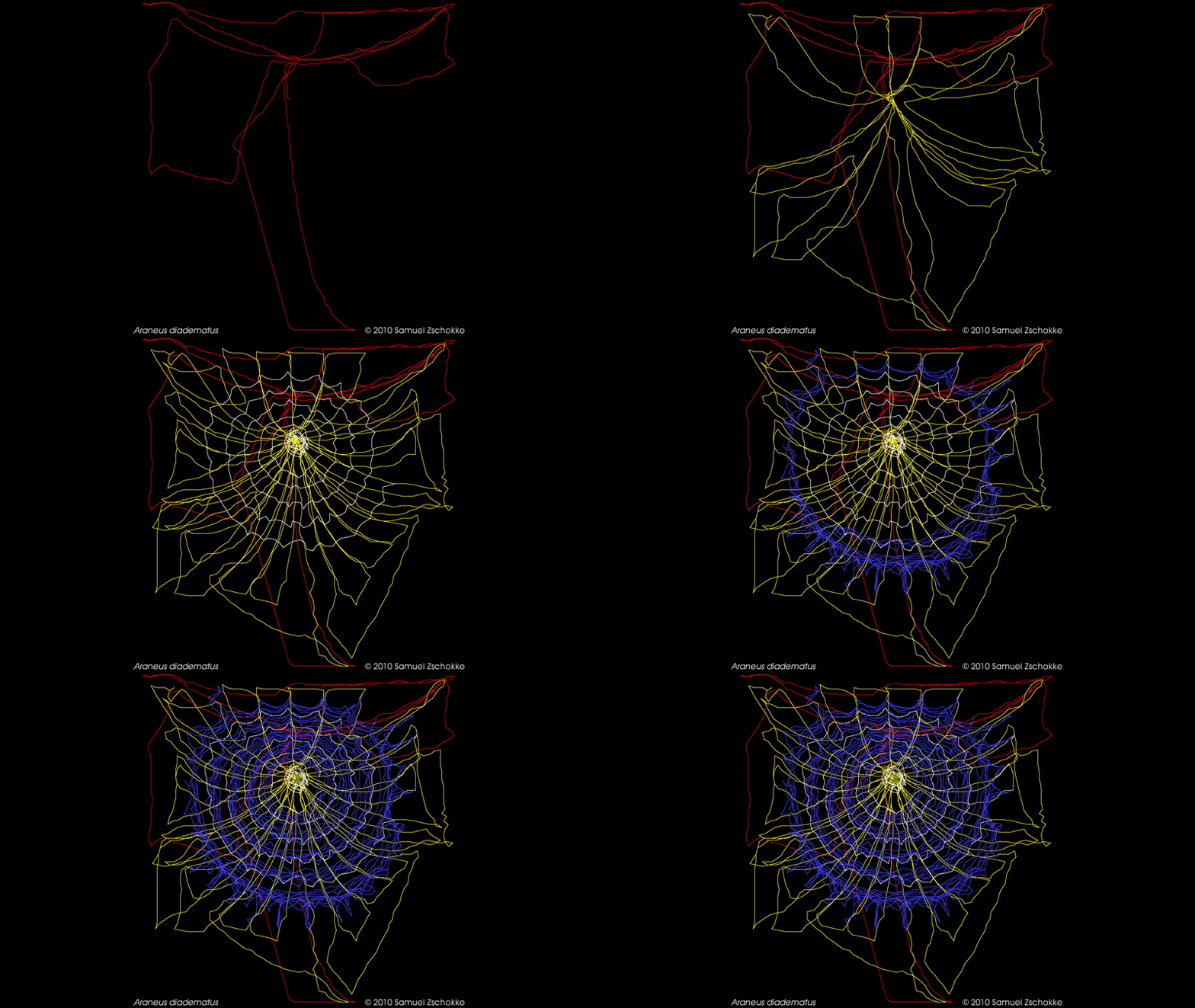
This animation shows orb-web construction by Araneus diadematus.
At this point, the spider moves to the middle and builds what is known as an auxiliary spiral from the inside out. This is a placeholding structure made of non-sticky silk. Once this temporary spiral is finished, the spider crafts a new, sticky spiral by working toward the center from the outer frame. When that spiral is finished, the spider removes the auxiliary spiral, Zschokke explained.
Related: 21 totally sweet spider superlatives
To some extent, all orb webs resemble each other, but there are details that differ between species. For example, spiders in the Cyclosa genus install a "decoration" in the middle of their webs made of prey leftovers and bits of leaves, which the spider may use as camouflage, Zschokke said. Other orb weavers incorporate a zig-zag structure into the web center, known as a stabilimentum. And while most orb-weavers produce webs that are perpendicular to the ground, some, such as Leucauge dromedaria, spin webs that are oriented horizontally, according to the Atlas of Living Australia.
Webs spun by spiders that are not orb weavers may look messy or haphazard by comparison. These web types include funnel webs, sheet webs, mesh webs and tangle webs, according to a study published in 2013 in the journal PeerJ.

Web structures (A) funnel web (Agelenidae), (B) sheet web (Linyphiidae), (C) mesh web (Dictynidae), (D) reduced orb web (Uloboridae) (E) vertical orb web (Aranaeidae), (F) tangle web (Theridiidae), (G) horizontal orb web (Tetragnathidae).
An orb web's physical location can also influence what it looks like, Sebastian Echeverri, an arachnologist with the American Arachnological Society, told Live Science in a message on Twitter.
"Even if the central pattern of the web is essentially the same between individuals, the lines of silk that anchor it to the environment will have to be different," Echeverri said. An orb-web spider that builds a web in flexible grass faces different construction challenges than a spider from the same species that spins its web in a tree; though those spiders would still follow the same basic construction plan, their webs would look somewhat different, Echeverri said.
Recently, researchers observed individual orb-weaving spiders in the species Uloborus diversus as they built webs — one per day, over several days. Those webs were similar but not identical, even when conditions stayed the same, day after day, the scientists reported May 25 in bioRxiv, a preprint website.
In the study, which was not peer reviewed, the scientists said they captured small differences in the webs by tracking changes in the spider's position, but that didn't reveal why the spider varied its technique. Pinpointing the sensory cues that motivate slight changes in the spider's web spinning would require "a more detailed understanding of the spider's behavior," the researchers reported in the study.
Under the influence
Some very distinctive and unusual web variations in orb weavers have sprung from circumstances that most spiders usually don't encounter in nature: exposure to stimulants, sedatives and psychedelics. Since the late 1940s, scientists have manipulated spiders into designing webs that diverged wildly from the usual patterns by feeding the arachnids a smorgasbord of mind-altering drugs.
A 1971 study published in the journal Behavioral Science documented more than two decades of such experiments beginning in 1948, when H. M. Peters, a professor of zoology at the University of Tübingen in Germany, decided that he wanted his lab spiders to build their webs at a time that was more convenient for humans than the spiders' preferred pre-dawn schedule.
So Peters gave the spiders amphetamines, reported study author Peter Witt, who in 1971 was a pharmacologist with the North Carolina Department of Mental Health in Raleigh. Witt collaborated with Peters in the spider experiments, and the two scientists co-authored a landmark 1949 study documenting how the Tübingen spiders responded to amphetamines.
Related: How do spiders make silk?
While stimulants didn't affect what time the spiders chose to spin their webs, "the webs were built in a way which seemed distorted beyond the range of variations in the geometric pattern which had been observed up to that time," Witt wrote, adding that "it took only a few days to prove that the phenomenon was reproducible."
The 1948 discovery fueled Witt's curiosity about spiders' web spinning and what it could tell scientists about the ways that drugs alter behavior, and he continued investigating how drugs affected behavior in spiders and in people, according to a biography published in 2013 in the journal Archives of Environmental Health). In more than two decades of research, Witt and other scientists found that different drugs prompted different web-building techniques.

A female Araneus diadematus spider built the web on the left, about 12 hours after receiving a relatively high dose (1 milligram) of d-amphetamine in sugar water. The web on the right was built by an adult female Zygiella x-notata spider that received a low dose of LSD, resulting in a web with spiral turns that were "unusually regularly spaced," according to pharmacologist Peter Witt.
RELATED MYSTERIES
For example, dextroamphetamine, a stimulant that is used to treat narcolepsy and ADHD, led to "irregular radius and spiral spacing," according to the 1971 study. Scopolamine, a medication for motion sickness, "caused wide deviation of spiral spacing distinctly different from amphetamine." By comparison, spiders that were given the hallucinogenic drug lysergic acid diethylamide — LSD — produced "unusually regular webs," Witt reported.
Decades later, researchers at NASA's Marshall Space Flight Center in Huntsville, Alabama revisited these experiments by dosing European garden spiders (Araneus diadematus) with caffeine, benzedrine, marijuana and the sedative chloral hydrate, according to a 1995 report published in the journal NASA Tech Briefs. Photos of the resulting webs revealed that caffeine was the biggest structural disrupter, the web's signature spokes and spirals replaced with a seemingly random hodgepodge of strands, according to the study.

In 1995, scientists evaluated toxicity in different chemicals by analyzing how they affected web construction.
While spiders normally don't build webs that are so dramatically distinctive (and wonky) without chemical assistance, they do craft a fresh web every night or so. That means a spider can produce about 100 to 200 webs over the course of its lifetime, depending on the species, so there's bound to be at least some variation from web to web — even if it isn't quite as extreme as a web spun by a spider that's high caffeine, Zschokke said.
"If you look close enough, each web will be somewhat different," he said.
Originally published on Live Science.

Mindy Weisberger is a science journalist and author of "Rise of the Zombie Bugs: The Surprising Science of Parasitic Mind-Control" (Hopkins Press). She formerly edited for Scholastic and was a channel editor and senior writer for Live Science. She has reported on general science, covering climate change, paleontology, biology and space. Mindy studied film at Columbia University; prior to LS, she produced, wrote and directed media for the American Museum of Natural History in NYC. Her videos about dinosaurs, astrophysics, biodiversity and evolution appear in museums and science centers worldwide, earning awards such as the CINE Golden Eagle and the Communicator Award of Excellence. Her writing has also appeared in Scientific American, The Washington Post, How It Works Magazine and CNN.