













Magic mushrooms temporarily 'dissolve' brain network responsible for sense of self
Psilocybin, the active ingredient in magic mushrooms, reduces the synchronicity within a brain network responsible for reflection and the sense of self.

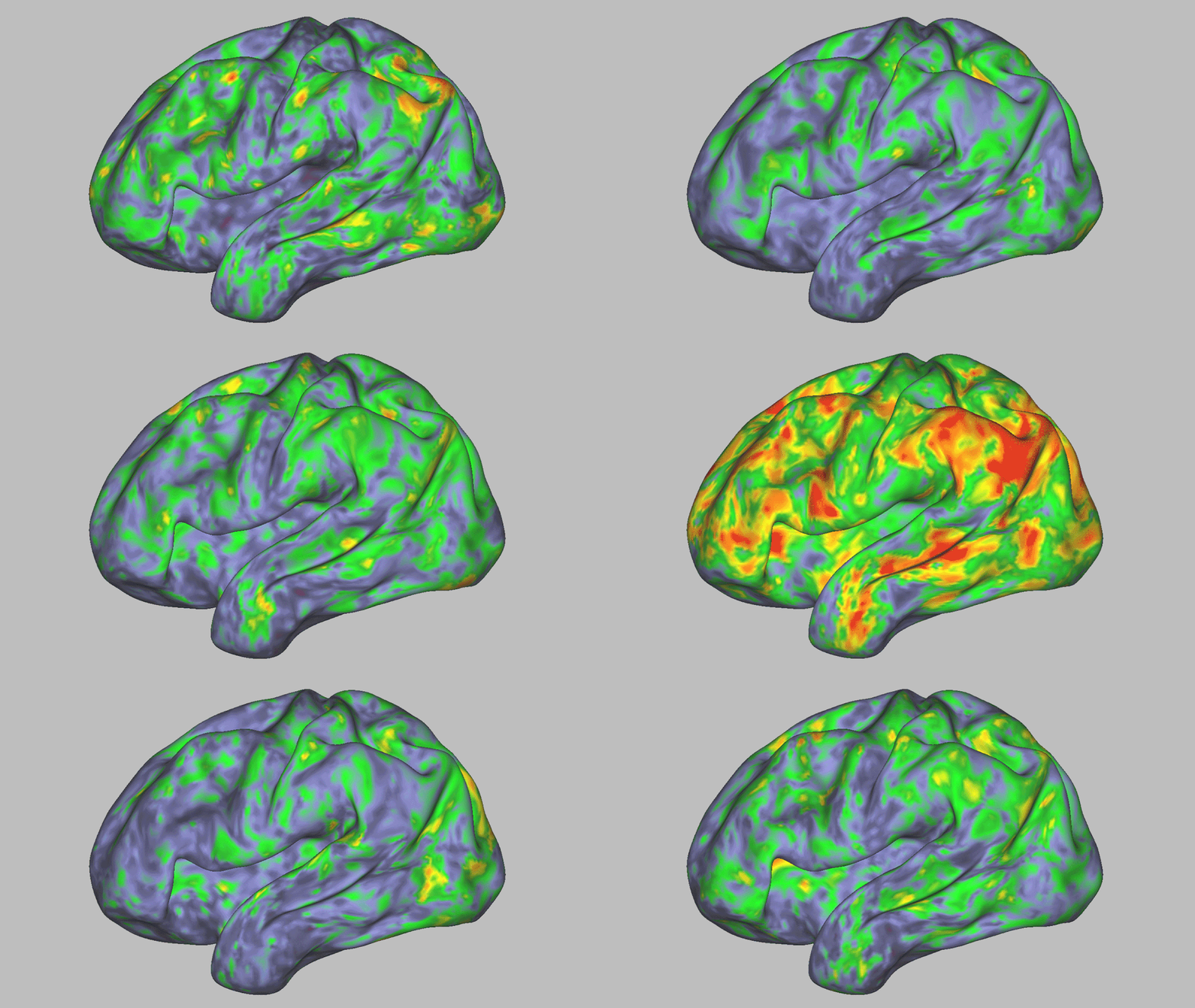
Psilocybin, the compound that makes magic mushrooms trippy, works its magic by desynchronizing the brain network responsible for a person's sense of self, new research finds.
Psilocybin warps people's sense of time and space, as well as shifts their feelings of connection to the world around them. While most of these subjective effects wane pretty quickly, the new study finds that some changes in the brain persist for weeks after a high dose of psilocybin.
This is the first time such persistence has been detailed in humans, and the findings may help explain why psilocybin is a promising treatment for depression and other mental health conditions, said lead study author Dr. Joshua Siegel, a psychiatrist at the Washington University School of Medicine in St. Louis.
"If there's this plasticity [in the brain] and there's this clinical response, we expected there would be a change in connectivity and activity," Siegel told Live Science. "This is the first study really to provide a compelling answer as to what that is."
Related: 'Flow state' uncovered: We finally know what happens in the brain when you're 'in the zone'
Studies have found that psilocybin works by plugging into brain cells that react to serotonin, a chemical messenger. Brain scans of people with and without depression suggest the drug encourages some parts of the brain to forge new connections and sync their activity. Meanwhile, the activity of other brain networks gets disrupted and falls out of sync.
To probe these effects further, Siegel and colleagues used precision functional mapping, which involves getting large amounts of brain-activity data from just a few participants. In the study, published Wednesday (July 17) in the journal Nature, seven participants had their brains scanned with functional magnetic resonance imaging (fMRI), a technique that tracks blood flow to infer the activity of different brain regions.
Get the world’s most fascinating discoveries delivered straight to your inbox.
The participants were given high doses of either psilocybin or Ritalin, a stimulant commonly used to treat attention deficit hyperactivity disorder. Then, a week or two later, they returned to take the other drug. Ritalin served as a control, Siegel said, because it has stimulating effects on the brain but it is not psychedelic.
The participants had their brains scanned an average of 18 times, including before, during and three weeks after their doses. Some were scanned nearly every other day, Siegel said. This detailed each participants' day-to-day variability in brain activity and revealed psilocybin's ongoing effects.
What the researchers found was significant: The psychedelic led to a major drop in synchronicity in a brain network known as the "default mode network." This circuit of connected brain regions spans structures called the thalamus, basal ganglia, cerebellum and hippocampus. It's most active when people are self reflecting and letting their minds wander but not engaging in a specific task.
"That was the network that was most altered by psilocybin," Siegel said. "And in fact, that fits with how we think about the psychedelic experience — with this idea of ego dissolution and distortion of the sense of space and time."
These effects faded as people sobered up, but there was decreased synchronicity between the default mode network and the anterior hippocampus — a structure linked to memory and emotion — that lasted for at least three weeks.
These findings tracked with what previous neuroscience studies have shown, Siegel said.
Studies suggest that psilocybin leads to a less-rigid style of connection in the brain, and this may be the reason the compound might assist in treatment of depression. By putting the brain in a more adaptable state, Siegel said, psilocybin might allow for long-term changes in cognition. Perhaps it's the desynchronization, specifically, that acts as a reset that enables people with depression to regain healthier, more-dynamic brain connectivity.
"In other words, psilocybin could open the door to change, allowing the therapist to lead the patient through," Dr. Petros Petridis, a psychiatrist at the NYU Langone Center for Psychedelic Medicine, wrote in a commentary.
The drug's effects are context-dependent, though, Siegel cautioned. In the study, the researchers found the brain desynchronization declined when they asked participants to participate in a simple word-picture matching task. The default mode network isn't in charge during such tasks, bringing brain regions less susceptible to psilocybin into play, he said.
RELATED STORIES
This may explain why cutting out external stimuli — using eyeshades, for instance — can help people fully engage with their psychedelic experience, Petridis wrote.
At least one participant initially had a deeply meaningful experience with psilocybin but later had a bad trip. It's likely important that, when treating mental health issues, psilocybin use happens in a controlled environment in which participants have been screened for a risk of psychosis, Siegel said. These and additional precautions are taken in clinical trials of psilocybin, in which participants are typically given only low doses.
"You want somebody to be able to have this internal experience and be in a place and setting where they're able to fully enter into this intense experience," he said, "in order to maximize the likelihood that you're going to get a lasting therapeutic response afterwards."
This article is for informational purposes only and is not meant to offer medical advice.
Ever wonder why some people build muscle more easily than others or why freckles come out in the sun? Send us your questions about how the human body works to [email protected] with the subject line "Health Desk Q," and you may see your question answered on the website!

Stephanie Pappas is a contributing writer for Live Science, covering topics ranging from geoscience to archaeology to the human brain and behavior. She was previously a senior writer for Live Science but is now a freelancer based in Denver, Colorado, and regularly contributes to Scientific American and The Monitor, the monthly magazine of the American Psychological Association. Stephanie received a bachelor's degree in psychology from the University of South Carolina and a graduate certificate in science communication from the University of California, Santa Cruz.