















Giant 'phantom jellyfish' that eats with mouth-arms spotted off California coast
The giant sea monster traps its prey in 33 feet-long mouth-arms.

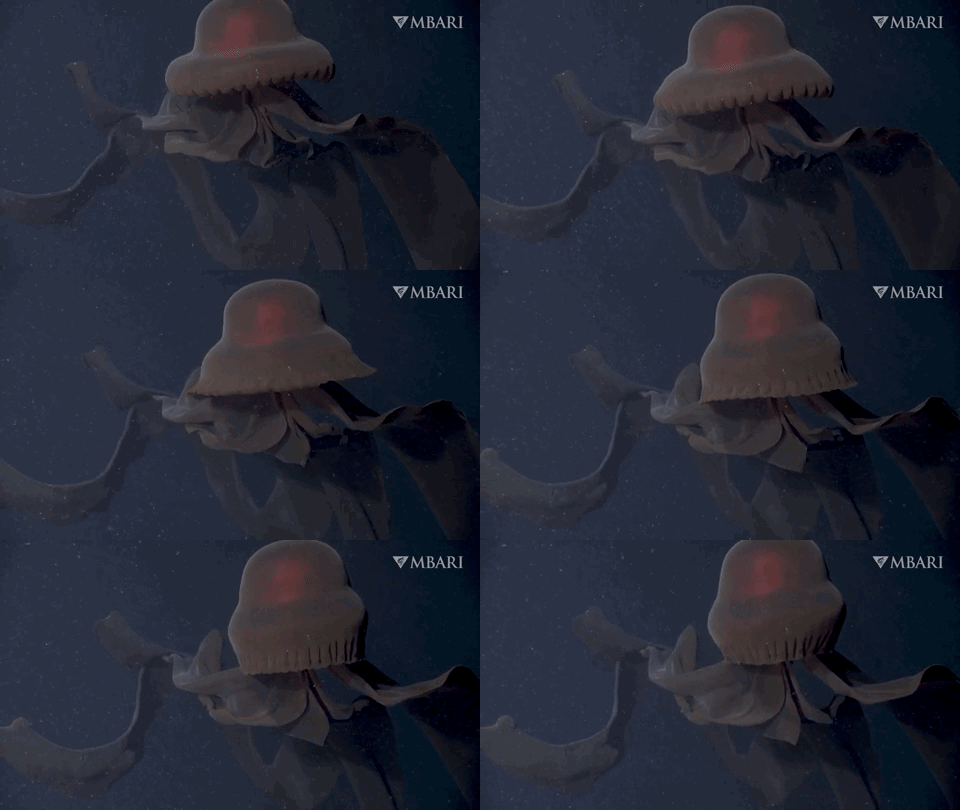
The phantom jellyfish (Stygiomedusa gigantea) is one of the ocean's most elusive animals.
Scientists piloting a remote submarine have filmed mesmerizing footage of a giant phantom predator lurking in the deep waters of Monterey Bay, California.
The giant phantom jellyfish (Stygiomedusa gigantea) was captured as it was serenely floating — its long, velvety "mouth-arms" trailing around it — at a depth of 3,200 feet (975 meters) by marine biologists from the Monterey Bay Aquarium Research Institute (MBARI). This is one of only nine times that MBARI scientists have spotted the elusive creature across the institute’s many thousands of submarine dives.
"The giant phantom jelly was first collected in 1899. Since then, scientists have only encountered this animal about 100 times," MBARI said in a statement.
Related: In photos: Spooky deep-sea creatures
The giant phantom, which is among the largest jellyfish on the planet, has been spotted in the deepest parts of all the world’s oceans except for the Arctic. Even so, MBARI says that sightings of the creature are still rare, as it usually lives too far down for humans or remote submarines to access.
The sunhat shaped-bell of the deep-sea dweller is more than 3.3 feet (1 meter) wide, and it's ribbon-like mouth-arms can grow to more than 33 feet (10 m) in length, MBARI said.
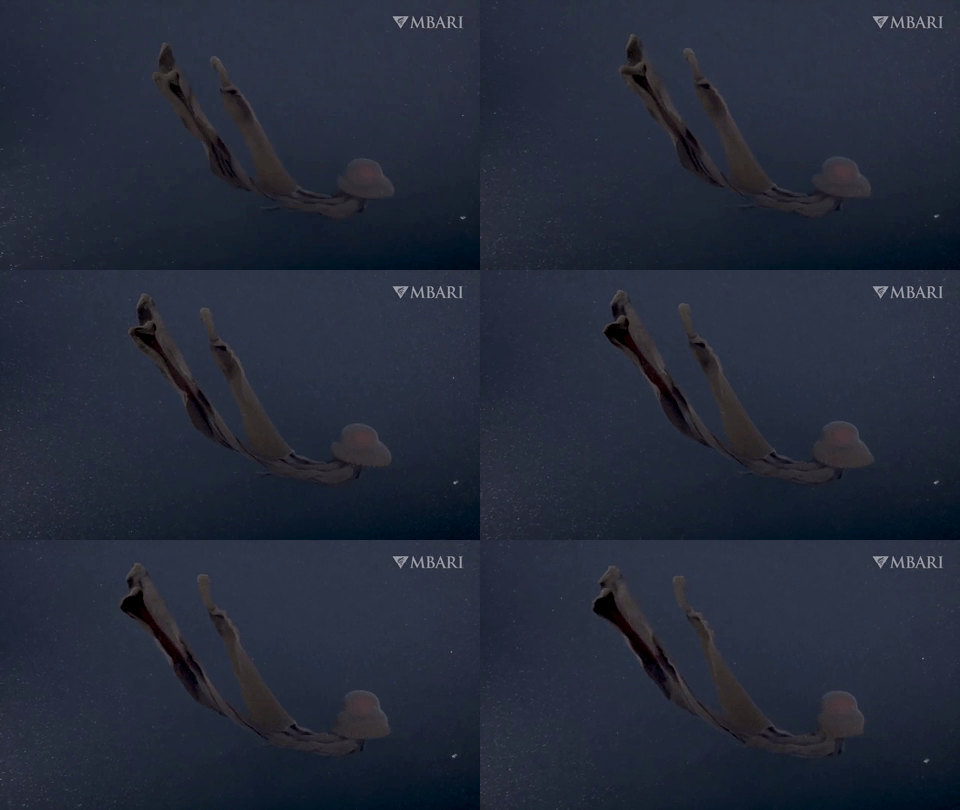
The mouth-arms of the phantom jellyfish trail behind it like scarves in the wind.
Not much is known about phantom jellyfish, but scientists think it uses its mouth-arms, which stream like loose scarves in its wake, to ensnare unfortunate prey and winch them up to its mouth. The creature propels itself through the pitch-black depths of the ocean with periodic pulses from its faintly-glowing orange head.
Get the world’s most fascinating discoveries delivered straight to your inbox.
Before the deployment of remote controlled submarines like the one used for this expedition, scientists often used trawl nets to capture deep-sea creatures. This was ideal for studying some creatures, but not deep-sea jellyfish, MBARI said.
RELATED CONTENT
"These nets can be useful for researching robust creatures like fish, crustaceans and squids," MBARI said. "But jellies disintegrate into gelatinous goo in trawl nets."
Jellyfish are some of the most common creatures to be found in the deep sea, the compressible, squidgy jelly of their bodies enabling them to survive incredibly high pressures. However, much about the brainless creatures remains to be discovered. It was once assumed that jellyfish were largely unimportant in deep-sea ecology, but a 2017 study by MBARI researchers showed that these cnidarians are actually among the most important predators in the dark depths, competing with cephalopods like squid, as well as fish and even blue whales for food.
Originally published on Live Science.

Ben Turner is the features editor at Live Science. He covers physics and astronomy, among other topics such as tech and climate change. He graduated from University College London with a degree in particle physics before training as a journalist. When he's not writing, Ben enjoys reading literature, playing the guitar and losing at chess.