













Rare meteorite, a 'relic of the early solar system,' falls on a driveway in England

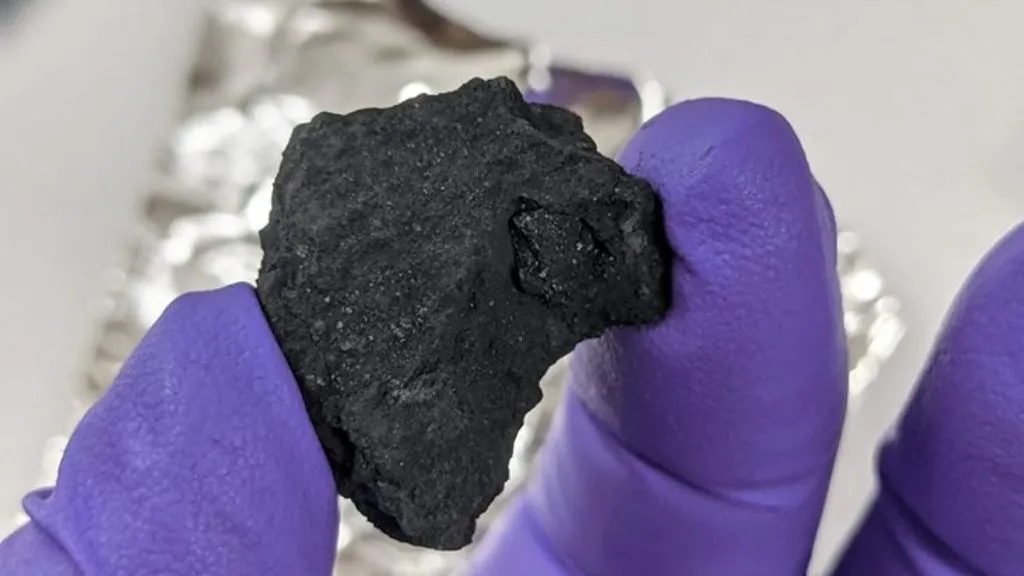
A meteorite found in the U.K. contains an extremely rare combination of minerals that could give scientists a glimpse into how the solar system formed and even how life emerged on Earth.
The meteorite tumbled to Earth on Feb. 28, when a dazzling fireball zoomed over southwest England, Live Science previously reported. At the time, scientists suspected that quite a few fragments of the space rock likely reached the ground. One such fragment landed on a driveway in Winchcombe, a town in Gloucestershire, according to a statement from the Natural History Museum in London.
Noticing a black, sooty splotch on their driveway, the house's occupants bagged up bits of the meteorite and quickly alerted the U.K. Meteor Observation Network, which then contacted the Natural History Museum.
Related: Crash! 10 biggest impact craters on Earth
"For somebody who didn't really have an idea what it actually was, the finder did a fantastic job in collecting it," Ashley King, a researcher at the museum who studies meteorites, said in the statement. "He bagged most of it up really quickly on Monday morning, perhaps less than 12 hours after the actual event. He then kept finding bits in his garden over the next few days."
It's important to collect fallen meteorites soon after they hit the ground, since they can quickly become contaminated by rain or exposure to the atmosphere, Live Science reported. In all, the collected fragments weigh almost 11 ounces (300 grams) and represent the first bits of fallen space rock recovered in the U.K. since 1991, according to the museum statement.
Upon examining the rocky fragments, the museum researchers identified the meteorite as a carbonaceous chondrite, a rare type of meteorite that originates from an ancient asteroid forged in the early days of the solar system when the first planets formed.
Get the world’s most fascinating discoveries delivered straight to your inbox.
"Meteorites like this are relics from the early solar system, which means they can tell us what the planets are made of," Sara Russell, a researcher at the museum who studies carbonaceous chondrite meteorites, said in the statement. "But we also ... think that meteorites like this may have brought water to the Earth, providing the planet with its oceans."
The meteorite itself looks a bit like coal but is much softer and more fragile, King said in the statement. The texture hints that the space rock contains soft clay minerals and, therefore, once contained water ice. In general, carbonaceous chondrite meteorites usually contain a mix of minerals and organic compounds, including amino acids, the building blocks of proteins.
Related Content
"It is almost mind-blowingly amazing, because we are working on the asteroid-sample-return space missions Hayabusa2 and OSIRIS-REx, and this material looks exactly like the material they are collecting," Russell said in the statement. Both these spacecrafts were designed to intercept and collect samples from asteroids; Hayabusa2 returned to Earth in 2020, bearing 0.16 ounces (4.5 grams) of space rock, and OSIRIS-REx is scheduled to deliver about 2.1 ounces (60 grams) of samples in 2023, according to the statement.
But thanks to the Winchcombe meteorite, the museum researchers now have more than 10 ounces (280 grams) of carbonaceous chondrite to study. The minerals likely survived their fall to Earth because they descended relatively slowly, striking the ground at 28,800 mph (46,800 km/h), the researchers noted.
While that may sound fast, meteorites can reach speeds of up to 154,800 mph (252,000 km/h) as they streak through the atmosphere — a rate that would cause carbonaceous chondrite to disintegrate before it ever hit the ground, King said in the statement.
In regard to the Winchcombe meteorite, "the fact that it was going quite slowly, and then that it was collected so quickly after landing, avoiding any rainfall that could change its pristine composition, means that we've just really lucked out with everything," she said.
Originally published on Live Science.

Nicoletta Lanese is the health channel editor at Live Science and was previously a news editor and staff writer at the site. She is a recipient of the 2026 AHCJ International Health Study Fellowship, with a project focused on antibiotic stewardship practices in Japan and the U.S. They hold a graduate certificate in science communication from UC Santa Cruz and degrees in neuroscience and dance from the University of Florida. Beyond Live Science, Lanese's work has appeared in The Scientist, Science News, the Mercury News, Mongabay and Stanford Medicine Magazine, among other outlets. Based in NYC, she also remains involved in dance and performs in local choreographers' work.