The first phase of NASA's ambitious, three-part Artemis mission was a success. But whether the mission achieved all its goals remains to be seen.
If all goes to plan, NASA's Artemis program will culminate in 2025/2026 with astronauts setting foot on the moon for the first time in 50 years, and will include the first woman and person of color ever to do so. Ultimately, NASA intends to build a permanent lunar base at the moon's south pole, serving not only as a residence for moon-bound astronauts, but also as a staging ground for crewed missions to Mars and deep space exploration, Pat Troutman, Strategy and Architectures Liaison for NASA’s Moon to Mars Architecture Development office, told Live Science.
However, every journey of a thousand light-years begins with a single step. For Artemis, that first step is making sure that the mighty Space Launch System (SLS) rocket (also known as the Mega Moon Rocket) and the attached Orion Crew Capsule are safe and sturdy enough for humans to one day use. As such, the first phase of the Artemis mission was totally un-crewed, with only three mannequins riding aboard the Orion capsule on its trans-lunar voyage.
"This is the first flight of a major space system," Troutman said. "It's a highly integrated, complex system with lots of energy, and typically you want to test those the first time without people too close."
Phantoms of the moon
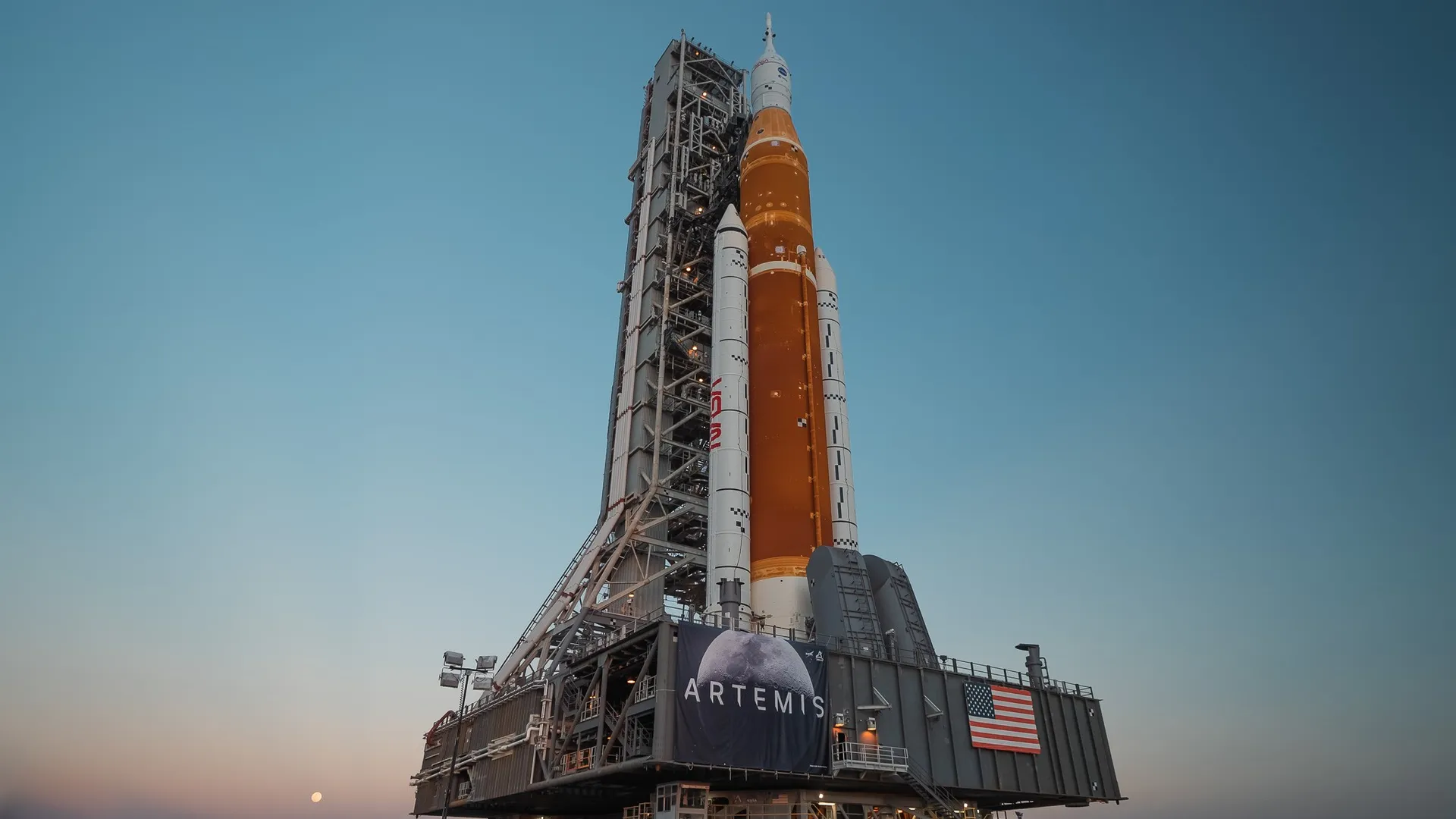
NASA's SLS rocket eyes its target from Kennedy Space Center in Florida.
(Image credit: NASA)
What does NASA hope to learn from this un-crewed mission to the moon? According to Troutman, the Artemis I mission will primarily test two things: The performance of the SLS rocket and Orion Crew Capsule, and the safety of the astronauts inside.
For the purposes of the Artemis I mission, those astronauts were played by three mannequins — or "moonikins" — riding inside the Orion capsule.
Sitting up front, Commander Moonikin Campos (named after former NASA scientist Arturo Campos, a key figure in the Apollo 13 mission of 1970) tested out NASA's new space suit, the Orion Crew Survival System flight suit. Behind him sat Helga and Zohar — two "phantoms," or limbless mannequins made of "materials that mimic human bones, soft tissues, and organs of an adult female,"according to NASA. (Commander Campos' name was selected through a public contest; Helga and Zohar were named by the German and Israeli space agencies, who are partners on the mission).
Sign up for the Live Science daily newsletter now
Get the world’s most fascinating discoveries delivered straight to your inbox.
Campos and Zohar wore special vests to protect them from the intense solar radiation that Earth's atmosphere usually blocks; the third mannequin went vestless to serve as an experimental control (sorry, Helga).
All three mannequins sat on chairs rigged with sensors to measure the acceleration and vibrations during the spacecraft's launch and reentry to Earth. By studying the moonikins and their sensor data after the mission concludes, NASA should get a clear picture of the potential bodily strain and radiation exposure that human astronauts can expect to endure during future phases of the Artemis program.
The four "nail-biter" moments
The Space Launch System (SLS) is the most powerful rocket ever built. What could go wrong?
(Image credit: NASA)
Assessing the durability and functionality of the spacecraft itself is the other crucial objective for Artemis I, Troutman said. And the best tests of the SLS and Orion spacecraft's abilities boil down to four key "high energy events."
The first of those events is the SLS launch, when the 322-foot-tall (98 meters) rocket's four massive RS-25 engines finally ignited, shooting the rocket off of the launchpad at Kennedy Space Center in Florida and upward on an eight-minute climb through Earth's atmosphere.
Following the rocket's successful liftoff on Nov.16, the second high-energy event occured about two minutes later, when the SLS's two solid rocket boosters detached from the main rocket stage and parachuted down into the ocean.
"That's always a nail-biter, because you have these large moving bodies and they have to come up and separate and clear," Troutman said. While numerous NASA launches have successfully completed this procedure in the past, "it's still a tricky maneuver to do."
The third big event was the trans-lunar injection — a critical maneuver that lasts about 20 minutes, wherein the now-booster-free spacecraft fired a smaller RL10 engine to push entirely out of Earth's orbit and set off on a trajectory for the moon. Five days later, the Orion spacecraft arrived on the moon's doorstep, orbiting within about 80 miles (130 km) of the lunar surface.
After several weeks of orbiting the moon, taking pictures, and running tests on various spacecraft equipment, the Orion capsule returned to Earth. This set in motion the final high-energy event: the fiery fall through Earth's atmosphere, during which the spacecraft endured temperatures of about 5,000 degrees Fahrenheit (2,760 degrees Celsius) — about half as hot as the surface of the sun.
"Orion's going to come screaming down at 11 kilometers a second [6.8 miles per second]," Troutman said. "This is where we'll test Orion's heat shield, which is one of our big objectives for the mission."
Finally, the capsule deployed parachutes and splashed down into the Pacific Ocean off Baja California, Mexico.
It will take researchers months to assess how the spacecraft fared through these high-energy events. Ultimately, these results will tell NASA whether the Artemis program is ready to proceed to its second phase. In Artemis II, currently planned for May 2024, a crew of real human astronauts will repeat the journey around the moon that their mannequin colleagues embarked on during Artemis I.
"This is the first mission of the future," Troutman said. "We had Apollo, we had ISS [the International Space Station]. The next chapter of the book is Artemis — and this is the first page."
Brandon is the space / physics editor at Live Science. With more than 20 years of editorial experience, his writing has appeared in The Washington Post, Reader's Digest, CBS.com, the Richard Dawkins Foundation website and other outlets. He holds a bachelor's degree in creative writing from the University of Arizona, with minors in journalism and media arts. His interests include black holes, asteroids and comets, and the search for extraterrestrial life.