













'William the Hippo': The ancient Egyptian statuette deliberately crippled to prevent it wreaking havoc in the afterlife
Ancient Egyptians feared hippos, to the point that they removed three of the statuette's legs so it wouldn't cause chaos in the afterlife.
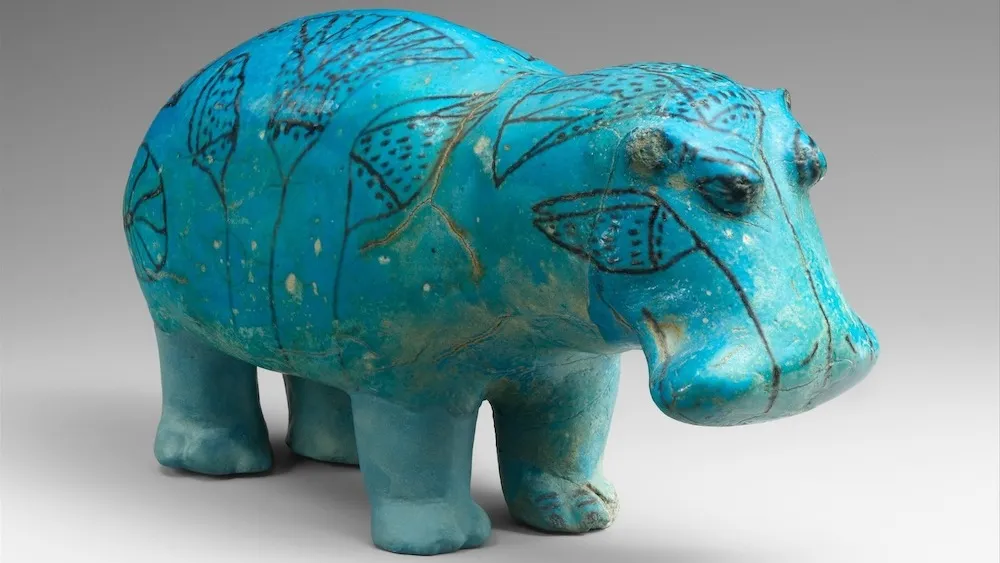
Name: Hippopotamus ("William")
What it is: A cerulean statuette of a hippopotamus molded in faience, a glazed ceramic material made partly out of ground quartz. The artifact is decorated with drawings of lotus flowers, which grow in marshes and symbolize regeneration and rebirth.
Where it was found: Inside a shaft associated with a tomb chapel in Meir, an ancient Egyptian cemetery located outside the city of Asyut.
When it was made: Circa 1961 to 1878 B.C.
What it tells us about the past: Ancient Egyptians feared hippos (Hippopotamus amphibius), viewing them as dangerous and aggressive animals, especially when provoked, according to The Metropolitan Museum of Art in New York City. Thanks to these mostly herbivorous mammals' insatiable appetites, they often wreaked havoc on farmers' fields. In fact, one papyrus refers to a particularly bad harvest in which "the worm took half and the hippopotamus ate the rest."
Related: The Hope Diamond: The 'cursed' blue gemstone coveted by royalty
Hippo hunts were a common sport among the ancient Egyptians, who would use harpoons to snare the large beasts, which were associated with chaos. By 3000 B.C., depictions of kings successfully battling hippos became commonplace, as it was a way to show rulers overcoming chaos. However, due to overhunting, the last wild hippos disappeared from Egypt by the early 19th century, according to The Met.
Get the world’s most fascinating discoveries delivered straight to your inbox.
RELATED STORIES
This statuette, which measures about 8 inches by 5 inches (20 centimeters by 11 cm), is one of many examples of hippo sculptures crafted by ancient Egyptians. When it was discovered, three of its legs were missing and were likely broken on purpose to prevent it from doing harm in the afterlife, according to The Met.
In 1931, the artifact was dubbed "William" after the British humor magazine Punch ran a cartoon about the hippo.
Jennifer Nalewicki is former Live Science staff writer and Salt Lake City-based journalist whose work has been featured in The New York Times, Smithsonian Magazine, Scientific American, Popular Mechanics and more. She covers several science topics from planet Earth to paleontology and archaeology to health and culture. Prior to freelancing, Jennifer held an Editor role at Time Inc. Jennifer has a bachelor's degree in Journalism from The University of Texas at Austin.